King-Kill/33
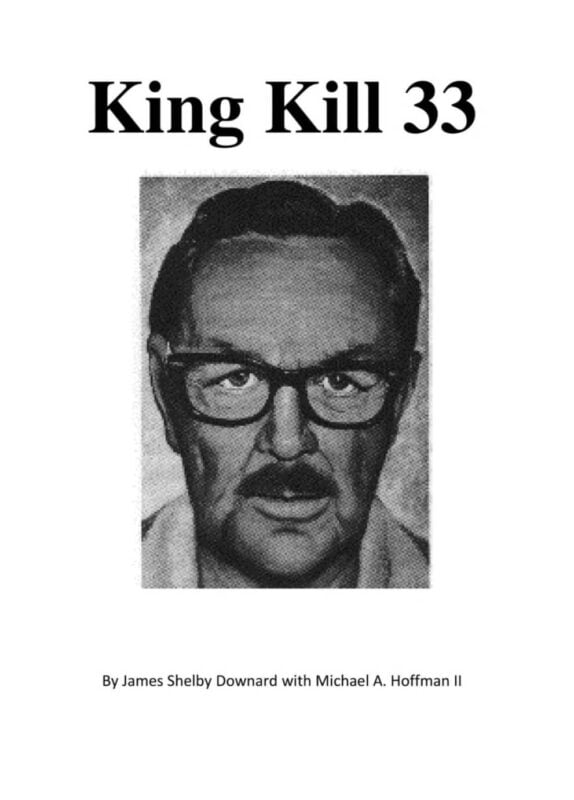
King-Kill 33 by James Shelby Downard and Michael A. Hoffman II introduces a provocative thesis: the assassination of President John F. Kennedy was a ritualistic execution designed by a Masonic elite to manipulate public consciousness. Downard positions the event not within the sphere of conventional political intrigue but as a manifestation of esoteric control, meticulously orchestrated through symbolism, geography, and ceremony.
Masonic Coordinates and Ritual Geography
The authors trace Dealey Plaza’s location to the 33rd degree of latitude, emphasizing its proximity to the foundational lodge of the Scottish Rite in Charleston, South Carolina. This alignment is not incidental. Within Masonic numerology, the 33rd degree denotes the apex of occult initiation. Dallas, situated just south of this line, becomes a stage for symbolic sacrifice. Dealey Plaza housed the city’s first Masonic temple, now destroyed, but its historical footprint persists as an operative node within a broader ritual map.
What significance emerges from the intersection of names, routes, and monuments? Downard describes a geographical ritual circuit that includes the Mason Road in Texas, the Three Sisters Mountains in New Mexico, and the ghost town of Ruby, each named or shaped to echo Masonic motifs. These locations align with key events or symbols in the Kennedy narrative. Ruby, for example, evokes Jack Ruby, the nightclub owner who killed Lee Harvey Oswald, and by extension, seals the sacrificial rite. Place names act as incantations, their meanings compounded through repetition, proximity, and hidden associations.
The Science of Symbolism
Names carry weight beyond identification. They function as symbols and incantations. Downard invokes the Masonic preoccupation with onomatology—the science of names—as a core mechanism of esoteric control. Within this system, Kennedy’s address at 83 Beals Street, Brookline, Massachusetts, aligns semantically with the Beale surname and its variants—rendered in symbolic etymology as El-Bel-Baal-Beal-Beale. "El" connotes divine authority. "Baal" refers to fertility and death deities. The synthesis situates Kennedy within a mythic framework of sacrificial kingship.
The linkage deepens through Jackie Kennedy’s lineage. The Bouvier name means cowherd. Ancient fertility rites and pastoral archetypes converge in her travels to sanctified locations: Delos, Delphi, and the Temple of Apollo. These are not idle vacations but enactments of archetypal roles—queen, mourner, priestess. Her visit to Delos, island of the dead and birthplace of Apollo, transforms personal mourning into ritual closure. Each location corresponds to mythological coordinates, activating latent symbolic power.
The Ritual of the Sun King
Kennedy appears as a modern Sun King, a figure cast in solar imagery from his birth to his burial. Downard identifies solar correspondences in the presentation of the President’s image, his charisma, and even his assassination date. November 22 falls under the astrological sign of Sagittarius, ruled by Jupiter, traditionally associated with kingship and expansion. The red carpet reception in Houston, the golden suite at the Rice Hotel, and the fiery red crab cocktail served before his final motorcade all contribute to the solar metaphor.
The numerological code persists. JFK died in Dallas, near the 33rd parallel. The number 33 is the highest degree in Scottish Rite Masonry. He landed at Gate 28 in Love Field—28 being a Solomonic number in kabbalistic numerology. He died on Elm Street, near the intersection of Elm, Main, and Commerce—streets that form a trident, another ritual sign. Elm Street housed the Blue-Front Tavern, formerly a fire station with a pole, symbol of phallic energy and ritual descent. These details accumulate, forming a ceremonial lexicon.
Death and Resurrection Symbology
The authors present Kennedy’s death as the culmination of an ancient fertility-death-rebirth cycle, aligning with seasonal and mythical models. The black horse used in his funeral, named Sardar, had to be dyed black to fulfill symbolic requirements. Originally a gift from Pakistani President Ayub Khan, Sardar’s connection to solar lineage was literal—he was descended from a horse named Solaris. The inversion—sun horse turned death horse—amplifies the transition from vitality to demise.
Sardar’s boots were tied backward, a funerary rite symbolizing the reversal of time, return to the source, and the soul’s passage into the underworld. Downard interprets this not as military tradition but as necromantic theatre. Kennedy’s journey from the Rice Hotel (formerly a Masonic Capitol) to Dealey Plaza mimics a death procession. The settings, names, and stages were predetermined. The script followed ancient patterns, the audience unaware of the rite’s depth.
The Specter of the Hell-Fire Club
To contextualize the American Masonic tradition, Downard explores the European legacy of esoteric orders. He delves into the Hell-Fire Club, linking its debauched ceremonies to founding fathers like Benjamin Franklin. These secret societies, combining sexual perversion and occult ritual, shaped the ceremonial template followed in contemporary politics. Franklin’s collaboration with Sir Francis Dashwood on the Franklin-DeSpencer prayer book ties American civic religion to magica sexualis.
The road from Dashwood’s manor to High Wycombe was paved using soil from the Hell-Fire caves. Brunei University’s cybernetics department now occupies that location. Downard suggests a continuity: the occult soil transmits symbolic voltage to modern systems of artificial intelligence and control. The symbolic legacy of ritualized deviance mutates, embedding itself into computational and administrative structures. Ritual and algorithm become interchangeable languages.
Sexual Geometry and Symbolic Machines
The third degree of Freemasonry involves the 47th problem of Euclid—the Pythagorean theorem. Downard contends this geometric axiom encodes sexual union. Osiris and Isis form the right angle. Their union produces Horus. The triangle, foundational to architecture, functions as a symbol of generative fusion. Downard extrapolates this into cybernetics, imagining that computers governed by axiomatic systems participate in ritual logic, inferring symbolic patterns and executing control via language and geometry.
If a machine can derive axioms, it can absorb occult semiotics. A computer situated in High Wycombe, connected by history to the Hell-Fire Club, might trace its inputs to magico-sexual rites. Such a device could interpret place names, historical events, and human actions as data within a symbolic matrix. The human user becomes a participant in a hidden ritual, their interactions guided by embedded rites of passage. Downard asserts that this convergence of technology and sorcery constitutes the new apparatus of control.
The Death of Individual Will
Downard accuses American culture of manufacturing apathy. He describes the United States as a “news ghetto” where media mimics reform but delivers sedation. The public absorbs revelations without response. Each exposure of truth fails to elicit action. This conditioned inertia, he argues, serves the goals of the Masonic Cryptocracy. The assassination ritual, televised and dissected, becomes a collective trauma that severs individual agency. Americans no longer act; they consume symbolism.
He proposes that the final purpose of Kennedy’s killing was spiritual attrition. The death of idealism, heroism, and national unity was not collateral—it was primary. The shock stripped Americans of mythic cohesion. Without myth, they drift, susceptible to external patterning. The Masonic elite step into the vacuum, offering a simulacrum of freedom, equality, and fraternity while administering the symbolic architecture of control.
MacBird and the Theatrics of Power
Barbara Garson’s play MacBird, which caricatures Lyndon Johnson as Macbeth, receives significant attention in Downard’s analysis. He interprets the production as an esoteric whistleblower event, veiled as satire. The connection between the Bain/Baine/Bane surnames and Macbeth’s clan links Johnson genealogically to the Scottish rite of betrayal. The play thus becomes a cipher, its performance a minor inversion ritual, casting light on the hidden architecture of political succession.
Garson, dubbed a “wise fool,” mirrors the archetype of the prophetic jester. Her script, cloaked in farce, encodes mythic betrayal and occult substitution. In MacBird, the slain king is replaced not by political force but by ritual appropriation. Johnson, as Bane, absorbs the power of the murdered monarch and uses it to complete the Masonic working. Downard underscores this not as critique but as confirmation. The symbols speak with authority. Their coherence affirms the structure.
The Final Convergence
The Kennedy assassination, as constructed by Downard and Hoffman, fulfills the components of a ritual sacrifice, a mythic retelling, and a psychological operation. It aligns temporal events with symbolic coordinates, transforming history into initiation. The stage was set in Masonic chambers, inscribed with numerological significance, and populated by agents executing a rite older than the Republic.
This convergence of place, number, name, and act transforms a public killing into an esoteric conquest. Downard does not invite disbelief. He assembles the symbols, places them within mythic syntax, and challenges the reader to decode their logic. The ritual does not conceal itself. It operates in daylight. It uses ceremony to command assent, iconography to neutralize resistance, and narrative to induce sleep. The king is dead. The rite is complete. The audience applauds, unaware they were part of the spell.