Letters on Freemasonry
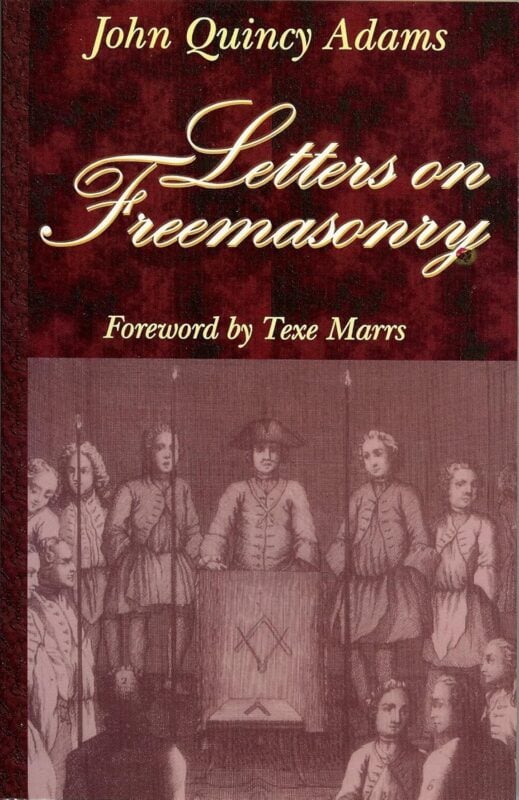
Letters and Addresses on Freemasonry by John Quincy Adams attacks the moral, social, and political dangers of secret societies through a relentless critique of Freemasonry, its oaths, and its unchecked influence across American institutions.
A Presidential Indictment of Hidden Power
John Quincy Adams, the sixth President of the United States, used his pen to confront what he saw as an existential threat to republican integrity. In this volume, he compiles decades of letters, addresses, and open correspondence in which he exposes Freemasonry’s structure, rituals, and clandestine control over American civil and judicial systems. Adams writes not as a casual critic but as a legal scholar and constitutional advocate disclosing a clear, systematic subversion of democratic accountability.
Freemasonry, Adams argues, binds its members through extra-legal oaths that prioritize loyalty to the order above allegiance to the Constitution or conscience. These oaths, taken in stages through degrees—Entered Apprentice, Fellowcraft, Master Mason, Royal Arch, and Knight Templar—condition initiates to secrecy and submission under penalty of symbolic death. Through these rites, the lodge demands silence about its operations and protection for members, regardless of their moral conduct.
Morgan’s Murder and the Breaking of the Veil
The murder of William Morgan in 1826 triggered a wave of outrage and exposed Freemasonry’s reach. Morgan had attempted to publish the rituals of the lodge. Soon after, he vanished. His kidnapping and presumed assassination revealed the ability of Masonic networks to manipulate law enforcement, evade justice, and silence dissenters. Adams seizes on this case to demonstrate how Masonic oaths function in practice, enabling coordinated criminal activity cloaked in fraternal rhetoric.
By tracing the movements of Morgan’s abductors—through towns where sheriffs, jurors, and jailers belonged to the lodge—Adams assembles an anatomy of conspiracy. In court, Masons perjured themselves or remained mute; in government, governors and legislators refused to act. Adams proves that Masonic loyalty overrode civic duty. He builds the argument not on ideology but on documentary evidence, legal affidavits, and the testimony of ex-Masons who recanted their vows and exposed the system from within.
Clerical Complicity and the Religious Facade
Adams challenges Freemasonry’s use of religious imagery. The lodge borrows freely from Biblical language, Jewish temple iconography, and Christian liturgical forms. It crafts a moral aura without grounding in doctrine or accountability. In doing so, it cloaks its political and economic ambitions in the garb of spiritual brotherhood.
Clergymen, Adams observes, frequently join Masonic ranks and lend credibility to rituals that subordinate God’s authority to that of the Worshipful Master. Oaths taken in the lodge room become binding beyond those made before church or law. The religious veneer becomes a mechanism of recruitment and defense, not reflection or faith. Adams insists on the incompatibility between Christianity’s universal ethics and Masonry’s closed hierarchies.
The Political System Under Siege
Through extensive correspondence with leading public figures—including Edward Livingston, William L. Stone, and Levi Lincoln—Adams dissects the influence of Freemasonry on American political life. Offices from sheriffs to governors to judges had been filled with Masons. The grip of the order over public appointments, jury selections, and legislative decisions created a parallel power structure, one immune to electoral oversight.
Adams does not theorize; he names. He traces the involvement of Grand Masters, state legislators, and national leaders in defending Masonry despite mounting evidence of corruption. He reveals how prominent politicians continued to defend the fraternity while evidence accumulated of their complicity in obstructing investigations into Morgan’s death. These letters unfold as a sustained exposure, each deepening the reader’s understanding of how systemic secrecy undermines democratic governance.
Antimasonry as a Democratic Imperative
Adams’s writing helped ignite a political movement. The Antimasonic Party, founded in the 1820s, emerged in direct response to revelations like those Adams documented. It became the first third party in American politics, grounded in the principle that secret oaths and public service cannot coexist. Adams lent intellectual and moral credibility to this movement without seeking office from it.
His address to the people of Massachusetts articulates a fundamental premise: a republic cannot permit private combinations to control public power. The vote must be open. Laws must be public. Officers must be accountable to the whole, not to a cabal. Masonry, by design, reverses that order. Adams calls for its civil dissolution—not through violence or proscription, but through public exposure and the refusal of citizens to enter or respect its ranks.
Livingston and the High Priesthood of Injustice
Adams’s correspondence with Edward Livingston captures the ethical core of the crisis. Livingston, then Secretary of State under President Jackson and Grand High Priest of the Royal Arch, stood as the living synthesis of secret loyalty and public authority. Adams demands to know how a man sworn to conceal the crimes of his brethren—so long as they are revealed under Masonic seal—could serve as a custodian of the nation’s laws.
Livingston, through silence, answers the charge. He refuses to debate the moral implications of his position. Adams presses further, examining the language of the Royal Arch oath, which binds the initiate to protect Masonic secrets even when they conflict with justice. He demonstrates how that oath nullifies all other obligations, turning men into agents of an invisible regime. Livingston, who had once drafted legal codes for Louisiana, became in Adams’s view the executor of an anti-law.
The Architecture of Obedience
Freemasonry’s strength, Adams shows, lies in its organizational discipline. With separate degrees, each requiring deeper submission, the order trains its members to obey without question and defend without inquiry. Its lodge network connects local chapters to state Grand Lodges and ultimately to a national General Grand Chapter. Through this structure, it replicates a command hierarchy, absorbing recruits through psychological conditioning and public ritual.
Adams maps how information flows vertically while loyalty binds horizontally. Members are taught to prioritize “brothers” over fellow citizens, even in cases of crime. Justice becomes conditional on fraternity. In letters addressed to legislators, governors, and convention delegates, Adams outlines legal remedies: the criminalization of extrajudicial oaths, public renunciation by public officials, and the exclusion of Masons from positions requiring impartiality.
Obligation and the Destruction of Moral Agency
Each Masonic degree initiates the member into an act of self-renunciation. Adams dissects the text of the oaths to reveal their moral mechanics. An Entered Apprentice swears to conceal crimes told to him under Masonic seal. A Royal Arch Mason accepts death—cutting open his breast, tearing out his heart—should he violate secrecy. These are not metaphors. They are formative psychological tools that invert moral reasoning.
Adams argues that once a man has taken such an oath, he cannot claim moral independence. His sense of right becomes subject to interpretation by lodge superiors. His silence is no longer prudence but duty. His judgment is no longer conscience but obedience. In this inversion lies the power of the order: it captures the will by sacralizing its secrecy.
The Fiction of Brotherhood
Benevolence, Adams concedes, often appears as a justification for Freemasonry. Lodges boast of their charity, their aid to widows and orphans, their public rituals of unity. Adams dismantles this fiction by analyzing its exclusions. Masonry aids Masons. It selects its beneficiaries through the filter of affiliation, not need. It elevates the mediocre if they conform, while excluding the virtuous who decline initiation.
Brotherhood without universality, Adams insists, degenerates into caste. It breeds favoritism in courts, bias in business, and distrust in communities. He shows how Masons have steered public contracts, manipulated jury verdicts, and suppressed press freedom under the guise of fraternal protection. The oath functions as a lever of influence, and the lodge becomes an engine of privilege.
Moral Clarity and Republican Survival
Adams closes his public letters with an appeal to the American people. He urges them to choose between a nation governed by law or governed by lodge. No republic can survive dual sovereignty. Masonic loyalty cannot coexist with constitutional fidelity. The path forward requires renunciation—not of individuals, but of the institutional framework that binds them to secrecy over truth.
His critique stands as a constitutional sermon. It defines secret societies not as curiosities but as structural threats. He calls for laws to prohibit secret obligations in public service, for education to warn youth against false fraternity, and for civic virtue to assert itself against ritualized obedience. Through sustained moral argument and historical documentation, Adams transforms the Antimasonic cause into a national imperative.
