Seven Pillars of Wisdom
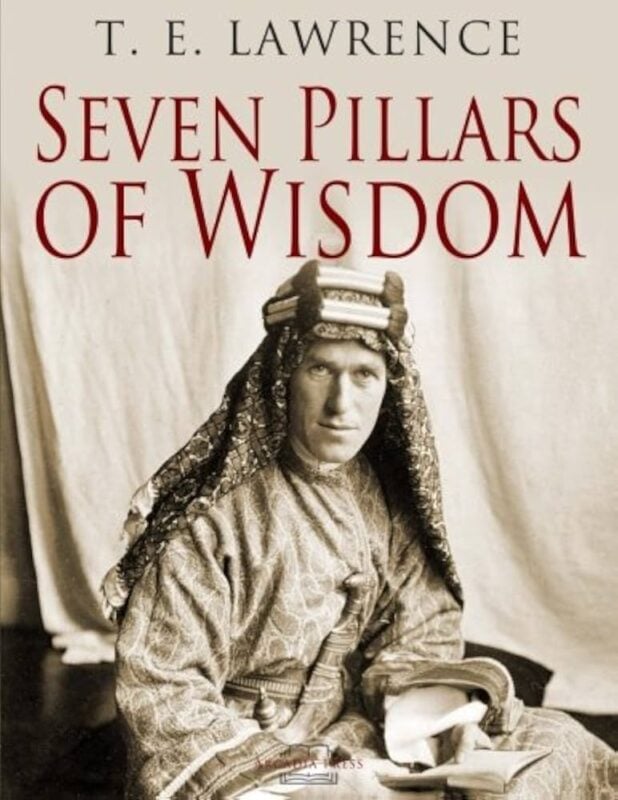
Seven Pillars of Wisdom by T.E. Lawrence chronicles the experience of a British officer who orchestrated and participated in the Arab Revolt against Ottoman rule during the First World War. Lawrence’s account merges history, ethnography, military strategy, personal confession, and philosophical exploration, resulting in a narrative that exposes the inner workings of revolt, the architecture of empire, and the quest for meaning in the chaos of desert war.
Origins and Historical Frame
T.E. Lawrence emerges as an archaeologist and academic who is drawn by circumstance into the British intelligence service. The landscape of the book unfolds across the vast Arabian Peninsula, its mountains, deserts, and oases forming both stage and character. The narrative begins with Lawrence’s introduction to the region and the network of tribal, linguistic, and religious complexities that compose Arab identity. He details the slow movement of nomadic clans across the peninsula, the patterns of migration from the mountains of Yemen, and the transformation of settled villagers into desert wanderers through necessity and pressure.
Lawrence situates the Arab people not as a monolithic group but as a manufactured nation—bound by a common language, a history of conquest and adaptation, and the organizing force of the desert. The Semitic imagination, as he asserts, oscillates between extremes—spiritual asceticism and carnal abandon, visionary idealism and pragmatic violence. The rise of the Arabs and their long struggle against foreign domination—first by Persians, Greeks, Romans, then by the Turks—produced cycles of migration, resistance, and reformation. Lawrence’s own mission, he claims, was to enable the Arabs to act as agents of their own liberation and to provide them with a foundation upon which to build a national identity.
The Structure of Revolt
The book describes how British officers and strategists saw in the Arab Revolt an opportunity to destabilize the Ottoman Empire, an ally of Germany. Lawrence enters the service of the Sharif of Mecca and his son Feisal, who becomes both the symbolic and practical leader of the Arab movement. The narrative proceeds as a detailed account of strategy: sabotage missions on the Hejaz railway, ambushes in the desert, and the occupation of key cities such as Aqaba.
Lawrence describes the psychology of insurgency—how hope becomes a consuming faith, forging a chain that binds men together in a shared enterprise. Tribal alliances shift, individual ambitions compete, yet the specter of an Arab nation sustains the movement. Lawrence inserts himself as both participant and observer, mediating between British imperial aims and the desires of his Arab companions. The book attends to the rituals, social codes, and the raw physicality of desert life. Hardships, privation, and the ever-present threat of betrayal and death form the crucible in which trust is forged.
Personality and Philosophy
Lawrence’s voice dominates the narrative: at once confessional, analytical, and mythopoetic. He admits his own marginality—an Englishman imitating the habits of the Arabs, forever apart from both worlds. The emotional and psychological cost of this detachment becomes a recurring motif. His ambitions—restoring Arab autonomy, securing a place for them at the postwar settlement—are shadowed by doubts over British sincerity and the moral ambiguity of his own role. Lawrence refuses to present himself as a simple hero; his narrative reveals pride in moments of bloodless victory but also shame and grief at the betrayals inherent in war and diplomacy.
Lawrence interrogates the relationship between leader and follower, the uses of violence, the corrupting nature of power, and the seductions of fame. In the desert, stripped of comforts and distractions, he contemplates the nature of faith, the illusions of empire, and the meaning of sacrifice. He regards the Arab desert as a crucible of spiritual clarity—an environment where the mind is purged of distraction and forced to confront ultimate questions.
Strategy and Campaign
The core of the book is a narrative of campaigns, raids, and sieges. Lawrence recounts the slow accumulation of victories—destruction of bridges and trains, the capture of Aqaba, and the long campaign northward towards Damascus. The desert, hostile and sublime, determines the logistics of war and the pace of events. Lawrence’s account is attentive to the intricate negotiations with tribal leaders, the management of supply lines, and the improvisational nature of guerrilla warfare.
The campaign’s success depended on the Arabs’ mobility, their ability to strike and vanish, and their capacity to exploit the vastness and secrecy of the desert. Lawrence explores the nature of discipline, the moral economy of revenge and reward, and the ways in which the habits of Bedouin life shape the conduct of war. The conquest of Damascus forms the climax of the narrative, where the contradictions of victory—division, disappointment, the restoration of old elites—become manifest.
Identity, Memory, and Aftermath
Seven Pillars of Wisdom offers a meditation on the failures and the costs of revolution. Lawrence observes that youth may win a revolution but lacks the strength to hold its gains against the return of the old order. The victory of the Arabs, he concludes, was appropriated by the established powers at the peace conference. Lawrence records his own disillusionment and sense of complicity in the British government’s failure to honor its promises of self-determination. He attempts to understand his place within the movement, both as manipulator and instrument, and to reckon with the consequences of his actions.
The legacy of the revolt, in Lawrence’s account, lies not in territorial gains or permanent institutions, but in the fleeting experience of collective action and the transformation of self through risk and commitment. The book closes in a tone of resignation and reflection, aware that the work remains unfinished, the dream incomplete.
Archaeologist in Arms
Lawrence’s transformation from scholar to strategist reflects the convergence of intellectual preparation and historical contingency. His work on ancient sites gave him knowledge of terrain and peoples that proved decisive when war arrived. His decision to join the Arab cause positions him as a bridge between cultures, forced to navigate loyalty and selfhood in the crucible of conflict.
Desert and Destiny
The physical geography of Arabia—the mountains of Syria and Yemen, the Nejd and its gravel and lava expanses, the sand seas of the south—shapes the destiny of the people. The desert is not merely background but an active force, determining the rhythms of migration, the emergence of tribes, and the forms of spiritual life. The harshness of the landscape imparts endurance, a taste for risk, and a philosophical detachment.
Semitic Imagination
Lawrence defines the Arabs by their capacity for radical belief and action, their preference for extremes, and their resistance to compromise. The Semitic mind, he claims, is both dogmatic and visionary, given to religious creation and philosophical asceticism. The history of the region is the history of prophets, reformers, and rebels, each swept forward by the force of an idea.
Revolt as Process
The Arab Revolt emerges from the pressures of Turkish oppression, British strategic calculation, and the ambitions of local leaders. Lawrence records the practical challenges—securing alliances, managing rivalries, organizing supply chains, and deploying sabotage. He dissects the psychology of insurgency, how hope turns to faith, and how faith sustains sacrifice in the face of privation.
Role of the Outsider
Lawrence occupies a unique position as both insider and outsider. His fluency in Arabic and understanding of local customs enable him to advise and lead, yet he is always conscious of his foreignness. The book’s psychological depth derives from Lawrence’s willingness to confront his own motives, to question his role, and to acknowledge the paradoxes of influence and submission.
Tactics of Guerrilla War
The account of the military campaign highlights the adaptation of Bedouin traditions to modern warfare. Lawrence emphasizes mobility, flexibility, and the use of sabotage. The destruction of the Hejaz railway becomes a symbol of the revolt’s ability to disrupt imperial control with limited means. The conquest of Aqaba, achieved through an audacious desert crossing, exemplifies the fusion of planning, improvisation, and daring.
Negotiation and Betrayal
The success of the revolt depends as much on negotiation as on combat. Lawrence documents the intricate diplomacy required to secure tribal loyalty, the system of rewards and punishments, and the constant threat of desertion or betrayal. The British promise of independence serves as the central currency of persuasion, yet Lawrence recognizes the fragility of these assurances.
Victory and Disillusion
The campaign culminates in the capture of Damascus, yet the arrival of British and French officials signals the end of the revolutionary moment. Lawrence recounts the struggles to form an Arab government, the return of old rivalries, and the imposition of imperial interests at the peace conference. The dream of Arab independence dissolves into the reality of mandate and partition.
Aftermath and Reflection
Lawrence’s narrative does not end with triumph, but with questioning. He returns to England burdened by guilt and uncertainty, acutely aware of the costs of action and the limitations of intention. The final chapters consider the meanings of loyalty, sacrifice, and the uses of power, searching for understanding in the ruins of hope.
Enduring Influence
Seven Pillars of Wisdom endures as a record of the Arab Revolt and as an exploration of identity, leadership, and historical change. Lawrence’s style—lyrical, precise, and introspective—imbues the narrative with a sense of immediacy and gravity. The book continues to shape perceptions of the Middle East, revolution, and the possibilities and perils of cross-cultural alliance. What does it mean to dream and to act, to lead and to serve, to win and to lose? Lawrence’s answer emerges not as a doctrine but as an invitation to confront the consequences of vision and the limits of power.

