Sherman: Soldier, Realist, American
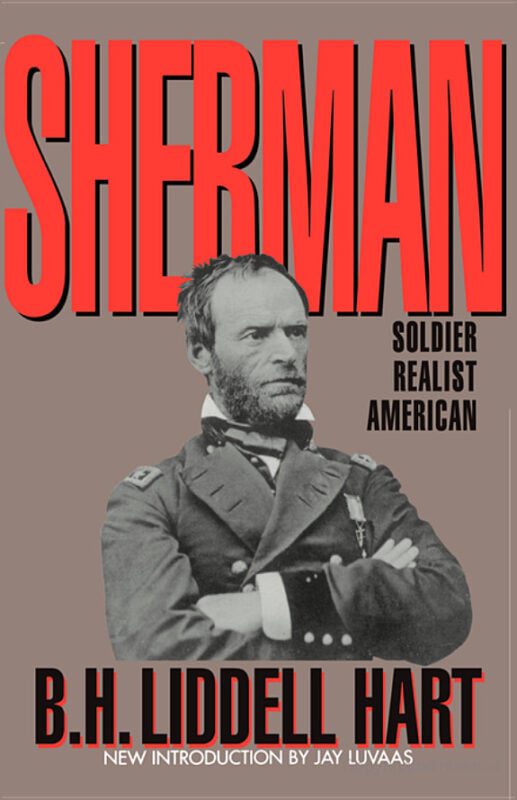
Sherman: Soldier, Realist, American by B. H. Liddell Hart redefines the boundaries of military biography by fusing strategic theory, psychological insight, and historical narrative into a single intellectual current. William Tecumseh Sherman emerges not only as a Civil War general but as a case study in applied foresight, organizational command, and national development. Liddell Hart's portrayal advances a vision of Sherman as a master of modern warfare whose ideas penetrated deeper into military theory than many of his more lauded contemporaries.
Origins of Strategic Genius
Sherman inherited a legacy shaped by Puritan discipline, frontier pragmatism, and judicial clarity. Raised in Ohio after the early death of his father, he absorbed a blend of stoic resolve and expansive curiosity. His foster father, Thomas Ewing, cultivated his intellectual formation, steering him to West Point, where Sherman developed an analytical style grounded in precision, skepticism, and tactical reasoning. He approached military education not as a rote accumulation of methods, but as an environment in which to test institutional assumptions. His experiences at West Point did not conform to models of command-through-conformity; he challenged superficial markers of excellence and internalized the deeper structures of operational thinking.
Formative Years in Command and Observation
Sherman’s early assignments in Florida and California unfolded across contested geographies. Each campaign offered a laboratory for testing movement, logistics, and civil-military relations. In California, serving under Colonel Mason during the gold rush, Sherman managed both material infrastructure and political ambiguity. He documented, categorized, and interpreted. He acted as both observer and participant in a nascent civil order shaped by explosive economic dynamics. These years grounded his thinking in the primacy of logistical control, terrain manipulation, and psychological dominance. The field became a medium not for maneuver alone but for structural transformation.
War as Environment, Not Theater
The American Civil War revealed the scope of Sherman’s strategic insight. His campaigns in the Western Theater—culminating in the March to the Sea—embodied what Liddell Hart later defined as the strategy of the indirect approach. Sherman did not pursue annihilation; he executed disruption. His goal was not the enemy’s destruction in the field but the disintegration of the enemy’s ability to function as a system. The destruction of railroads, plantations, and communication centers fragmented Confederate coherence and recalibrated the balance of momentum.
Sherman’s decisions moved beyond tactical brilliance to generate cumulative structural advantage. He understood warfare as an act that shapes perception, drains initiative, and redefines space. His movements compressed time and widened the margin of uncertainty for Confederate commanders. His approach fused mobility with psychological pressure. By denying predictable engagements and selecting operational axes that restructured strategic expectations, Sherman transformed how wars achieve decisive outcomes.
The Indirect Approach as Operational Doctrine
Liddell Hart's theory of the indirect approach crystallized through his analysis of Sherman. Rather than serve as a post hoc confirmation of his theory, Sherman’s campaigns shaped the theory itself. By studying Sherman's day-to-day decisions, Liddell Hart derived principles such as deep strategic penetration, the baited gambit, and the manipulation of alternative objectives. These principles challenged the attrition-based doctrines that dominated World War I and offered a template for restoring mobility and initiative in mechanized warfare.
This intellectual synergy culminated in Liddell Hart’s advocacy for operational flexibility, mechanized mobility, and terrain-based deception. Sherman’s methods exemplified how a commander could leverage uncertainty, mobility, and psychological strain to unbalance a stronger or entrenched opponent. These concepts reverberated in 20th-century doctrines, from Blitzkrieg to AirLand Battle, embedding Sherman’s operational DNA into global military structures.
Psychology of Command
Sherman’s value to military science extends beyond movement and mechanics. His letters, orders, and reports reveal a commander who led through foresight, emotional discipline, and cognitive clarity. He resisted impulsive action, insisting on alignment between means, timing, and effect. He defined success in operational terms rather than symbolic victories. He focused on breaking will rather than seizing locations. His realism derived not from cynicism but from structural understanding.
Liddell Hart places particular emphasis on Sherman’s psychological realism. Sherman viewed military success as contingent on mental asymmetry between commanders. The side that maintained conceptual initiative and strategic dislocation gained dominance, regardless of battlefield parity. The mind, not the muscle, won wars.
Civil-Military Transitions
Sherman’s postwar roles, particularly his tenure as Commanding General of the U.S. Army, illustrate his systemic thinking beyond combat. He understood the fragility of victory and the volatility of occupation. He resisted efforts to politicize the military, upheld institutional boundaries, and pushed for coherent organizational doctrine. His focus turned to professionalizing the army, managing frontier operations, and interpreting the military’s place within a rapidly industrializing society.
His writings bridged the civil-military gap. Through his Memoirs and correspondence, Sherman contributed to American political identity, linking military action to national cohesion and modernization. He framed warfare not as an end-state but as a dynamic interlude in the life of the Republic.
Legacy in Modern Doctrine
The impact of Sherman’s ideas widened in the 20th century. Liddell Hart’s analysis gave Sherman intellectual traction in an era searching for alternatives to industrial slaughter. His campaigns offered precedence for mobility-based operational art. During World War II, commanders such as Patton studied Sherman’s routes and logic. In Desert Storm, the "Hail Mary" flanking maneuver echoed Sherman’s approach through Dalton. Doctrinal texts such as FM 100-5 incorporated his methods into strategic planning. Sherman's legacy penetrated doctrine, not merely commemoration.
Cultural and Structural Intelligence
Sherman grasped the interplay between military action and economic systems. He targeted infrastructure to disrupt Confederate capacity. He respected cultural terrain, predicting that operational decisions would ripple through social structures. He saw the interconnectedness of transportation, communication, and morale. By displacing populations, destroying supply nodes, and seizing rail junctions, he severed the arteries of Confederate resistance. His realism merged tactical execution with cultural consequence.
Beyond the Battlefield
Sherman’s realism extended into his critique of institutional orthodoxy. He warned against overreliance on fixed rules, emphasized the limits of textbook education, and highlighted the adaptive demands of modern command. His emphasis on situational understanding, logistical preparation, and long-range consequences placed him outside the narrow frame of battle captains. He demanded from officers a broader intellectual reach and from institutions a deeper structural awareness.
Intellectual Fusion in Liddell Hart’s Portrait
Liddell Hart’s treatment of Sherman merges biography with theory. The book operates simultaneously as a study of a man, a framework for strategic thought, and a commentary on the institutional evolution of modern warfare. Liddell Hart’s prose sharpens the reader’s focus not only on what Sherman did, but how he thought and why his methods reshaped warfare’s core assumptions. The biography unfolds as a layered narrative in which tactical choices reflect theoretical clarity and operational ambition aligns with structural transformation.
What defines a soldier’s greatness? In Sherman’s case, it was his capacity to see beyond position, to transform destruction into disintegration, to wield maneuver as leverage against systems of resistance. Liddell Hart captures this convergence, anchoring Sherman in the lineage of strategic innovation while casting forward into the challenges of mechanized warfare.
Sherman did not simply command armies—he redefined their function. Liddell Hart did not merely narrate a life—he constructed a theory. Together, they forged an enduring synthesis that continues to shape the structure of modern military thought.

