Technocracy and the American Dream
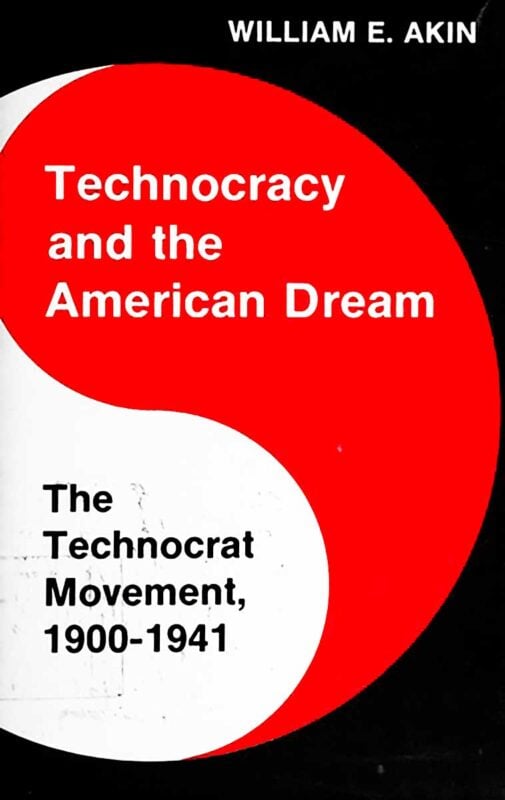
Technocracy and the American Dream by William E. Akin analyzes how early twentieth-century engineers and scientists envisioned a new national order rooted in technical expertise, industrial efficiency, and centralized planning. Their ambition fused utopian idealism with a precise belief in material systems. From 1900 to 1941, technocratic advocates identified waste, duplication, and irrationality in traditional government structures and proposed an economic system governed by trained experts who prioritized measurable outcomes over electoral mandates.
The foundation of technocratic ideology
Thorstein Veblen, with his critique of pecuniary values and advocacy for a “Soviet of engineers,” laid the theoretical groundwork. He questioned the authority of business elites and proposed an industrial order led by those who produced rather than those who speculated. His framework inspired reform-minded engineers and progressive thinkers who viewed technological development as a path toward both social equity and administrative coherence. These early figures linked economic dysfunction to the misallocation of knowledge and the failure to coordinate production scientifically.
Howard Scott and the rise of Technocracy Inc.
Howard Scott transformed scattered ideas into a movement. Charismatic and enigmatic, Scott founded Technocracy Inc. in the early 1930s. He delivered lectures with diagrams of energy accounting, charts of production inefficiencies, and projections of post-scarcity abundance. His vision involved replacing the price system with an energy-based accounting system. Each citizen would receive energy certificates based on available resources and technological capacity. Scott’s claim: only through scientifically managed distribution could society eliminate unemployment and poverty.
As the Great Depression deepened, Scott’s ideas gained momentum. Audiences packed auditoriums to hear alternatives to failing markets and political gridlock. Technocracy promised more than jobs or recovery. It imagined an entirely new civilization. Engineers would not just design machines; they would design society. That premise attracted disillusioned professionals, skilled workers, and even military planners who saw in technocracy a method to stabilize and scale.
Technocratic opposition to democratic institutions
Technocrats challenged the legitimacy of representative democracy. They viewed elected officials as generalists with limited knowledge, vulnerable to lobbying and ideological bias. Technocracy proposed governance by scientifically trained administrators who operated above partisanship. These experts would manage production, allocate goods, and design infrastructure without recourse to elections. Their authority derived from proven technical competence and system-level thinking.
This orientation produced friction with existing institutions. Journalists questioned Scott’s credentials. Academics dissected his proposals. Politicians denounced his ambitions as authoritarian. Yet technocrats sustained their appeal by highlighting systemic failures: breadlines, collapsing farms, bankrupt banks. Each crisis underscored their core argument—that only experts using scientific principles could coordinate a complex industrial economy.
Energy accounting as political vision
At the center of technocratic planning stood energy accounting. This system would quantify available natural resources, calculate necessary human effort, and determine equitable distribution. Unlike money, which functioned abstractly and unevenly, energy units measured real-world inputs and outputs. Akin describes how technocrats imagined North America as a single industrial unit with comprehensive data on labor capacity, energy flows, and mechanized output.
This system rejected speculative capital, rent-seeking behavior, and market fluctuations. Instead, it envisioned a steady-state economy defined by physical facts—kilowatt-hours, tons of steel, gallons of water. Planning replaced pricing. A continental control center would gather data and issue directives. Regional directors would execute technical orders. Consumption matched capacity, eliminating surpluses and shortages.
Popular appeal and mass mobilization
Technocracy’s strength came from its clarity. Amid economic panic, its charts, numbers, and terms offered structure. Its uniformed spokespeople, printed manuals, and training programs created a disciplined image. Large rallies across the United States and Canada attracted followers who embraced science as salvation. Newspapers reported on the growth of Technocracy Inc., and membership surged. In cities like Los Angeles, Seattle, and Vancouver, the movement gained local footholds, holding workshops and publishing newsletters.
What sustained this appeal? Akin identifies key motivators: the collapse of traditional economic narratives, the prestige of engineers, and the persuasive certainty of numerical models. Technocracy did not offer vague hopes. It offered blueprints. It claimed that once the existing system collapsed under its contradictions, engineers stood ready with operational plans.
Internal fractures and external skepticism
Scott’s leadership generated tension. Questions about his education and managerial decisions undermined credibility. Internal dissenters accused him of autocratic tendencies and strategic missteps. Attempts to integrate with other progressive movements faltered. The movement’s rigidity, including its opposition to electoral engagement, limited its alliances. Technocracy Inc. remained aloof from labor unions, New Deal reformers, and academic economists.
Public skepticism mounted. Critics charged that the movement oversimplified economics and ignored political realities. Its blueprint lacked mechanisms for consent, cultural variation, or individual initiative. By the late 1930s, government programs like Social Security and public works projects addressed economic needs more directly, reducing the urgency of radical systemic alternatives.
Institutional echoes and technological governance
Despite its decline as a mass movement, technocracy’s influence extended into postwar institutions. Systems analysis, cost-benefit modeling, and the rise of expert advisory panels reflected technocratic logic. The New Deal’s Tennessee Valley Authority, the Office of Price Administration, and the wartime mobilization effort all employed forms of centralized technical planning. Engineers staffed bureaucracies and shaped public works.
Akin traces these continuities, showing how technocratic assumptions infused American administrative thought. Even without formal power, technocracy reshaped the language of policy. Efficiency, metrics, optimization—these terms gained dominance. Agencies shifted toward data-driven decision-making, guided by consultants, scientists, and planners trained in the very disciplines technocrats elevated.
The American dream through a technocratic lens
Technocracy redefined the American dream. It imagined not individual upward mobility, but collective elevation through rational coordination. Instead of entrepreneurial risk, it celebrated competence. Instead of ownership, it promoted access. In this model, dignity came from participation in a functioning system, not accumulation. Citizenship became technical—defined by understanding, not voting.
This vision confronted cultural assumptions. Could Americans accept centralized allocation over private choice? Would they trade dynamic markets for managed abundance? Technocracy answered through demonstration: design the most efficient grid, the most productive farm, the most balanced city. Proof would replace persuasion.
The transformation of hope into policy
Akin’s analysis closes with a paradox. Technocracy failed as a movement but succeeded as an idea. Its central principles—technical governance, energy logic, systems thinking—filtered into mainstream planning. Agencies adopted selective tools without adopting the whole vision. The spectacle of total replacement gave way to incremental application. Yet the impulse endured: engineer the future, control the variables, replace politics with precision.
The book traces that transformation with clarity and depth. From Veblen’s essays to Scott’s rallies, from blueprints to bureaucracies, Akin shows how a technical elite tried to redesign society through control of its most basic flows—energy, labor, production, time. That effort recast American ambitions. It made planning an aspiration, and system-level control a method of reform.