The 2030 Spike: Countdown to Global Catastrophe
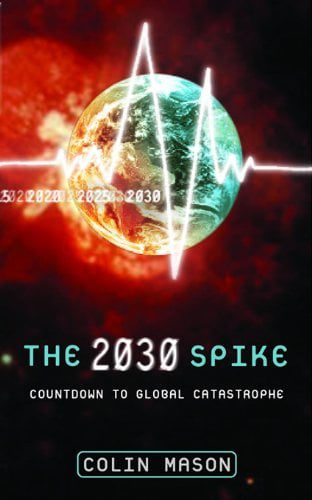
Colin Mason’s The 2030 Spike: Countdown to Global Catastrophe investigates a unique convergence of global forces set to transform the planet by the third decade of the twenty-first century. Drawing on evidence from demography, energy, climate science, economics, and geopolitics, Mason demonstrates how six accelerating drivers—energy depletion, population growth, climate disruption, food and water shortages, poverty, and geopolitical instability—gather momentum toward a “spike” of global crisis. Mason guides readers through the mechanisms that push each of these forces to their limit, revealing how their interaction could create a phase transition in the world order. The future Mason envisions demands new strategies, new actors, and a new global consciousness.
The Drivers of the 2030 Spike
Mason identifies six “drivers” whose convergence forms the core of the book’s argument. Population growth surges toward eight billion, primarily in resource-scarce, impoverished nations. The world faces an energy crunch as conventional oil reserves dwindle, triggering struggles over remaining resources and exposing the vulnerability of modern agriculture, transport, and global trade. Water scarcity escalates as rivers, aquifers, and rainfall patterns shift, placing over a billion people at risk by 2025. Food insecurity follows, as climate volatility and exhausted soils shrink harvests, pushing entire regions toward famine. Environmental crises intensify through climate change, deforestation, and soil loss, threatening coastlines, cities, and agriculture alike. Geopolitical instability sharpens these tensions, as nuclear proliferation, resource wars, and terrorism surge in regions with weakened states and contested resources.
Population Growth and the Pressures of Poverty
By 2030, population projections indicate eight billion people on Earth. Growth centers on Asia, Africa, and Latin America, where poverty and illiteracy constrain opportunities. Mason connects high birth rates to education and income, showing that illiterate, impoverished societies experience more rapid population expansion. The burden of hunger persists: over 770 million live in extreme food insecurity, and three billion consume less protein than a domestic cat in the developed world. Unemployment—understood as the absence of paid work—affects 1.5 billion people. The urban-rural divide widens, as megacities expand and rural villages face decline or collapse. Aid flows, both public and private, often miss the mark, channeling resources to elites or inappropriate projects while failing to address root causes.
Energy Depletion and the Coming Fuel Crunch
Mason details the mechanics and consequences of declining petroleum reserves. The global economy consumes 28 billion barrels of oil annually; reserves approach exhaustion within three decades. Increases in global demand—especially from developing economies—compress the timeline. Mason’s analysis asserts that modern agriculture depends on oil for machinery, fertilizer, and distribution. When oil runs short, food production contracts, especially in countries unable to afford imports or develop alternatives. The transportation sector faces paralysis, with cascading effects on trade, mobility, and urban infrastructure. Attempts to find new reserves reveal only minor additions, insufficient to reverse the trend. Unconventional sources such as tar sands, shale oil, and methane hydrates impose higher energy and environmental costs, complicating extraction and deployment. Nuclear energy, while technologically potent, presents unresolved risks in waste, proliferation, and safety.
Climate Change: The Imminent Catalyst
Climate science, as Mason presents it, converges on clear projections of global warming through the twenty-first century. The Intergovernmental Panel on Climate Change estimates temperature rises of 1.4–5.8°C, but some models foresee abrupt jumps if methane hydrates in the Arctic and carbon sinks in rainforests destabilize. Mason foregrounds the agricultural consequences—drought, flooding, loss of arable land, and shifts in crop yields. Coastal cities and low-lying countries, from Bangladesh to Tuvalu, face inundation as sea levels rise. Extreme weather—storms, floods, hurricanes—destroys infrastructure, homes, and livelihoods. Plant and animal species migrate or vanish as habitats change faster than adaptation allows. The global food supply chain strains as once-stable regions become unpredictable or infertile. Even as emissions rise, Mason points out, international agreements such as the Kyoto Protocol fall short of meaningful enforcement or compliance.
Food and Water Insecurity
Water scarcity emerges as both a cause and a consequence of the 2030 spike. The International Water Management Institute predicts a billion people will confront absolute water shortage by 2025. Mason observes that wars over rivers—such as those forecasted by the United Nations for 2032—become probable as states scramble to secure dwindling supplies. Agricultural productivity plummets where irrigation falters or fails, exposing populations to malnutrition and famine. Soil degradation—through erosion, desertification, and salinity—spreads across continents, undermining subsistence farming and reducing resilience. Mason highlights innovative solutions, such as seawater greenhouses and the introduction of nitrogen-fixing crops, but insists these require investment, coordination, and political will.
Geopolitical Instability and the Nuclear Threat
The convergence of resource scarcity and population pressure amplifies conflict potential. Mason analyzes nuclear proliferation trends, noting the heightened risk as nations seek to protect or acquire vital resources. Policy shifts in the use of atomic weapons, particularly in the United States and Russia, and confrontations in South Asia and the Middle East, build tension across fault lines. Terrorism escalates as social and economic stressors fuel radicalization and desperation. Failed states and weak governance permit criminal networks and warlords to seize opportunity, undermining regional security. Mason attributes much of the world’s volatility to unequal economic development and the unresolved legacies of colonialism, arguing that marginalized populations face heightened risks in a destabilized world.
Economic Imbalances and the Globalization Trap
Economic globalization, Mason contends, benefits a minority of wealthy nations and multinational corporations while extracting resources and labor from the developing world. The structural imbalance reveals itself in persistent debt—Ecuador, for example, devotes 40 percent of its national budget to debt payments. International financial institutions impose austerity measures that curtail spending on health, education, and food subsidies. Grassroots campaigns like Jubilee 2000 gain momentum, pressing for debt cancellation and economic justice. Yet, the system resists reform, entrenching cycles of poverty and dependency. Mason’s narrative interrogates the effectiveness of traditional aid models, advocating for direct engagement with local communities, technological transfer adapted to local needs, and transparent governance.
Technological Solutions and the Energy Transition
Mason devotes considerable attention to sustainable technology and energy transition. He catalogues advances in solar, wind, geothermal, and hydroelectric power. Large-scale projects, such as solar towers in Australia and wind farms in Germany and the United Kingdom, promise cleaner energy but face limitations of scale, intermittency, and cost. Hydrogen emerges as a potential energy carrier, particularly when generated by renewables in desert regions. Iceland’s bold initiative to eliminate fossil fuels by 2040 signals the feasibility of national-scale transformation. Mason insists that innovation must extend beyond rich nations; he describes simple, locally-adapted technologies—biogas digesters in China, fuel-efficient stoves in India, and efficient agricultural tools across Africa—that increase resilience and productivity. Passive solar design, energy-efficient lighting, and compact urban development offer pathways to reduced consumption. Conservation, in Mason’s framework, forms the backbone of adaptation: when societies design systems for minimal energy use and maximum utility, vulnerability to shocks diminishes.
Education, Gender, and Appropriate Technology
Education surfaces as a pivotal agent of change in Mason’s structure. He links female education to reduced birth rates, healthier families, and economic improvement. Schools that teach practical science, engineering, and literacy foster empowerment and enable communities to adopt and adapt technology. Mason advocates for the manufacture and deployment of “appropriate technology”—artifacts that fit local environments, skillsets, and resource constraints. He provides case studies of successful interventions: water pumps powered by wind or solar, rainwater harvesting systems, traveling clinics equipped for disease prevention and birth control, and locally-fabricated agricultural implements. The Jaipur foot, a low-cost prosthetic developed in India, exemplifies how frugal innovation meets urgent needs.
The Internet, Consumer Power, and Global Activism
Mason recognizes new sources of agency in the twenty-first century. He identifies the internet and consumer spending as tools that allow individuals to influence corporate and governmental decision-making. International networks of activists, informed consumers, and grassroots organizations wield leverage over multinational corporations by organizing boycotts and advocacy campaigns. Transparency, driven by access to information, exposes abuses and corruption, creating pressure for reform. Mason sees these developments as the early signs of a “truly global consciousness,” with the capacity to coordinate action at unprecedented scale and speed.
The Challenge of Leadership and Governance
Decision-making at national and international levels shapes the outcome of the 2030 spike. Mason assesses the limitations of current political hierarchies, think tanks, and multilateral institutions, finding that inertia, self-interest, and short-termism block transformative change. He stresses the need for informed, accountable leadership that integrates scientific understanding, ethical reasoning, and long-term planning. Governments must foster collaboration across sectors, incentivize research and development, and create policy frameworks that support transition. The multinationals, with their global reach and resources, hold power but require new norms of accountability and responsibility.
The Power of Civilization and Human Nature
Mason asserts two axioms to anchor his recommendations. First, useful change must yield demonstrable, widely distributed benefits. Second, policies must account for self-interest and the realities of human motivation. He argues that the human capacity for cooperation and civilization enables societies to restrain destructive impulses and build institutions that promote common welfare. Civilization, as Mason frames it, rests on training, mutual responsibility, and collective problem-solving.
Conclusion: Choosing the Path Forward
The 2030 spike embodies both threat and opportunity. Mason shows that catastrophe becomes probable when societies ignore compounding risks and fail to act on available knowledge. The alternative—a peaceful, prosperous, and sustainable world—remains within reach for those who mobilize resources, reform institutions, and build coalitions. Mason closes by asserting that the window for preventive action narrows as 2030 approaches. The book urges leaders, citizens, and communities to recognize patterns, act with urgency, and seize the transformative potential of this pivotal moment.

