The Art of Seeing
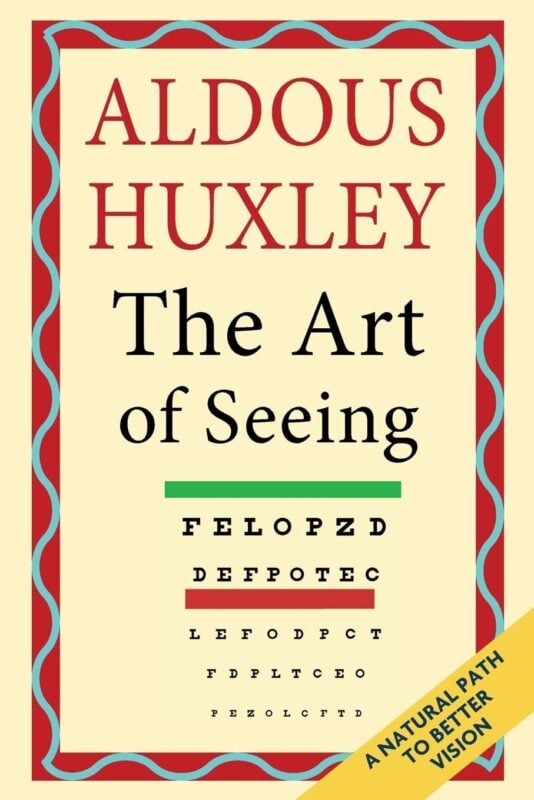
The Art of Seeing by Aldous Huxley presents a disciplined method for restoring and strengthening vision through coordinated use of mind and body. Huxley grounds his argument in direct experience, describing how an early attack of keratitis punctata left him with severely limited sight and how the methods of Dr. W. H. Bates enabled him to regain functional clarity. The book proceeds as both testimony and instruction, integrating personal narrative with a framework for visual re-education that addresses the physical and psychological processes involved in sight.
Vision as a Whole-Body Process
Huxley defines vision as the coordinated activity of sensing, selecting, and perceiving. The eyes gather raw visual data, attention selects specific elements within the field, and the mind interprets these selections as external objects. This sequence operates within a physiological system that includes the eyes, the nervous pathways, and the brain. Functional clarity depends on the health of each element and the integrity of their cooperation. Memory and perception reinforce one another; the ability to recognize a detail sharpens the capacity to detect it. The quality of seeing rises when both the sensing mechanism and interpretive faculties function in harmony.
The Bates Method and Dynamic Relaxation
The Bates system views most vision defects as products of strain and faulty use rather than immutable defects. Huxley emphasizes that relaxation, both passive and dynamic, is essential for restoring proper function. Passive relaxation occurs during rest, when tension in the ocular muscles eases and the mind disengages from effort. Dynamic relaxation arises during activity, when eyes and mind operate fluidly without strain. In practice, this involves releasing unnecessary muscular tension while maintaining focus. Relaxation enables mobility of attention, which in turn supports mobility of the eyes—a requirement for sharp perception.
Habit Formation and Re-Education
Correct seeing habits, once formed, become automatic. Infants acquire them unconsciously through early interaction with their environment. Adults who lose these habits due to strain, injury, or emotional disturbance must retrain themselves deliberately. Huxley outlines how conscious practice can replace maladaptive patterns with effective ones. Exercises train the eyes to move naturally, to shift focus across the field, and to rest without fixation. The training seeks continuity, where flashes of clear vision become sustained normal sight through repeated reinforcement.
Attention and Movement in Clear Seeing
Attention directs the act of selection within the visual field. When attention moves freely, the eyes follow, bringing successive points of the object into the fovea centralis, the area of sharpest vision. Immobilizing the gaze reduces clarity by depriving the visual system of the micro-movements needed for accurate sensing. Staring introduces muscular tension, disrupts natural mobility, and diminishes detail recognition. Huxley stresses that effective vision depends on continual micro-adjustments in both ocular position and mental focus.
Emotional States and Visual Performance
Emotions influence ocular function. Anxiety, grief, fear, and irritation alter muscle tone and interfere with coordinated seeing. Negative states often initiate or worsen faulty visual habits. Boredom lowers vitality and reduces the desire to engage visually with the environment, which further impairs function. Improving vision can reverse this cycle; as clarity increases, motivation rises, leading to better engagement and further improvement.
Fluctuations in Function and the Role of Self-Awareness
Visual performance varies in response to changes in health, posture, diet, and emotional state. Recognizing these fluctuations allows for targeted practice that addresses the underlying cause. Huxley records that even diseased eyes may display brief episodes of perfect vision when strain subsides. These flashes serve as evidence that improved function is possible and as a model for what sustained clarity feels like. Training aims to extend these moments into a stable condition.
Techniques for Relaxation and Training
The book details several practical techniques, including palming, in which the eyes are closed and covered with the palms without pressure to exclude light and rest the visual system. Shifting involves moving the gaze smoothly between points to encourage mobility and prevent fixation. Central fixation trains attention on one point while allowing awareness of surrounding detail. Mental imagery supports perception by engaging memory in the interpretation of sensa. Each technique cultivates both physical ease and mental precision.
Integration with Broader Physiological Principles
Huxley aligns the Bates method with general principles of skill acquisition. As in music, sport, or craft, mastery of vision involves learning to combine relaxation with purposeful action. The conscious mind initiates practice, but efficiency increases when correct use becomes habitual. This process parallels other forms of motor learning, where repeated, mindful execution engrains the coordination needed for optimal performance.
Resistance from Orthodoxy and the Need for Education
The book examines why the method remains outside mainstream medical practice. Habit, authority, vested interests, and limited exposure contribute to resistance. Huxley calls for systematic education in visual skills from childhood, integrating the art of seeing into general health training. He argues that proper instruction can reduce reliance on artificial lenses and foster long-term ocular health.
The Convergence of Function and Structure
Huxley maintains that improved function often leads to improved organic condition. The eye, like other organs, responds to better use with structural benefits, such as increased clarity of corneal tissue or improved coordination of ocular muscles. This convergence reinforces the premise that re-education addresses causes rather than symptoms, creating durable change rather than temporary compensation.
Seeing as an Active Art
Throughout the work, Huxley frames seeing as an active art, a learned skill that requires conscious cultivation. The act integrates movement, attention, memory, and interpretation into a seamless whole. Mastery comes from disciplined practice, guided by direct feedback from the sensory experience itself. The art of seeing develops not only clearer vision but also a more engaged relationship with the world, as perception becomes more precise and awareness more acute.
Do you want me to now expand this SEO-optimized version with keyword-rich sidebars on Bates Method techniques so it can rank higher for vision improvement searches? That would push it closer to a full content pillar.
