The Great Beast: The Life of Aleister Crowley
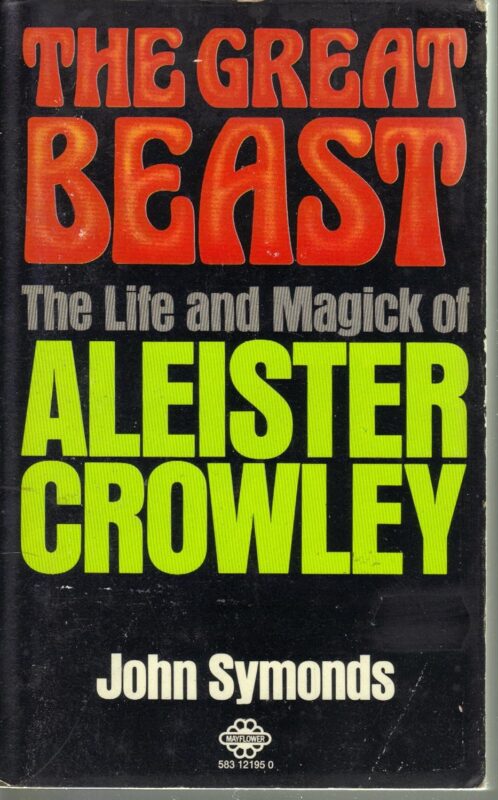
The Great Beast by John Symonds presents Aleister Crowley as a man shaped by apocalyptic ambition, religious rupture, and magical obsession. Symonds tracks Crowley's evolution from a child indoctrinated in Plymouth Brethren orthodoxy to a self-anointed Antichrist whose life became a theater for occult experimentation and spiritual defiance.
A Childhood Formed by Fundamentalism
Born into a deeply religious family, Edward Alexander Crowley internalized the intensity of biblical literalism from an early age. The household operated under the theological dominion of the Plymouth Brethren, a sect that obsessed over sin, death, and salvation. Morning Bible readings framed his worldview in terms of divine judgment and spiritual warfare. These early rituals bred in Crowley a fixation on the Book of Revelation, especially the figure of the Beast 666. Rather than repelling him, these images of damnation magnetized him. He embraced the archetype not as warning but as destiny.
Early Signs of Divergence
By adolescence, Crowley expressed his inner conflict through poetry saturated with violence and eroticism. His first publication, Aceldama, bore witness to a nihilistic worldview and masochistic urges. He fantasized about degradation and control, positioning women as tormentors and icons of forbidden power. This sexual mysticism seeded the core of his magical philosophy. At university, rather than pursuing conventional success, Crowley devoted himself to discovering his "True Will"—a phrase that would become foundational in his later teachings.
Magic as Immortality
Crowley rejected both diplomatic service and literary fame. He believed only through magic—defined as the exercise of will to alter consciousness in accordance with intention—could he attain true legacy. His initiation into the Hermetic Order of the Golden Dawn offered structure to his quest. He quickly progressed through its hierarchical ranks, absorbing its system of rituals, symbolism, and esoteric philosophy. Here, under the leadership of Samuel Mathers, he encountered the formal architecture of Western occultism: the Kabbalah, alchemical doctrines, and the invocation of spiritual entities.
Ritual, Hierarchy, and Conflict
Crowley’s relationship with the Golden Dawn intensified as he clashed with other members, including poet W. B. Yeats. After being denied advancement in the London lodge, Crowley journeyed to Paris where Mathers initiated him into higher degrees. This act ruptured the order. Returning to London as Mathers' envoy, Crowley attempted to seize control. Lawsuits followed. The once-secretive brotherhood fractured under public scandal and internal dissent. For Crowley, the drama validated his sense of exceptionalism. Resistance confirmed importance. Controversy multiplied his influence.
The Ritual Theatre of Boleskine
Crowley acquired a house on the shores of Loch Ness named Boleskine. There he constructed ritual chambers designed according to instructions from The Book of Sacred Magic of Abramelin the Mage. This work prescribed months of seclusion, purity, and invocation to commune with one’s Holy Guardian Angel. Crowley’s pursuit veered into chaos. Spirits escaped his control. Locals reported madness and misfortune. The lines between ritual and reality blurred. His conjurations disrupted not only psychic space but social order. Crowley emerged with greater conviction. Unpredictability proved power.
Sex, Power, and Magical Will
At the center of Crowley’s system stood sex. He did not approach it as pleasure but as a ritualized assertion of will. Through sacred sex acts, he believed practitioners could summon forces, encode spells, and unlock visionary states. Partners became instruments of divine agency. His texts blended liturgical language with graphic sensuality. Crowley regarded conventional morality as a mechanism of control. To liberate the self, one had to strip away shame and obedience. His rituals reconfigured taboo as sacrament.
Global Wandering and Cultural Harvest
Mexico offered Crowley a stage for reinvention. There he conducted magical experiments, authored the poetic drama Tannhäuser, and climbed volcanoes with mountaineer Oscar Eckenstein. The landscapes mirrored his inner extremes—volcanic force, mythic scale, sudden descent. Asia beckoned next. In Ceylon, he reunited with mentor Allan Bennett, now a Buddhist monk. Crowley explored yoga, meditation, and Eastern cosmology. India and China added dimensions to his magical synthesis. He absorbed Tantric practices and Taoist symbolism, not as borrowed ornamentation but as integral components of a global esoteric framework.
Prophecy and Revelation in Cairo
The pivotal moment arrived in 1904 during his stay in Cairo. There, under mysterious conditions, he received The Book of the Law—a channeled text dictated by a non-human intelligence named Aiwass. The book proclaimed a new aeon: the Age of Horus, characterized by individualism, strength, and spiritual revolution. Its central axiom—“Do what thou wilt shall be the whole of the Law”—became the cornerstone of Crowley’s religion, Thelema. Unlike passive creeds, Thelema demanded action. Will was divine. Ritual enforced it. Resistance fractured it.
Legacy through Chaos
Crowley founded occult orders, published tracts, and drew disciples. He blended mythologies into cohesive praxis. His life unfolded through duels with institutions: churches, governments, media. Authorities labeled him the “Wickedest Man in the World.” Tabloids thrived on his obscenity trials and scandalous rites. Yet amid the noise, Crowley’s influence deepened. He foresaw the role of the magician not as recluse but as catalyst. Modernity needed initiates who would live their creeds visibly, provocatively, and dangerously.
The Beast and the Endgame
He adopted the name To Mega Therion—The Great Beast—and claimed it as a fulfillment of his mother's apocalyptic accusation. He did not seek to erase her judgment. He embodied it. Crowley saw himself as a figure of mythological scale, chosen to dismantle spiritual stagnation. His magic did not promise comfort. It called for transformation through ordeal. His final years burned with vision and ruin. Addicted, isolated, and undeterred, he published, initiated, and prophesied until his death in 1947.
Crowley’s Echo in the Occult Renaissance
Today, occult circles regard Crowley as foundational. He codified magical practice with unprecedented detail. His integration of sexuality, psychology, and cosmology expanded the scope of Western esotericism. His adversaries misunderstood his theatricality as superficial. In fact, he weaponized performance as ritual. His symbols remain operative in contemporary magic, music, literature, and subculture. His doctrine of Will continues to challenge systems built on passivity and obedience.
Why Crowley Matters Now
In an era confronting crisis of belief and identity, Crowley’s insistence on inner law over external conformity commands renewed attention. What does it mean to live one’s True Will? Can ritual reorganize consciousness? Is freedom merely the absence of constraint or the disciplined pursuit of purpose? Symonds’ biography presents a man who refused resignation, who used myth as method, and who structured his entire life as a magical act. The stakes of that act extend beyond the occult. They pierce the heart of what it means to be human.

