The Modern World-System I: Capitalist Agriculture and the origins of the European World-Economy in the Sixteenth Century
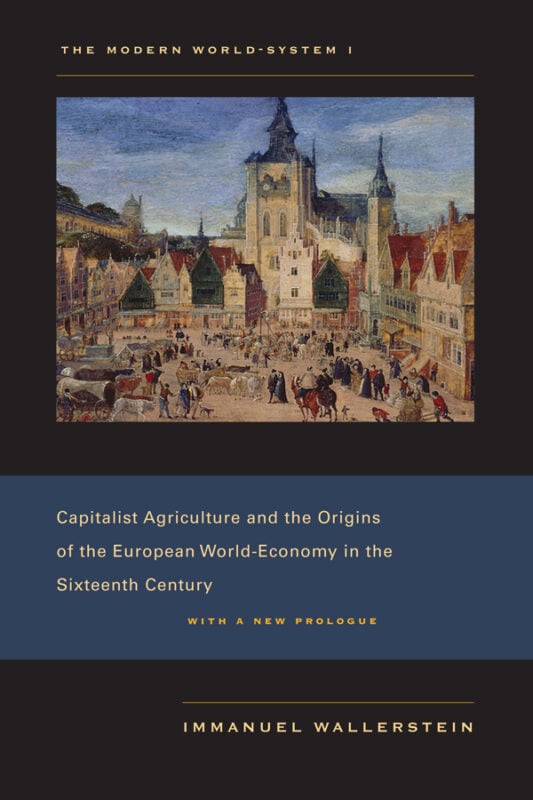
The Modern World-System I by Immanuel Wallerstein reframes the origins and dynamics of capitalism through the lens of global historical structures, challenging the explanatory sufficiency of nation-state-centered social science. Wallerstein asserts that the modern world’s defining transformation emerged from the formation of a European-centered world-economy in the sixteenth century, rooted in the practices of capitalist agriculture and transcontinental trade. The argument unfolds with direct engagement with core debates in sociology, economic history, and political theory, driving toward a coherent model of global structural change.
Origins of the Capitalist World-Economy
Wallerstein locates the decisive threshold of modernity in the long sixteenth century, a period marked by the rise of capitalist agriculture and the reorganization of labor and trade relations on a planetary scale. He identifies capitalist agriculture as the catalytic innovation, integrating local production with international markets through mechanisms of price formation and wage relations. Landowners, merchants, and states coalesced into an emerging class structure capable of extracting surplus from coerced and waged labor alike. This system expanded outward, seeking resources, labor, and new markets beyond Europe’s core, forging networks that bound peripheries into subordination and channelled flows of value toward the center.
Structure and Dynamics of the World-System
Within Wallerstein’s model, the world-system operates as a singular social structure whose essential characteristics include a hierarchy of core, periphery, and semiperiphery zones. Core areas develop advanced forms of capitalist production, assert control over finance and technology, and shape political institutions to sustain dominance. Peripheral regions, incorporated through conquest or commercial penetration, supply raw materials and labor, often under coercive conditions. Semiperipheries serve as transitional zones, mediating exchanges, absorbing shocks, and occasionally ascending or descending within the hierarchy. These zones do not exist as isolated entities but as relationally defined positions within the total structure of the world-economy.
Division of Labor and Global Integration
The world-system’s logic compels a division of labor organized on a transnational basis. Core regions specialize in high-value manufactures and command financial flows. Peripheral areas export agricultural goods, minerals, and other primary commodities, their productive arrangements shaped to maximize extraction for external benefit. Semiperipheries exhibit mixed features—some industries parallel core patterns, others align with peripheral characteristics. Integration advances as trade intensifies and transportation technologies improve, enabling capital and commodities to circulate across increasingly interconnected markets.
Transformation of State Power
States emerge as key agents in the world-system, not as independent actors but as structures shaped by their location within the global hierarchy. In core zones, state institutions develop capacities for centralized administration, taxation, military force, and regulatory control. These capacities sustain domestic stability, enforce property rights, and support capital accumulation. In peripheral regions, state apparatuses often remain fragmented, subordinate, or externally directed. Semiperipheral states navigate between these poles, balancing internal consolidation with the demands imposed by their intermediary position. State formation does not proceed from endogenous developmental logic alone but as a direct consequence of system-wide competition and interdependence.
Critique of Methodological Nationalism
Wallerstein dismantles the conceptual foundation of methodological nationalism—the assumption that nation-states serve as the natural unit for analyzing social change. He argues that systemic transformations in the modern era occur not within discrete national containers but through processes unfolding across interconnected zones. The apparent distinctiveness of national trajectories arises from their position in the global structure and from their specific role within the division of labor. Theories anchored solely in national attributes obscure the mechanisms of structural change that cross borders and define the possibilities of political and economic action.
Challenging Linear Theories of Development
The world-system perspective rejects unilinear models of development that posit a uniform progression from traditional to modern societies. Instead, it reveals how processes of development and underdevelopment form together, entangled within the expanding capitalist order. Peripheral regions do not merely lag behind; their integration into the system generates conditions of dependency, surplus extraction, and structural disadvantage. The core’s advance thus links directly to the periphery’s persistent deprivation, both produced by the same systemic forces.
Intellectual Lineage and Theoretical Synthesis
Wallerstein engages the legacies of Marx, Weber, and Braudel, synthesizing and transcending their insights. He adapts Braudel’s longue durée approach, tracking slow-moving structural shifts that shape historical outcomes. From Marx, he takes the focus on modes of production and exploitation, but redirects analysis from national class struggle to global class relations. Weberian themes—values, status, and authority—enter the analysis as derivative of structural transformations, rather than their cause. The result is an integrative theory that treats economic, political, and cultural dynamics as facets of a single world-systemic reality.
Empirical Foundations and Historical Cases
Wallerstein grounds his model in close historical study. He examines the rise of absolute monarchies, the failure of empires such as Spain, the emergence of strong core states, and the shifting locus of commercial power from Seville to Amsterdam. He dissects the mechanisms through which trans-European trade networks emerged, how merchant classes consolidated power, and how systems of coerced labor proliferated in the peripheries. Illustrations of sugar plantations in the Atlantic world, the Polish grain trade, and Dutch commercial dominance provide concrete reference points for systemic patterns.
Debates on Boundaries and Periodization
Scholars debate the spatial and temporal boundaries of the world-system. Wallerstein draws sharp lines between regions incorporated into the capitalist economy—Poland, Hungary, and Brazil—versus those positioned outside or on the margins, such as Russia and the Ottoman Empire. Some critics argue for earlier origins or broader spatial scope, invoking trade systems in Asia or the Mediterranean centuries before the sixteenth century. Wallerstein acknowledges these debates, insisting on the necessity of empirical specificity and theoretical clarity in drawing systemic boundaries.
Institutional Complexity and Systemic Interactions
The world-system comprises not only economic but also political, military, and cultural institutions. State power, armed force, technological change, and ecological factors interact to shape structural possibilities. Wallerstein recognizes the environmental consequences of capitalist expansion, the role of military technology in core formation, and the significance of ideological legitimation in stabilizing hierarchies. The system’s resilience stems from its ability to incorporate, adapt, and reconfigure institutional arrangements in response to shifting pressures and opportunities.
Revising Core Concepts: Capitalism, Class, and Agency
Wallerstein redefines capitalism as a global mode of production characterized by the endless accumulation of capital within a networked division of labor. He challenges conventional definitions that restrict capitalism to wage labor or industrial production, emphasizing the primacy of profit-seeking and market integration across agriculture and trade. Class structure unfolds not within nations but across the world-system, as surplus flows from peripheries to cores. Agency emerges within, and because of, systemically produced opportunities and constraints—states, classes, and groups act, but always in relation to the structure that defines their capacities.
Theoretical Critique and Intellectual Reception
The publication of The Modern World-System I provoked intense debate across the social sciences. Orthodox Marxists accused Wallerstein of economic reductionism and circulationism, prioritizing exchange and trade over class struggle in production. Economists challenged his rejection of Ricardo’s law of comparative advantage, perceiving a threat to foundational assumptions about global trade. Political historians and cultural theorists questioned his integration of politics and culture within a single economic framework, suggesting a need for analytic autonomy. Wallerstein directly engages these critiques, dissecting their premises and clarifying the boundaries of his argument.
Confronting the Sinocentric World-System Hypothesis
Late twentieth-century scholarship advanced the hypothesis of a centuries-old, Asia-centered world-system, with China at its core. Andre Gunder Frank and others traced global cycles and flows of silver, arguing for a premodern world-system stretching back millennia. Wallerstein responds by insisting on the centrality of capitalist transformation, the particular configuration of European expansion, and the empirical evidence for the sixteenth-century rupture. He interrogates the data on trade, production, and power, concluding that only the modern world-system manifests the structural features and global scope necessary for systemic analysis.
Calls for Holistic Analysis
Wallerstein maintains that analysis of the modern world requires an integrated, holistic approach. Economic, political, and cultural domains must be studied as co-constitutive and relational, rather than as separate spheres. The world-system’s evolution generates novel institutional forms, transforms relations of power, and reshapes cultural identities. The analytic priority rests on tracing causal pathways across domains, following the flows of capital, authority, and meaning as they bind disparate regions into a single structural whole.
Ongoing Influence and Research Trajectories
The Modern World-System I endures as a foundational text, shaping research agendas in world history, sociology, political economy, and international relations. Scholars continue to elaborate, revise, and contest its central claims. Debates persist over the timing and geography of systemic origins, the mechanisms of incorporation and resistance, and the dynamics of core-periphery transformation. Wallerstein’s insistence on structural analysis, empirical rigor, and theoretical synthesis anchors contemporary inquiries into globalization, development, and inequality.
Strategic Implications for Understanding Global Change
By locating social change at the level of the world-system, Wallerstein opens new pathways for explaining historical transformation. His analysis reveals how cycles of expansion and contraction, crisis and consolidation, drive systemic change. Agents act within, and help reshape, the structures that condition their possibilities. Questions of power, agency, and resistance must be situated within the evolving logic of the world-economy. What patterns of accumulation, dominance, and revolt emerge from this structure? How do institutional innovations and social struggles redirect the flows of capital and authority? What new systemic transformations loom as the contemporary order encounters its limits?
The Modern World-System I asserts a paradigm for interpreting the past and confronting the future: structural forces, historical agency, and global interconnection produce the modern world’s distinctive forms. To understand this world, analysis must follow the system—its origins, logic, and unfolding contradictions.
