The Splendid Blond Beast: Money, Law, and Genocide in the Twentieth Century
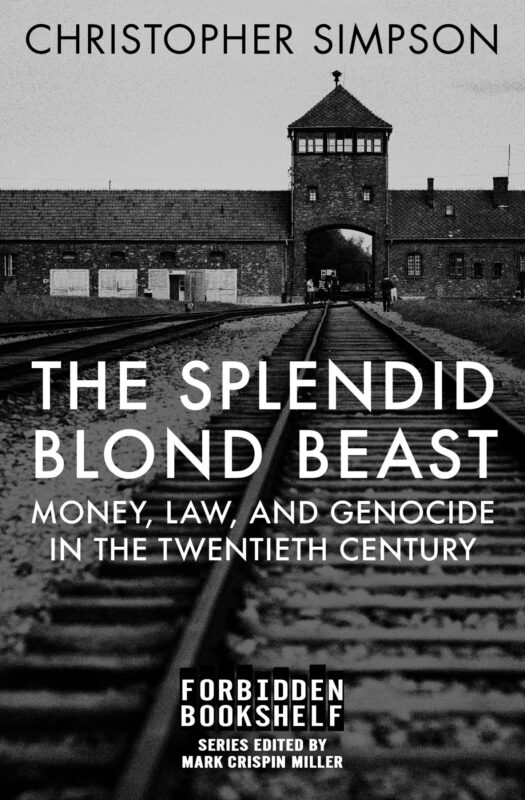
The Splendid Blond Beast by Christopher Simpson investigates the interdependence of economic elites, legal structures, and mass political violence in the twentieth century. Drawing from detailed case studies of the Armenian Genocide and the Holocaust, Simpson exposes how systemic violence often requires not merely ideological fervor but active, material support from legal, financial, and governmental institutions. Elites used international law, corporate influence, and strategic diplomacy to enable mass murder, then shield perpetrators from justice.
Genocide as Institutional Strategy
Genocide functions through the integration of violence into bureaucratic, legal, and economic systems. Simpson shows that mass killing evolves as an institutional process, not a spontaneous eruption of hatred. Political parties under strain—such as the Turkish Committee of Union and Progress or Hitler’s Nazi regime—develop genocidal policies when they can link these crimes to state-building or economic gain. These regimes reward collaborators with property, social status, and economic dominance. Such incentives turn genocide into a rational choice for power brokers seeking to secure or elevate their positions.
The economic infrastructure becomes a delivery system for persecution. German and Turkish businesses participated in Aryanization and asset seizures, not to serve ideology, but to preserve competitive advantage. Banks processed looted Jewish and Armenian assets. Corporations built infrastructure using slave labor. Government agencies coordinated logistics of displacement and extermination. These systems required deep cooperation across sectors of society, especially those whose leaders professed ambivalence or opposition to state violence. Their participation made genocide operational.
Law as a Mechanism of Immunity
International law offered frameworks that legitimized the actions of genocidal states. The Hague and Geneva Conventions outlined formal boundaries for warfare, but those limits excluded mass violence within sovereign borders. Crimes against civilians by a state against its own people fell outside legal definitions. Simpson explains how this legal void emboldened perpetrators. U.S. Secretary of State Robert Lansing argued that international trials for war crimes would compromise American sovereignty. Legal theorists reinforced immunity by asserting that heads of state could not be prosecuted for actions taken within their jurisdictions.
Legalist interpretations defined what counted as justice. These interpretations often originated from countries with material interests in the outcomes. Simpson documents how U.S. and British diplomats prioritized reconstruction, political alliances, and economic recovery over trials for war criminals. They classified mass killings as internal policy rather than international crime. The result was a system that allowed perpetrators to negotiate from a position of leverage, turning the promise of postwar stability into a bargaining chip.
Corporate and Political Continuity
Economic elites pursued continuity over accountability. Simpson tracks how many of the industrialists, bankers, and bureaucrats who enabled the Holocaust and the Armenian Genocide retained influence after the wars. The Dulles brothers, who later shaped American Cold War foreign policy, illustrate this continuity. They opposed prosecuting Axis-aligned industrialists and protected figures like Karl Wolff, a top SS officer involved in the deportation of Jews. John Foster Dulles and Allen Dulles helped secure amnesty for Nazi collaborators in the name of preserving European capitalism and preventing Communist influence.
This strategic leniency served American corporate interests. U.S. companies expanded their investments in Nazi Germany during the 1930s, benefiting from Aryanized industries and labor policies. After the war, the same networks ensured that German industrial capacity would rebound under the leadership of executives with documented ties to forced labor and extermination programs. The political decision to forgive their crimes arose from a calculated belief that economic reconstruction required their expertise and allegiance.
Systemic Obstruction of Justice
Institutional efforts to bring war criminals to justice collapsed under internal opposition. Simpson details how the United Nations War Crimes Commission (UNWCC), led by Herbert Pell, faced sabotage from within the U.S. State Department. Pell sought to prosecute German and Turkish elites for their roles in genocide, but Green Hackworth, the department’s legal chief, neutralized those initiatives. He dismissed war crimes as unenforceable and obstructed efforts to expand international criminal law.
Hackworth’s position reflected a broader consensus. Simpson outlines how internal memos, classified reports, and diplomatic correspondences reveal a shared intent among Allied diplomats to prevent the establishment of binding legal precedents. They dismantled legal commissions, sealed archives, and buried documentation. These actions preserved diplomatic flexibility at the cost of historical justice. Victims were denied accountability, and perpetrators were integrated into the postwar world order.
The Unresolved Legacy of the Armenian Genocide
The failure to prosecute perpetrators of the Armenian Genocide created a precedent that influenced Nazi strategy. Hitler cited the Turkish campaign against the Armenians as evidence that the world forgets mass atrocities. Simpson examines how the Allied powers, despite public outrage and extensive documentation, refused to intervene. Djemal Pasha, one of the Young Turk leaders, offered to end the genocide in exchange for Allied support. Instead, France and Britain prioritized oil concessions in the Middle East. They dismissed the offer, securing resource access at the price of hundreds of thousands of lives.
Simpson presents this episode as a critical junction. The inaction confirmed to future perpetrators that strategic value outweighs humanitarian concerns. The Young Turks returned to prominence in Turkish nationalist movements. Western governments negotiated with them to ensure favorable access to post-Ottoman markets. The international community signaled that mass murder, when aligned with national interests, would meet silence or compromise rather than accountability.
Comparative Frameworks for Genocide Studies
Simpson rejects the notion that the Holocaust and the Armenian Genocide exist beyond comparison. He asserts that the structure of mass killing must be understood across cases to identify patterns of elite complicity, legal failure, and institutional continuity. Scholars like Ervin Staub and Yehuda Bauer support this approach. Comparative analysis does not flatten distinctions; it highlights systemic features that recur. Ideological content varies, but operational methods converge.
The book challenges moral exceptionalism. Simpson urges readers to observe how elites normalize atrocities through institutional channels. Comparative frameworks reveal how bureaucracies adapt to genocidal objectives without transforming their stated missions. Educational institutions, churches, corporations, and courts become instrumental when they reframe mass murder as administrative necessity.
Diplomacy as a Shield for Crime
International diplomacy structured immunity for perpetrators. During World War II, Allied legal advisors claimed that crimes inside Axis borders were outside their jurisdiction. They argued that Hitler, as head of state, could not be prosecuted. British and American officials warned against overemphasizing the Holocaust, fearing it would derail negotiations with German elites. These calculations delayed rescue operations, restricted refugee policies, and permitted the continuation of extermination efforts.
Simpson exposes the rhetoric of necessity as a tool of obstruction. When Allied diplomats chose to limit intervention, they cited legal obstacles. Yet those obstacles were selectively enforced. They prosecuted war crimes when it suited military objectives and ignored them when it complicated alliances. These choices shaped the development of international law, embedding power-based exemptions into its foundation.
Economic Rationality in Genocide
Perpetrators acted with strategic calculation. Genocide created opportunities for asset acquisition, political advancement, and social engineering. The Nazis integrated business leaders into the machinery of extermination by offering them labor, contracts, and market dominance. Turkish authorities enriched collaborators by redistributing Armenian property. These incentives transformed crimes into mechanisms of governance.
Simpson shows how violence became efficient when institutions internalized its logic. Universities developed racial theories. Courts ratified discriminatory laws. Banks facilitated wealth transfers. Each actor performed their professional role while contributing to genocide. The moral disassociation enabled mass participation. Once institutions aligned incentives with policy, resistance collapsed.
Toward Structural Justice
Simpson concludes that prosecuting genocide requires dismantling the alliances that enable it. Legal reforms must address how law becomes complicit. Historical justice depends on exposing how power secures immunity. Accountability cannot rely on victor’s justice or selective enforcement. It demands transparent institutions with jurisdiction over sovereign crimes.
Simpson does not offer closure. He presents a pattern of elite complicity and legal evasion that persists. The book documents a system where perpetrators reemerge as allies and advisors. The price of stability is silence. Justice, when deferred, becomes structurally unreachable. Recognizing these dynamics is the first step toward altering them.