The Stranger In The Mirror: Dissociation – The Hidden Epidemic
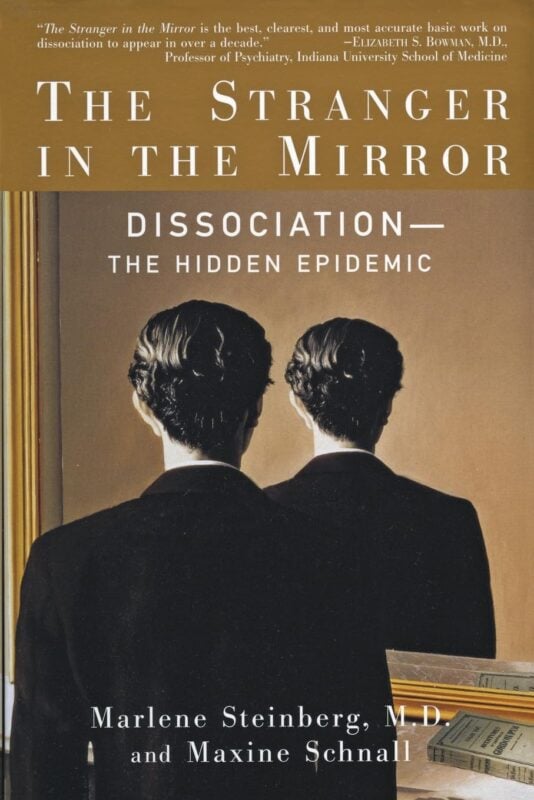
The Stranger in the Mirror by Marlene Steinberg, M.D., opens with a provocative claim: dissociation is the hidden epidemic of modern psychiatry. Drawing from decades of clinical experience and groundbreaking research, Steinberg reframes dissociation as a widespread, underdiagnosed psychological defense. Through personal stories, diagnostic innovation, and neurobiological insight, she shows how dissociation quietly undermines mental health across demographic and diagnostic boundaries.
Dissociation as a Survival Strategy
Dissociation arises in response to overwhelming stress, enabling a person to detach from immediate danger. It interrupts normal consciousness to preserve psychological integrity. In moments of acute trauma—an auto accident, near-death experience, or abuse—dissociation provides mental distance, emotional numbing, and altered perception of time. People report floating outside their bodies, watching events unfold as if in a dream, or moving robotically through danger. These responses manifest not as delusions but as perceptual shifts that stabilize the self during chaos.
Steinberg identifies these symptoms as natural extensions of a continuum. Dissociation begins with common experiences like highway hypnosis or getting lost in a book. Under persistent stress, these episodes may intensify and disrupt daily functioning. Severe dissociation fragments memory, identity, and emotional regulation. The mechanism that once shielded a child from abuse evolves into a lifelong reflex that limits self-awareness and emotional coherence.
Hidden in Plain Sight
Mild to moderate dissociative symptoms pervade ordinary life. People describe time loss, blank spells, depersonalization, and identity confusion. They forget what they just did, feel detached from their surroundings, or act like someone else. These accounts surface across professions and backgrounds. Most people do not report these symptoms because they fail to recognize them as significant. Therapists overlook dissociation when they focus narrowly on mood or anxiety symptoms.
Dissociation often presents as depression, ADHD, panic disorder, or obsessive-compulsive behavior. Patients complain of mood swings, anxiety, compulsions, or numbness. Without direct questions about dissociative experiences, the core pathology remains invisible. Steinberg developed the SCID-D (Structured Clinical Interview for DSM-IV Dissociative Disorders) to bridge this gap. Her tool detects patterns that indicate dissociative disorders even when patients cannot name their symptoms.
From Misdiagnosis to Discovery
As a young psychiatrist, Steinberg encountered DID (Dissociative Identity Disorder) in patients whose symptoms had baffled other clinicians. She found that specific, trauma-informed questions could reveal dissociation where standard assessments saw only depression or mania. Her work at Yale led to the first federally funded research into dissociative disorders, validating the SCID-D through hundreds of clinical interviews.
The SCID-D identifies five core symptoms: amnesia, depersonalization, derealization, identity confusion, and identity alteration. These symptoms do not operate in isolation. They interact, forming a diagnostic constellation that distinguishes transient stress responses from entrenched dissociative disorders. Steinberg’s methodology converts vague experiences into clinical data, making diagnosis replicable and actionable.
Case Studies and Clinical Depth
Personal narratives illustrate the inner architecture of dissociation. Gloria, a woman hospitalized after self-harm, presents multiple identities under sedation—Carmelita, a weeping adolescent; CeeCee, a terrified child; Laura, a rational manager. These personas express compartmentalized trauma, each holding different memories, emotions, and coping styles. Their emergence is not theatrical but functional. Each alter performs a task the primary identity cannot.
Other cases reveal how dissociation adapts to social expectations. Patients hold jobs, maintain families, and succeed academically while compartmentalizing painful histories. Their switches may go unnoticed or seem like mood shifts. Steinberg shows that even the most fragmented patients can integrate and heal when treated with patience, precision, and empathy.
The Neurobiology of Dissociation
Dissociation originates in the brain’s trauma response system. When the thalamus detects threat, it routes sensory input to the amygdala. This structure activates survival reflexes—racing heart, tunnel vision, dissociation—without consulting the rational cortex. Emotional memories processed through the amygdala lack verbal narrative. They store as physical sensations, visual fragments, and emotional surges.
This split encoding explains why trauma survivors struggle to articulate what happened. They experience vivid flashbacks, bodily sensations, or sudden panic without coherent memories. The dissociative brain hides trauma not by erasing it but by sealing it in inaccessible regions. Therapy helps bridge these neural divides by linking emotional memory with conscious awareness.
Childhood Trauma and the Fragmented Self
Early abuse primes the brain for dissociation. A child who endures repeated sexual, physical, or emotional violence develops parts of the self that absorb the trauma. These parts may become independent identities. Unlike imaginative play, these identities function as real, autonomous entities managing specific tasks—enduring pain, expressing anger, preserving innocence.
The child escapes by creating internal figures who can survive what she cannot. Over time, these figures acquire names, preferences, and histories. They split memory and emotion across compartments. The result is DID. These patients do not pretend. They divide. Their identities evolve organically to manage overwhelming experience.
Therapeutic Recovery and Integration
Healing requires acknowledgment, safety, and sustained relational attunement. Steinberg emphasizes the Four C’s: Connection, Communication, Cooperation, and Integration. Therapy begins by establishing trust, then progresses to dialogue between identities. The goal is not to eliminate parts but to integrate them into a unified self.
Integration involves reliving trauma without re-traumatization. Patients recall abuse with support, then reprocess it within a safe therapeutic frame. Over time, the dissociative barriers dissolve. The patient gains access to memories, emotions, and skills held by different parts. Function improves. Anxiety, depression, and flashbacks recede. Identity stabilizes.
Prevalence and Public Misunderstanding
Recent studies estimate that 14 percent of the population experience substantial dissociative symptoms. One percent may meet criteria for DID. Misdiagnosis remains common because dissociation mimics other disorders and often goes undetected. Cultural narratives distort DID into a spectacle of wild personality shifts. In reality, most people with DID live quietly, managing symptoms alone.
Steinberg addresses seven myths that hinder understanding. Dissociation does not always signal disorder. Dissociative disorders are not rare. Multiples are not easy to spot. Most abuse memories predate therapy. Trauma survivors do forget, and later remember, real events. Effective treatment does not require memory recovery. Dissociative disorders stem from real abuse histories, not therapist suggestion.
Diagnostic Breakthroughs and Clinical Implications
The SCID-D represents a paradigm shift. By identifying dissociation through structured interviews, it enables clinicians to recognize patterns previously missed. The interview asks specific, nonleading questions. It captures how symptoms occur, their frequency, duration, and impact. The result is a diagnostic profile grounded in evidence, not interpretation.
Steinberg’s research proved that dissociation exists along a spectrum. People with mild symptoms need awareness and support. Those with moderate symptoms benefit from therapy. Those with severe symptoms, including DID, require specialized treatment. Each level involves real suffering and deserves appropriate care.
A New Diagnostic Lens
Dissociation shapes human response to trauma. It is adaptive, complex, and profoundly human. When misrecognized, it delays healing and deepens dysfunction. When identified and treated, it opens pathways to recovery that no other model can access.
Steinberg’s work reframes psychiatric inquiry. It does not ask what disorder a person has. It asks how their mind survived. Dissociation reflects the mind’s capacity to defend, divide, and adapt. Recovery honors that capacity by integrating it into a coherent whole. Through this lens, psychiatry advances from labeling to listening, from suspicion to understanding.