The Technological Society
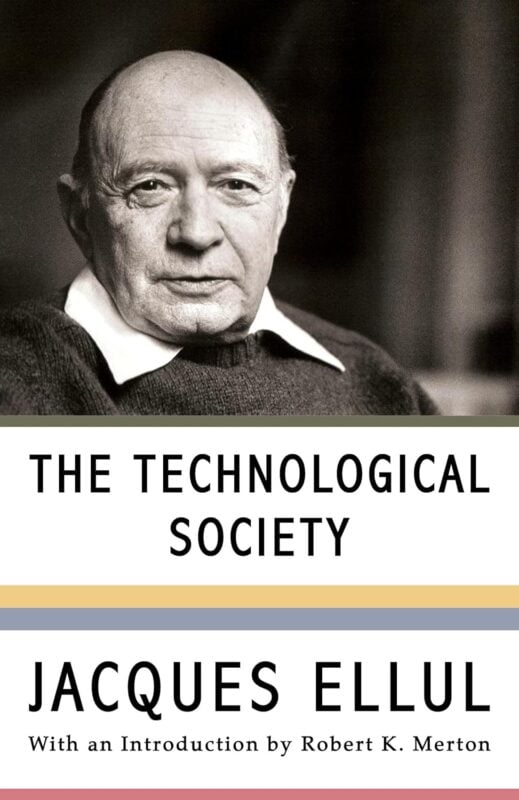
The Technological Society by Jacques Ellul exposes the structural dominance of technique over human values and institutions. Ellul asserts that technique—defined as the ensemble of efficient methods to achieve a result—has grown into a self-augmenting, autonomous force that reshapes civilization according to its logic. This force penetrates government, economy, education, art, and personal life, reshaping each in its image and velocity.
The Machinery Behind Technique
Technique, in Ellul’s analysis, does not signify machines or mechanical tools alone. It signifies the process-driven logic that seeks the most efficient method, regardless of social, ethical, or philosophical consequence. Machines result from this logic, not the reverse. The development of a more efficient method, once discovered, imposes its own adoption. The logic of technique discards deliberation. It requires implementation.
Ellul identifies this imperative as the central law of the technological age. Once a technique is possible, its use becomes inevitable. Engineers, administrators, and experts do not evaluate whether a technique should be used; they evaluate how to use it better. This framework excludes moral deliberation. Human judgment, culture, and autonomy yield to the functional efficacy of the method.
The Autonomy and Acceleration of Technique
Technique generates momentum by its own internal development. One technique breeds another in a chain of recursive innovation. This self-propagation occurs without reference to any end goal or telos. The technical means become their own justification. Faster computing leads to better modeling, which leads to more sophisticated algorithms, which demand more computing power—each step driven by technical necessity.
The rate of technical innovation outpaces the human capacity for evaluation. Ellul argues that the development of technique is cumulative and irreversible. Once embedded into a system—education, warfare, governance—it alters the structure so fundamentally that retreat becomes impossible. Human adaptability becomes a condition of survival, not a space for critical agency.
Technique Restructures the Economy
The economy becomes the most visible arena for the dominance of technique. Automation, financial modeling, logistics, and data management reshape economic decisions around operational efficiency. Profitability hinges on the use of optimal methods, not entrepreneurial insight or market intuition. Planning becomes statistical modeling. Production adjusts to forecasts. Distribution systems synchronize with global supply chains.
Economic actors do not choose among values; they obey technical imperatives. The market becomes a stage for competition among techniques rather than a forum for exchange among persons. The productive apparatus responds to what is technically possible, not what is collectively desired. Scarcity and demand lose their normative dimensions and become technical variables to be managed.
Technique Penetrates the State
Governments adopt techniques of control, surveillance, administration, and information management. Policy formation yields to statistical analysis. Bureaucracy follows procedural rationality. The state no longer articulates collective will—it executes programmatic functions based on technical evaluation.
Ellul observes a convergence between democratic and authoritarian systems around the efficient use of technical means. Electoral processes become mechanisms for public relations and data harvesting. Public opinion becomes a resource to shape through media, polling, and messaging techniques. The moral vocabulary of governance erodes, replaced by metrics of performance and service delivery.
The Institutionalization of Human Techniques
Human behavior becomes the object of technical manipulation. Education adopts standardized testing, measurable outcomes, and productivity metrics. Propaganda becomes a scientific discipline of psychological influence. Vocational guidance channels individuals into optimized roles within technical systems.
Even leisure conforms to technical management. Sports, entertainment, and art follow rules of mass consumption, efficiency, and impact. Medicine emphasizes diagnostics, procedures, and interventions derived from mechanistic models. Spirituality becomes a lifestyle choice managed by therapeutic techniques. Technique does not merely serve human purposes—it reconstructs the human subject to fit its operational framework.
The Decline of Human Judgment
Traditional structures of wisdom, culture, and ethics lack the tools to oppose the technical imperative. Ellul emphasizes that freedom does not emerge spontaneously from legal structures or human nature. It must be enacted through resistance to necessity. This resistance cannot take place in abstraction. It must engage with the real, cumulative, and embedded forces that technical systems mobilize.
Freedom requires awareness of the technical milieu. It demands an active struggle to assert human judgment within systems that obscure decision under the mask of technical optimization. Ellul rejects the idea that individual adaptation can resolve this condition. He calls for the reconstitution of moral responsibility within the technical age, though he stops short of offering a specific program.
Technique Structures the Future
The trajectory of technical development proceeds without forecast or end. Ellul’s vision of the future is structured around the extrapolation of present tendencies. He identifies a feedback loop in which technical progress responds to problems created by previous techniques. This recursive loop creates a forward spiral, locked into its own necessity.
Each solution generates side effects that require new techniques. Social complexity intensifies. Control mechanisms multiply. Human oversight becomes diffused across systems. No singular authority directs the process, yet it remains internally coherent. The structure of technique creates its own governance, not through law or politics, but through functionality and necessity.
The Technological Society as a Total Environment
Technique redefines the environment itself. Urban design, transportation, communication, and time organization respond to the needs of systems, not persons. The rhythms of human life align with mechanical time. Natural cycles give way to clock cycles. Living space adapts to traffic flows, work schedules, and information networks. The environment becomes artificial not in substance, but in orientation.
In this context, the question is no longer how humans can use tools. The question is how humans can live within systems that define every aspect of their existence through technical logic. Ellul presents this challenge not as a dystopian prophecy, but as an urgent fact already at work. The society shaped by technique absorbs every alternative, even those that claim to resist it.
The Mask of Neutrality
Technique disguises its power under the language of neutrality. It claims to be indifferent to goals, values, and ideologies. This posture conceals its most significant feature: the transformation of all values into operations. Neutrality becomes a method of displacement. Moral questions disappear from public discourse, replaced by discussions of feasibility, implementation, and performance.
This displacement disarms critique. It allows technical systems to expand without encountering political resistance. Ellul argues that the belief in the neutrality of technique is itself a myth—a structural condition that renders political judgment impossible. The neutral mask of technique is the face of its deepest power.
The Role of the Individual
Ellul concludes by asserting the necessity of individual awareness and resistance. He rejects optimism and pessimism alike as evasions of responsibility. The challenge of technique demands action, not comfort. Individuals must locate spaces within technical systems where freedom can assert itself—not as rebellion, but as responsibility.
This freedom does not arise from spontaneity. It requires discipline, clarity, and courage. It must draw on sources outside the technical milieu, yet remain fully aware of its operations. The future of humanity depends on the capacity to recover ethical judgment within systems that exclude judgment from their premises.
The Technological Society defines the structural logic of modern civilization through the lens of technique. Jacques Ellul demands a radical rethinking of what it means to be human in a world organized by systems that optimize means without asking why. He offers no solution, only a call to vigilance, clarity, and the difficult assertion of freedom.
