The Unseen Hand: An Introduction into the Conspiratorial View of History
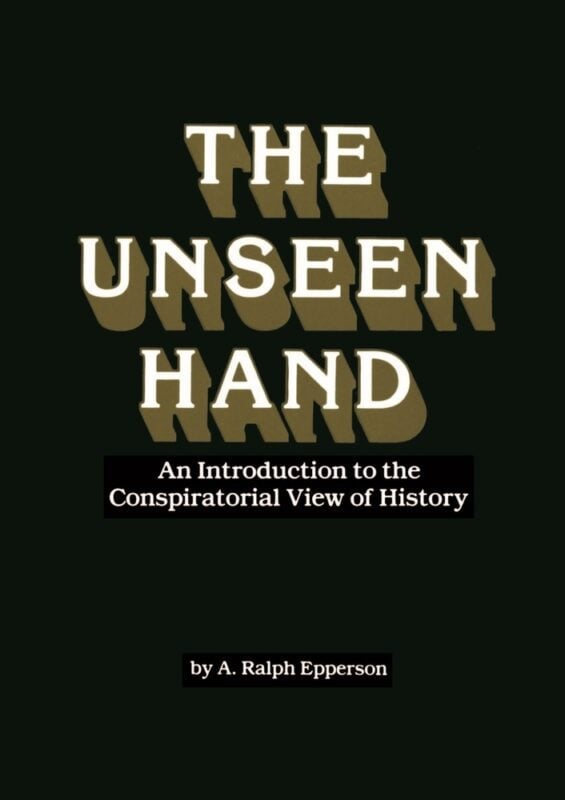
The Unseen Hand by A. Ralph Epperson constructs a detailed argument that world events follow deliberate design. The author advances a comprehensive account of hidden coordination among powerful individuals, governments, and financial systems. Through his analysis, Epperson traces a continuity of organized planning that shapes revolutions, economic crises, and wars, claiming that these actions converge toward a single goal: concentrated power through global governance.
The Structure of Historical Intention
Epperson defines two interpretive models for understanding history. The Accidental View treats wars, depressions, and revolutions as spontaneous results of chance and human error. The Conspiratorial View asserts that organized forces engineer these events to produce controlled outcomes. Epperson aligns with the latter and documents evidence that supports intentional causality across centuries. He cites statements from Franklin D. Roosevelt, Zbigniew Brzezinski, James Warburg, and Carroll Quigley to establish that elites have acknowledged strategic manipulation behind major developments. By connecting economic and political upheavals to a common pattern, he situates conspiracy as an active mechanism of governance.
Power as the Ultimate Motive
The author identifies power as the definitive pursuit of ruling elites. He quotes Lord Acton’s warning that power corrupts absolutely, illustrating that the desire for control transcends profit or ideology. Joseph Kennedy’s ambition for governmental power and Benjamin Franklin’s observation on the union of money and authority exemplify how wealth functions as an instrument of domination. Epperson argues that leaders seek not security or reform but the authority to direct populations. The continuity of power transfer across generations sustains the structure of control.
The Continuity of Secret Networks
Epperson outlines the recruitment process described by Norman Dodd, who claimed that influential circles monitor promising individuals and draw them into participation. George Orwell’s statement in 1984 that “the Party is not concerned with perpetuating its blood but with perpetuating itself” provides the conceptual foundation for the book’s central thesis: institutions outlive individuals, and the hierarchy renews itself through selective induction. Epperson references the Round Table groups, the Rothschild family, and modern think tanks such as the Trilateral Commission as visible nodes within an older system of coordination.
The Source of Human Rights and the Role of Government
The book contrasts divine and human origins of liberty. Epperson asserts that if rights derive from the Creator, they remain inalienable; if government grants them, it can remove them. He cites Thomas Jefferson and William Penn to demonstrate that liberty depends on divine authority. The argument establishes the moral foundation of political resistance: a government that claims to bestow rights claims ownership of the individual. From this perspective, any transfer of authority from God to the state marks the beginning of tyranny.
Freedom, Property, and the Economic Model of Obligation
To illustrate the moral economy of liberty, Epperson designs a model of seven individuals isolated on an island, producing and consuming unequally. The scenario defines surplus as wealth and deficit as dependency. When less productive individuals vote to redistribute the surplus, they convert theft into legality. Epperson calls this transition “legal plunder,” drawing from Frédéric Bastiat’s The Law. He defines true freedom as the right to retain the product of labor and condemns majority rule that confiscates property through policy. The parable demonstrates how democracy, when unrestrained, becomes a mechanism for exploitation.
Democracy and the Loss of Limitation
The book examines the American constitutional framework as a deliberate attempt to limit power through enumerated authority. Epperson describes the Constitution as a “named peril” form of government, where specific powers are granted and all others withheld. The “all risk” form, in contrast, allows unrestricted control except where explicitly denied. The inclusion of the Bill of Rights and the Tenth Amendment, he argues, expresses the founders’ intent to restrain federal reach. Through misinterpretation of the General Welfare Clause, later legislators expanded authority beyond original boundaries. Quotations from James Madison and Hugh Williamson confirm that early leaders foresaw this danger.
Economic Control and the Machinery of Finance
Central banking represents, in Epperson’s view, the operational core of the conspiracy. The establishment of the Federal Reserve in 1913 created a mechanism for debt-based control. By issuing currency unbacked by gold, banks convert national economies into instruments of dependence. Inflation becomes a deliberate policy to transfer value from producers to financiers. Graduated income taxes reinforce this mechanism by compelling citizens to finance their own subjugation. The author situates these developments within a historical chain leading from the Rothschild banking dynasty to modern international institutions.
Revolutions as Strategic Transitions
Epperson treats the Russian, French, American, and Cuban revolutions as orchestrated phases in the reconfiguration of power. Each uprising, he argues, replaced visible monarchy with a concealed oligarchy. The funding of both revolutionary movements and their opposition ensured that control remained within the same financial network. By analyzing the Bolshevik Revolution’s Western financial connections, the author links ideological conflict to coordinated planning. The concept of dialectical progression—thesis, antithesis, synthesis—organizes his interpretation of political change.
War as Instrument of Consolidation
World Wars I and II serve as primary examples of planned cataclysm. Epperson traces diplomatic agreements, corporate contracts, and strategic delays that facilitated conflict. He asserts that war accelerates the centralization of authority by justifying expanded bureaucracy, surveillance, and taxation. The same financiers who funded national war efforts profited from reconstruction loans. The pattern continues through the Korean and Vietnam wars, which he identifies as mechanisms to integrate military and economic systems under supranational direction.
Science, Education, and Human Control
Later chapters explore the intellectual infrastructure of domination. Epperson argues that education has shifted from the transmission of knowledge to the conditioning of compliance. Humanism replaces faith with secular dependency, producing citizens who seek approval from institutions rather than from moral conscience. He connects the rise of behavioral science and standardized testing to the management of populations. The technological advance of the twentieth century, in his framework, provides new means for central oversight rather than liberation.
Population Regulation and the Ideology of Survival
The author extends his analysis to health policy, citing programs of abortion, euthanasia, and pharmaceutical dependency as coordinated efforts to limit and control populations. He references organizations advocating population reduction as fronts for economic motives. Epperson identifies a moral inversion in which human life becomes a variable in planning rather than a value in itself. The moral argument converges with the political: when life loses sanctity, government acquires authority to define its worth.
The Convergence Toward Global Rule
The culmination of Epperson’s study occurs in his discussion of the New World Order. Institutions such as the United Nations, the International Monetary Fund, and the Trilateral Commission represent, in his view, the administrative scaffolding of an emerging global government. Treaties and economic dependencies erode national sovereignty. He interprets the language of “world peace” and “global cooperation” as euphemisms for centralized command. The consolidation of power proceeds through economic interdependence rather than open conquest.
Resistance and Responsibility
Epperson concludes with a direct appeal to the reader. Knowledge imposes responsibility; action restores agency. The individual must reclaim spiritual conviction as the foundation of freedom. He defines resistance as both moral and intellectual, grounded in the defense of property, belief, and local governance. The struggle against centralized power requires recognition that freedom begins within conscience and extends through law. The book closes with a declaration that liberty survives only through understanding of its enemies and a willingness to confront them.
The Architecture of Intentional History
Through its 476 pages, The Unseen Hand constructs a sequential argument that binds theology, economics, and politics into a single system of design. Each chapter builds upon the previous to demonstrate the endurance of organized strategy across centuries. The narrative does not rely on speculation but on documented continuity of influence, citation of primary sources, and direct testimony from participants in financial and political institutions. The book’s structure mirrors the system it describes: interconnected, hierarchical, and cumulative. Epperson defines conspiracy as the coordination of purpose among powerful men and frames history as the record of their execution.
Legacy of Interpretation
Epperson positions his work as both synthesis and documentation. His reliance on quoted material from Carroll Quigley’s Tragedy and Hope, James Warburg’s The West in Crisis, and congressional records situates his claims within accessible sources. The book provides a unified framework for interpreting political and economic phenomena as outcomes of directed strategy. Through its defined categories of power, wealth, and ideology, it advances a precise claim: human freedom endures only when individuals recognize and resist centralized coordination disguised as progress.