Theory Of Games And Economic Behavior
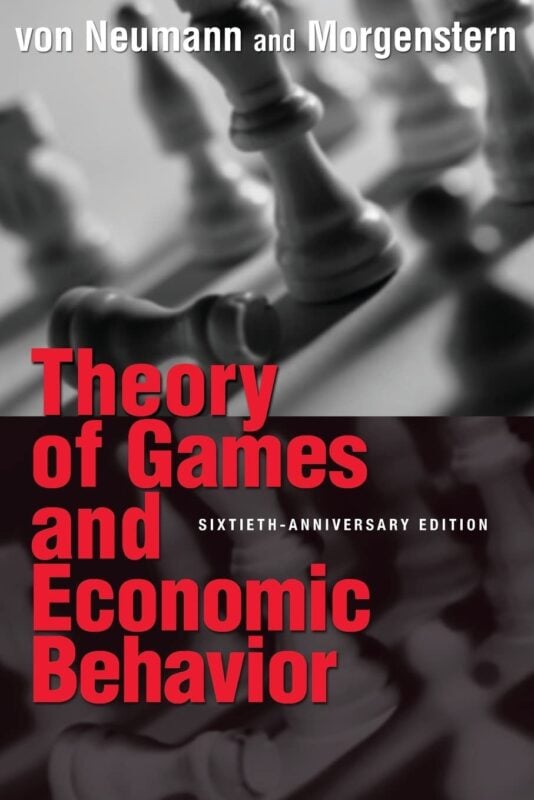
Theory of Games and Economic Behavior by John von Neumann and Oskar Morgenstern introduced a rigorous mathematical structure for analyzing conflict and cooperation between rational agents. The book develops a new language for strategic behavior, offering a decisive framework for understanding choices under conditions of interdependence. Through formal models of games, the authors open a pathway to precise analysis in economics, political science, sociology, and beyond.
Strategic reasoning as the basis of interaction
The book defines strategic behavior through mathematical games in which participants choose among alternatives based on the anticipated choices of others. The foundation lies in a detailed treatment of zero-sum two-person games, where one player’s gain equates to another’s loss. Von Neumann proves that such games have optimal solutions in mixed strategies—probabilistic combinations of pure strategies—that guarantee each player a minimum expected payoff. This minimax theorem forms the cornerstone of strategic rationality.
Game structure depends on clearly defined elements: players, strategies, payoffs, and information. Each game represents a decision problem where outcomes hinge on mutual interaction. Choices are not made in isolation. Each move anticipates countermoves, and each strategy reflects beliefs about how others will act. Rational behavior under such interdependence demands tools beyond classical utility maximization. Game theory supplies those tools.
The economic meaning of rational behavior
Von Neumann and Morgenstern seek to align economic theory with the logic of strategic games. They argue that individual behavior in markets, negotiations, or competitive enterprises mirrors the structure of games. The traditional assumption of isolated decision-making ignores the strategic constraints imposed by other agents. Rational economic action becomes intelligible only within an intersubjective context where each agent’s outcome depends on the actions of others.
The book constructs an axiomatic theory of utility that supports decisions under risk. Utility functions must represent consistent preferences over lotteries—choices involving probabilistic outcomes. The axioms provide a foundation for assigning numerical values to utilities, enabling precise calculation of expected utility. This treatment enables the integration of probability into economic decision-making without ad hoc assumptions.
From two to many: the logic of coalitions
While two-player zero-sum games form the theoretical core, the book extends the framework to games involving more players. As the number of participants grows, new phenomena emerge. Coalitions become possible. Players may form alliances to improve their collective outcomes. The concept of the characteristic function captures the value that any coalition can guarantee itself, regardless of what outsiders do. This abstraction supports analysis of complex strategic environments.
In multi-player settings, solutions involve allocations of payoffs that reflect both cooperative potential and strategic stability. An allocation must be immune to improvements through defection by any coalition. The authors introduce the notion of imputations—distributions of payoffs that satisfy certain fairness and stability conditions. Solutions are sets of imputations meeting these criteria, reflecting what rational agents can reasonably expect.
The structure and dynamics of strategic solutions
The book defines solutions not as unique points but as sets of possible outcomes consistent with rational behavior. In zero-sum two-player games, the solution corresponds to the saddle point of a payoff matrix—a strategy pair where neither player can improve unilaterally. For n-player games, solutions arise from geometric and set-theoretic constructions that map the structure of coalition values to payoff distributions.
These structures obey principles of convexity, symmetry, and fairness. Convexity ensures that mixtures of solutions are themselves viable. Symmetry implies equal treatment of identically placed players. Fairness requires that no coalition receives less than its guaranteed value. Through these principles, the book constructs a framework for analyzing distributive outcomes in strategic environments.
Simple games and collective decision-making
The authors apply their theory to simple games—models of collective decision-making based on voting and coalition power. A simple game assigns outcomes based on whether a coalition is “winning.” These structures abstract the essence of political and institutional choice. Majority rule, unanimity, and weighted voting schemes all fit within this framework.
By analyzing minimal winning coalitions and their properties, the book explores the conditions under which stable and fair outcomes can emerge. Some games exhibit decomposability, where the analysis can proceed by studying constituent parts. Others resist such simplification, requiring holistic methods. These models provide insights into how institutional design affects strategic incentives.
Bluffing, uncertainty, and the role of information
In games involving chance or hidden information, strategies adapt to new constraints. The book analyzes poker as a case study in bluffing and probabilistic deception. Players must form beliefs about opponents’ hidden cards and act under conditions of uncertainty. The mathematics of such games involves Bayesian reasoning and stochastic decision trees.
Strategies in games with imperfect information depend not only on current moves but on the history of play and the beliefs it generates. Rational behavior includes the possibility of misinformation, signaling, and inference. These dynamics expand the concept of strategy from fixed rules to contingent plans that evolve with the game.
Economic applications and market analysis
Von Neumann and Morgenstern apply their theory to markets, bargaining, and competition. They model a two-person market as a game with divisible goods and strategic price offers. The resulting analysis yields insights into the structure of exchange, surplus division, and the emergence of prices. The theory generalizes to multi-person markets, illuminating the role of marginal pairs and price vectors.
Their approach contrasts with earlier equilibrium theories that assume impersonal mechanisms and frictionless adjustment. Instead, strategic behavior drives market outcomes. Agents negotiate, signal, and adapt to others’ strategies. The market becomes a game—a structured conflict over surplus distribution.
Foundations and philosophical implications
The book challenges foundational assumptions in economics. It replaces isolated maximization with interdependent choice. It requires consistency in preferences under uncertainty. It demands precision in the definition of rationality. By grounding economic theory in formal logic and set theory, it reorients the discipline toward analytical rigor.
Utility, once a vague notion of satisfaction, becomes a mathematically defined function subject to axiomatic constraints. Probability, often treated as external data, becomes endogenous to the agent’s reasoning. Strategy, previously absent from economic theory, becomes central.
A framework for future research
Theory of Games and Economic Behavior does not offer a finished theory but a platform for further inquiry. It provides methods for analyzing any situation where outcomes depend on mutual choices. It applies to diplomacy, auctions, market design, regulation, and war. It invites extension into evolutionary models, behavioral refinements, and algorithmic implementation.
The book’s influence spans decades. It shaped decision theory, political science, operations research, and artificial intelligence. Its concepts underlie contemporary models of bargaining, competition, and collective choice. Every field that studies purposeful agents in structured interaction draws on its core principles.
Strategic insight and structural clarity
Von Neumann and Morgenstern deliver more than a technical manual. They offer a conceptual revolution in how humans understand conflict and cooperation. The clarity of their models reveals the deep structure of social behavior. Strategy is not an art; it is a system of logical relations. Rational choice is not an abstraction; it is a consequence of structural constraints. Their work remains a singular achievement in the formalization of strategic thought.