Vedanta in Light of Christian Wisdom
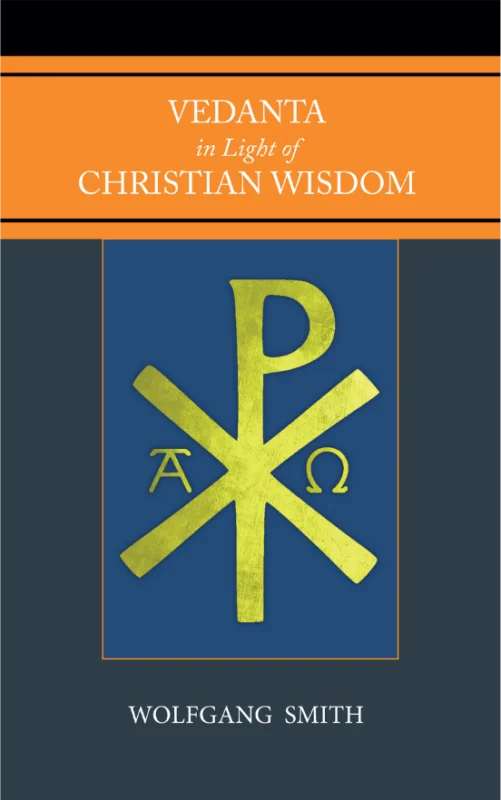
Vedanta in Light of Christian Wisdom by Wolfgang Smith redefines interreligious dialogue through a decisive metaphysical confrontation. Smith brings years of dual spiritual experience—immersed first in Indian Vedantic monasticism and later grounded in Catholic orthodoxy—into a rigorous comparative synthesis. His thesis centers not on accommodation but on discerning the nature of ultimate reality as perceived through both traditions.
The Eschatological Divide
Eschatology forms the structural hinge of Smith’s analysis. He identifies two radically divergent aims: in Christianity, salvation through personal union with God mediated by Christ; in Vedanta, liberation through the extinction of ego and absorption into Brahman. The former affirms a final human participation in the divine life, the latter a transcendence of all individuation. Smith frames this not as an epistemological difference but as a metaphysical divergence grounded in revelation.
In the Christian vision, Christ’s Incarnation changes the ontological possibility for human beings. The Logos assumes human nature and, through death and resurrection, opens the path to eternal life not as dissolution but as glorification. This eschaton defines the Christian understanding of time, personhood, and communion. Salvation becomes a participation in the life of the Trinity.
Vedanta presents moksha as release from samsara, the cycle of birth and death driven by ignorance (avidya) and attachment. Realization of atman as Brahman annihilates the illusion of separateness. Through nirodha—the stilling of all mental modifications—identity dissolves, and the aspirant awakens to the unconditioned Self. For Smith, this path culminates in the nirvanic option: a final transcendence of the personal.
The Error of Reduction
Smith challenges the prevailing intellectual tendency to subsume Christianity within Vedanta’s metaphysical framework. He identifies this as a mode of reductionism that collapses the ontological difference between the Creator and the created. This error emerges when scholars interpret Christian mysticism—particularly that of figures like Meister Eckhart—as essentially Vedantic in form, erasing the structural role of the Trinity and the Incarnation.
Rather than interpret Christianity through Vedantic categories, Smith proposes a metaphysical realignment that begins within the Christian tradition itself. The teachings of the Church, especially when read through its esoteric current, articulate a vision that neither opposes nor mirrors Vedanta but transcends its categories.
Christian Yoga and the Mystical Body
Smith locates the meeting point in the Christian concept of gnosis, clarified through the teachings of Meister Eckhart. Eckhart describes a purification of the soul that closely parallels the yogic process of nirodha. However, the subject who undergoes this purification remains rooted in Christ. The Christian yogi strips away false identity, not to vanish into impersonal being, but to become one with the Logos in love.
The key lies in the identity of the subject. For Vedanta, the human self has no ontological permanence. Realization entails the extinction of individuality. For Christianity, the self becomes capable of communion through the mediation of Christ. The Incarnate Logos, consubstantial with the Father, becomes the axis of union. The Christian does not disappear into God but enters into filial intimacy.
Smith’s reading of Eckhart reveals a metaphysical framework in which the cosmos does not arise as a separate creation but as a Word spoken once and eternally. Eckhart affirms that creation and divine emanation are not two separate events but one act of the eternal Logos. This view aligns with the insights of St. Augustine and St. Gregory of Nyssa, who describe a world that subsists only in relation to God and has no independent being.
Meister Eckhart’s Triune Framework
Eckhart distinguishes between form and image. A form separates from its exemplar; an image remains one with its source. The soul, in its deepest core, reflects God as image, not form. This insight allows Smith to interpret the Christian path as one of union without absorption. The soul, purified of all attachments and illusions, becomes capable of beholding God face to face.
The modicum—the “little something” that obstructs vision—functions like a mental modification in yoga. It is the last veil, the final remnant of false identity. When it vanishes, the soul sees. Yet the seer remains. This is the crux of Christian gnosis: a pure subjectivity that does not collapse but opens into beatitude.
Eckhart’s metaphysics reinforces Trinitarian theology. The Logos is not simply the medium of creation but the principle of intelligibility and communion. Christ mediates not only salvation but also metaphysical coherence. The difference between the world and God becomes intelligible in light of the eternal generation of the Son and the procession of the Spirit.
The Role of Discipleship and Cultural Formation
Smith insists that spiritual attainment cannot proceed apart from cultural embodiment. In India, the Vedic path shaped a civilization. The disciple absorbed not only teachings but a way of life configured to transcendence. Similarly, Christianity forms souls not merely through propositions but through sacramental life and ecclesial participation. Discipleship roots metaphysical ascent in community, authority, and liturgy.
Vedantic realization demands a total negation of ego, sustained by renunciation and contemplative discipline. Christianity directs this negation toward transformation. Asceticism becomes a means of participation, not erasure. The Christian death to self—echoed in Christ’s passion—culminates not in disappearance but resurrection.
Scriptural Grounding and Ontological Precision
Smith grounds his distinctions in scripture. He cites John 1:18—“No man has seen God at any time”—as evidence that divine vision requires mediation. Christ, the only-begotten Son, makes the Father known. This mediation does not obstruct the vision of God; it enables it. The Incarnation structures the entire economy of salvation. The beatific vision is not absorption into an essence but a union of love in the light of glory.
The Upanishadic “neti, neti” offers no such mediation. By negating all qualities, the seeker reaches a silence beyond description. The Real becomes the background against which phenomena lose meaning. Christianity defines God as personal, relational, self-revealing. The Word becomes flesh and dwells among us. This presence reconfigures the path and goal of spiritual life.
Sacrifice and Ontological Gift
Smith highlights the symmetry and divergence in sacrificial structures. In the Vedic tradition, the sadhu offers himself as the victim. The fire of renunciation consumes his personhood. In Christianity, Christ offers Himself. The sacrifice does not consume the aspirant but redeems and glorifies. This reversal transforms the meaning of eschatology. The human self becomes the recipient of divine life, not its negation.
The Christian Eucharist embodies this reversal. The Logos gives His body and blood as food. Participation in this sacrifice sustains the life of grace. It extends the Incarnation into the Church, the Mystical Body. The Christian path thus involves incorporation, communion, and transformation.
Theological Implications and the Future of Dialogue
Smith urges theologians to revisit the metaphysical foundations of their tradition. Reductionism cannot account for the uniqueness of Christian revelation. The claim that all religions converge in mystical experience overlooks the content of that experience. Salvation in Christ involves historical, sacramental, and personal dimensions irreducible to impersonal realization.
The encounter between Christianity and Vedanta demands more than tolerance. It requires clarity about the nature of truth, personhood, and destiny. Smith calls for an intellectual asceticism equal to the task. Only by entering deeply into one’s own tradition can one engage another without distortion.
A New Synthesis of Metaphysics and Faith
Vedanta in Light of Christian Wisdom opens a path for metaphysical renewal within the Church. Smith’s reading of Eckhart recovers a lineage of Christian gnosis capable of engaging the deepest insights of the Vedic sages. This recovery does not compromise doctrine. It fulfills it.
Smith’s contribution lies in his ability to integrate rigorous philosophical inquiry with deep spiritual intuition. His vision does not dilute either tradition. It sharpens the edges of both. The Christian path emerges with renewed intelligibility and spiritual power.
The convergence he identifies occurs not through abstraction but through the Logos. The Incarnation becomes the key to metaphysical synthesis. Christ reveals not only the Father but the structure of reality itself. In that revelation, the soul finds its way—not to extinction, but to life eternal.