What Technology Wants
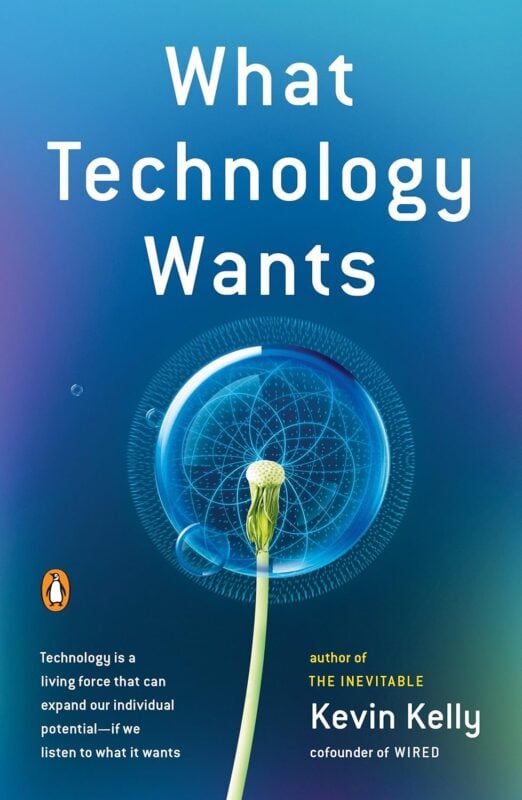
What Technology Wants by Kevin Kelly argues that technology evolves with its own direction, tendencies, and imperatives. It follows a trajectory shaped by internal logics that transcend human intention, forming a vast, interconnected system Kelly calls the technium. This system includes tools, networks, institutions, art, and symbolic systems that exhibit behaviors comparable to biological life. It expands, adapts, learns, and propagates new possibilities. Kelly studies technology as a self-organizing phenomenon, mapping its origins, accelerants, and implications for human identity and decision-making.
The technium as living system
Kelly defines the technium as the sum of all technologies and their interactions with culture, minds, and matter. This system behaves like a living organism. It processes information, responds to stimuli, and evolves patterns of increased complexity and interdependence. The technium accumulates feedback loops and recursive structures that generate novelty and propagate emergent outcomes. These dynamics mirror biological evolution and self-organization.
The technium builds upon itself through recombination, iteration, and convergent development. Each invention creates the precondition for multiple subsequent inventions. The printing press sets the stage for literacy networks, universities, and copyright law. The computer enables the internet, which births social media, decentralized finance, and artificial intelligence. These outcomes compound into new niches of invention, accelerating further complexity.
Language and innovation
Humanity’s evolutionary leap began with the invention of language. Kelly traces this development to approximately 50,000 years ago, when anatomically modern humans began innovating in ways that previous hominins did not. Language allows for abstraction, foresight, and cross-generational transmission of knowledge. It catalyzes tool refinement, cultural memory, and social coordination.
Language does more than communicate; it generates thought. It allows humans to model hypothetical futures, revise past errors, and map conceptual structures. This recursive capacity drives cumulative culture. Innovation accelerates through shared mental frameworks and symbolic feedback. As ideas replicate across minds, the collective memory base expands.
Hunting, storytelling, and spiritual ritual all evolve through linguistic scaffolding. Specialized tools multiply. Shelters become engineered environments. Societies encode knowledge in myth, law, and song. Culture layers upon culture, forming civilizational complexity.
The structure of self-propagation
Technology evolves through self-propagating systems. Innovations birth adjacent possibilities. The invention of fire leads to cooking, which shrinks gut size and enlarges brain capacity. Brains support language, which births narrative and mathematics. Mathematics builds astronomy and calendars, which lead to agriculture. Agriculture constructs cities, economies, and bureaucracy.
Each layer of technological scaffolding enables the next. This structure creates exponential acceleration. Kelly identifies deep progress as directional—not deterministic, but patterned. Technologies emerge where possibilities converge, and convergence often occurs independently across locations. The camera, electricity, the jet engine—all appeared simultaneously in multiple regions because preconditions aligned.
Systems under pressure evolve. As humans increase in number and density, the technium responds by optimizing energy use, communication speed, and organizational reach. Cities become information engines. The internet becomes a planetary-scale nervous system. These developments express the technium’s bias toward ubiquity, diversity, complexity, and specialization.
Biological analogues
Technology mimics life not metaphorically but structurally. Self-repairing systems, like electrical grids, operate on the same principles as immune responses. Self-replicating code follows genetic algorithms. Neural networks learn the way brains learn—by weighting feedback and optimizing for error minimization. Synthetic biology merges informational and mechanical evolution.
Kelly identifies DNA computing as a bridge: when strands of DNA solve logic problems, and when machines evolve themselves through recursive programming, the line between organism and mechanism blurs. Life processes information; so does technology. Life builds form from instruction; so does software. The technium inherits this lineage.
Desire and direction
The technium, as it grows, acquires tendencies that Kelly describes as wants. It leans toward certain forms, patterns, and structures. These wants are not conscious choices but emergent behaviors driven by the structure of the system. Just as gravity shapes rivers and evolution shapes wings, the technium shapes tool trajectories.
Technology wants to connect. It wants to diversify. It wants to increase possibilities. Kelly observes that in every field—media, medicine, mobility—new technologies open optionality. More choices, more hybrid forms, more combinations. This expansion expresses an internal drive toward potentiality.
The technium also amplifies sentience. It fosters feedback, reflection, and agency. Social networks create collective cognition. Artificial intelligence simulates decision-making. Tools enable creators to build tools. The system recursively expands human capacity. This feedback loop strengthens the technium’s internal coherence and accelerates its trajectory.
Cultural embodiment
Culture embeds within the technium. Art, religion, law, and science form part of its infrastructure. A symphony, a constitution, and a programming language function as technologies of meaning. They encode values, coordinate action, and transmit purpose.
Kelly includes these symbolic systems within the technium because they evolve, replicate, and shape human interaction. Culture does not merely sit atop technology—it co-evolves with it. The rise of agriculture changes social structure. Writing alters memory and hierarchy. Broadcast media reorganizes political power. Each cultural layer embeds technological affordances and drives new inventions.
Selective adoption
Within the technium’s growth, humans exercise agency through selective adoption. The Amish, for example, use technology without becoming consumed by it. They assess each tool through community impact. Does it strengthen family bonds? Does it support local resilience? If so, it enters their system. If not, they reject it.
This model reveals that humans can guide technology without halting its momentum. We shape the technium through values, governance, and cultural norms. Intentional design aligns its tendencies with human flourishing. Technological paths diverge based on decision-making at junctions of adoption, incentive, and regulation.
Inevitability and choice
Kelly addresses the tension between technological determinism and human freedom. He proposes that while broad trajectories remain consistent, specific implementations reflect choice. Electricity spreads wherever infrastructure allows—but how societies generate, distribute, and regulate it varies. The internet emerges as a convergent necessity—but how it is governed, censored, or monetized differs.
Technology’s form responds to constraint. Human laws, market incentives, and ecological pressures channel its growth. Constraints sculpt the flow. Within these channels, tools still tend toward greater complexity, network density, and modularity.
Partnership with technology
The technium demands a posture of engagement. Humans partner with technology to extend agency, increase compassion, and deepen understanding. This relationship requires discernment. Tools can empower or diminish. Design must prioritize alignment with long-term human values.
Kelly envisions a future where technology becomes co-evolutionary. As we build systems that adapt, learn, and self-organize, we must also build frameworks for ethics, transparency, and resilience. The technium grows more autonomous, and its trajectory increasingly influences social structures, identities, and ecological outcomes.
Humans must negotiate this partnership through governance, narrative, and imagination. By listening to what technology wants—its underlying structure, its directionality, its internal logic—we gain insight into where it will go and how to shape its path.
Continuity of creation
Kelly concludes with the recognition that the technium expresses life’s impulse toward greater freedom, possibility, and self-knowledge. It extends evolution beyond biology into symbolic and mechanical realms. Its structure mirrors the arc of creation.
To live within the technium is to participate in an expanding domain of choices. As options multiply, humans face the task of discernment: choosing tools, shaping systems, designing futures. The technium does not prescribe outcomes, but it structures possibilities. Understanding its wants clarifies our own.

