The Incubation of Nazism: A Tale of the Extreme Measures Undertaken by Britain to Safeguard Imperial Primacy, 1900-1944
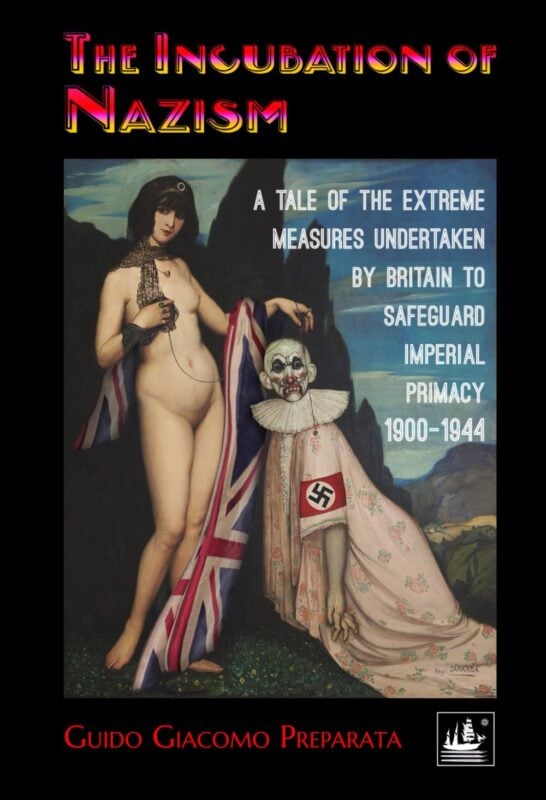
The Incubation of Nazism by Guido Giacomo Preparata reconstructs the strategic rationale behind British efforts to encircle, manipulate, and ultimately dismantle German geopolitical potential from 1900 to 1944. This analytical history asserts that Britain, guided by an unyielding imperative to forestall any Eurasian unification that might rival its sea-based empire, devised a long-term siege through military, financial, and ideological means. Preparata’s thesis links the rise of Nazism not to internal German failures alone, but to calculated Anglo-American engineering designed to provoke, direct, and then destroy Germany’s imperial resurgence.
The Anglo-Saxon Geopolitical Doctrine
Halford Mackinder's Heartland Theory underpinned British foreign policy throughout the twentieth century. Mackinder identified Central Eurasia—stretching from France to Manchuria—as the pivot of global power. British strategists resolved to prevent any unification of German and Russian power across this zone. The threat lay in the possibility of a technologically sophisticated land power eclipsing maritime empires by achieving internal resource sufficiency, continental scale, and military dominance.
Britain orchestrated a continental balance of power to avert this risk. It promoted alliances, financial entanglements, and colonial bargains with France and Russia while diplomatically isolating Germany. The Entente Cordiale of 1904 and the Anglo-Russian Convention of 1907 sealed a strategic encirclement. Britain viewed a Russo-German fusion as the primary danger to its imperial integrity and economic supremacy. To suppress that threat, British planners began preparing for a generational confrontation.
World War I as Strategic Siege
Preparata characterizes World War I as the first phase in a three-act siege. Germany’s ascent had disrupted Britain’s control over industrial markets and maritime dominance. The Reich had surpassed Britain in steel production and scientific-industrial output. Yet Germany lacked colonies, global naval reach, and diplomatic finesse. The war emerged from a deliberate escalation of Balkan hostilities, culminating in the assassination of Archduke Ferdinand and Austria’s ultimatum to Serbia.
Germany mobilized according to the Schlieffen Plan, anticipating rapid victory in the West. British policymakers had foreseen this maneuver and positioned themselves as defenders of Belgian neutrality, though their war planning predated the ultimatum. British strategy depended on a two-front war to bleed Germany. France absorbed the western blow. Russia mobilized in the East. Britain imposed a crippling naval blockade. Still, Germany held out. The war dragged on.
Revolution and the Bolshevik Gambit
By 1916, Russia faced military collapse. Britain’s effort to keep the eastern front active led to direct intervention in Russian internal affairs. In March 1917, the Romanovs fell. Britain supported the establishment of a constitutional regime under Kerensky, but when that failed to stabilize the front, London pivoted. Through diplomatic conduits and financial intermediaries, Britain facilitated the transfer of Lenin from Zurich to Petrograd, via an arrangement coordinated with Germany and funded through Wall Street-linked channels.
Lenin pledged to withdraw from the war. The Bolsheviks seized power in November 1917. Trotsky signed the Treaty of Brest-Litovsk, ending Russia’s participation. This apparent disaster allowed Britain to intensify another aspect of its long-range strategy: the economic and ideological remaking of Germany. The stage was set for a different kind of warfare—one of internal rupture and re-engineering.
Versailles and the Geopolitical Setup
The Treaty of Versailles inflicted nominal penalties while concealing a deeper logic. Preparata highlights the analysis of Thorstein Veblen, who identified in the treaty’s structure a calculated provocation. Rather than disarming Germany definitively, the treaty planted seeds for a nationalist revival. Reparations, territorial losses, and military restrictions were designed not to contain, but to enrage and polarize. Britain and its allies sought a controlled destabilization that would pave the way for a more militarized, fanatical Germany.
Germany did not disintegrate. Instead, it transitioned into the Weimar Republic, a nominal democracy operating under external control. Financial institutions, particularly the Reichsbank, came under the influence of foreign capital. Montagu Norman, Governor of the Bank of England, orchestrated monetary strategies that triggered Weimar’s hyperinflation of 1923. The currency collapse eviscerated the middle class and emboldened radical movements. This economic trauma prepared the social body for authoritarian experimentation.
Hitler's Rise and the Silent Quinquennium
In the midst of economic disarray, Adolf Hitler emerged. His Beerhall Putsch failed in 1923, but in prison he authored Mein Kampf. He proposed a geopolitical fantasy: a German empire of racial dominion in Ukraine, established in partnership with Britain. Hitler expressed admiration for the British Empire, not as an opponent but as a model. This vision aligned with British hopes of deflecting German aggression eastward.
From 1924 to 1929, Weimar stabilized under the Dawes Plan. With American capital and British supervision, Germany rebuilt its economy. This was the golden quinquennium. The Nazis faded from view. Then came the Wall Street Crash. The ensuing global depression destabilized Weimar again. Montagu Norman engineered Britain’s exit from the gold standard in 1931, collapsing the German economy for a second time. In the resulting chaos, the Nazis surged, becoming the second largest party in 1930. Hitler demanded power.
Entrenchment and Armament
In 1933, Hindenburg appointed Hitler Chancellor. The Nazis launched the Reichstag Fire, blamed communists, and consolidated power through emergency decrees. Political opponents vanished. Hjalmar Schacht, a banker tied closely to British financial circles, led an economic revival through public works and rearmament. Germany returned to full employment. Industrial output soared.
Britain extended commercial goodwill. Under the guise of appeasement, it expanded trade and provided diplomatic tolerance. These gestures reinforced Hitler’s perception that Britain shared his anti-communist crusade. Appeasement functioned as a signal. Hitler prepared for war against the USSR, interpreting British reticence as tacit support. Preparata argues that this perception was no illusion. It was part of the script.
The Soviet Purge and the Strategic Vacuum
Stalin eliminated internal dissent. In 1937, he executed Marshal Tukhachevsky and purged 35,000 officers. Tukhachevsky had urged preemptive war against Germany. His removal ensured the Red Army would be unprepared for the coming invasion. Stalin's motivations remain opaque, but Preparata sees coordination. Both Britain and the USSR maneuvered to direct German aggression toward the East.
The Molotov-Ribbentrop Pact of 1939 formalized non-aggression between Germany and the Soviet Union. Behind the scenes, Stalin prepared to absorb the blow. Hitler launched Operation Barbarossa in June 1941. Millions of Germans poured into Russia. The British delayed opening a second front. The United States, after entering the war in December 1941, focused on the Pacific. Germany faced the Soviet juggernaut alone.
The Delayed Second Front
For three years, Britain and America withheld full engagement in Europe. Preparata identifies this delay as a calculated maneuver. Germany’s entrapment in Russia served Allied objectives. The tide turned at Stalingrad. Only then did the Allies prepare Operation Overlord. Normandy landings began in June 1944. Hitler’s defeat became inevitable. The Western front closed on a spent army. The timing aligned with the exhaustion of Germany and the territorial positioning of Soviet forces.
Rudolf Hess’s mysterious flight to Scotland in 1941, often dismissed as erratic, appears as a potential attempt to finalize a secret deal. His disappearance removed a key witness. The war’s end, far from a spontaneous Allied triumph, marked the fulfillment of long-laid designs.
The Postwar World and Anglo-American Order
The destruction of Germany cleared the path for Anglo-American hegemony. Britain, though weakened, handed the torch to the United States. Together, they forged a new architecture of global control—military alliances, financial institutions, intelligence networks. The Cold War stabilized the Eurasian frontier, locking Russia behind an iron curtain. NATO ringed the continent. American bases replaced imperial garrisons.
Preparata sees continuity. The logic of encirclement, subversion, and ideological warfare persisted. Regimes were destabilized. Regional powers faced division. Financial leverage replaced gunboat diplomacy. The world became an Anglo-American protectorate managed through orchestrated conflict, mediated propaganda, and structural dependence. From Korea to Ukraine, the same pattern endures: identify a faction, arm it, provoke war, and extract geopolitical advantage.
What drives this pattern? Preparata answers with a thesis of imperial reflex. The sea powers, driven by their geographic constraints, must prevent land powers from consolidating. This imperative animates their policy. It animates their wars. It animates the birth of Nazism and its sacrificial destruction.
The Incubation of Nazism delivers a historical narrative in which cause, intent, and outcome align. Britain’s geopolitical doctrine shaped the modern world through deliberate, coordinated, and devastating means. The rise of Hitler was not a tragic accident. It was a consequence of strategic design.