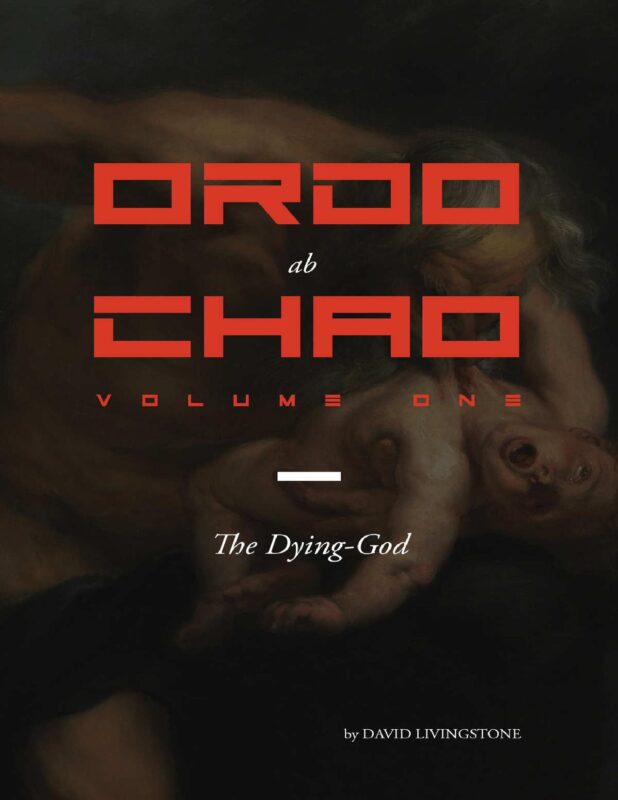
Ordo ab Chao: Volume Five: The New Age
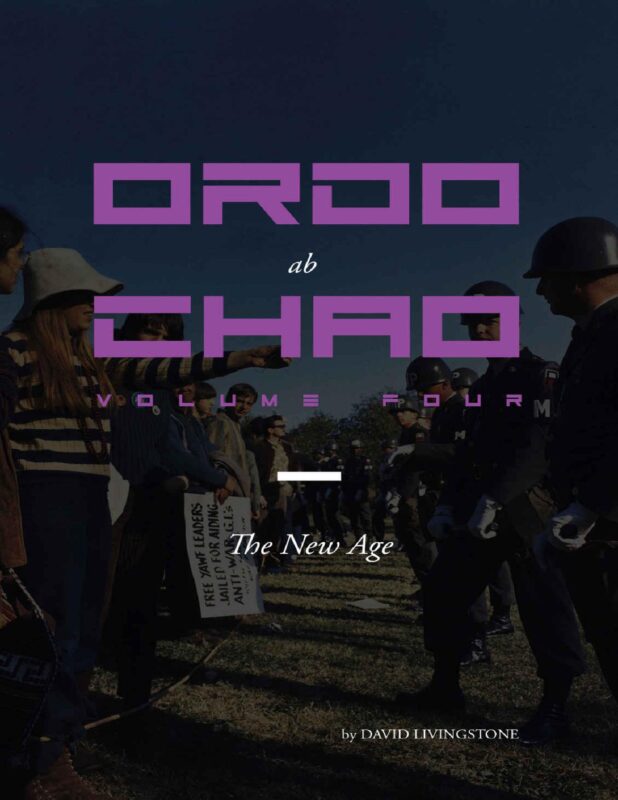
Ordo ab Chao: Volume Five – The New Age by David Livingstone exposes the entangled network of ideological manipulation, covert warfare, and elite power engineering that shaped the modern world through strategic deception and psychological control.
Neoconservatism and Intelligence Engineering
Neoconservatism emerges in Livingstone’s analysis as the intellectual offspring of Cold War liberalism repurposed for militant intervention. Irving Kristol, Midge Decter, and Norman Podhoretz form a cadre of political operatives who institutionalized this movement through the American Enterprise Institute and Heritage Foundation. Their sponsorship by foundations like Sarah Scaife and Bradley reveals a funding architecture tied to the Mellon empire and intelligence-linked philanthropic networks.
This movement engineered a parallel policy architecture. Organizations such as the Philadelphia Society and the Committee on the Present Danger incubated propaganda strategies that influenced presidential policy through a revolving door of think tanks and covert advisory networks. Figures like Michael Ledeen and Richard Pipes advanced a doctrine of manufactured threat perception, shaping U.S. foreign policy through controlled narratives about Soviet aggression.
Strategy of Tension and Manufactured Terror
Livingstone outlines how NATO’s secret armies and fascist operatives carried out a “Strategy of Tension” across Europe to simulate a communist threat. Michael Ledeen, trained under George Mosse and Renzo De Felice, operated within the Italian deep state alongside Propaganda Due. His doctrine of necessary evil, borrowed from Machiavelli, formed the philosophical basis for psychological operations that legitimated state repression and paramilitary intervention.
The black terror operations used false-flag attacks to provoke fear, aligning public perception with policy objectives. Ledeen’s fabrication of the Soviet terror network and KGB plots integrated seamlessly into Reagan’s ideological apparatus, justifying a renewed arms race and counterintelligence expansion.
Deep State Structures: The Secret Team
The legacy of General Earle Cocke and Ted Shackley defines a financial and operational backbone for covert global operations. The Nugan Hand Bank, functioning as a CIA front, laundered opium proceeds while simultaneously funding regime change efforts. Edwin Wilson’s Libyan connections illustrate the dual function of private intelligence networks—gathering actionable intelligence and enabling elimination programs.
Task Force 157 and its connections to the Iran-Contra affair expose a structure wherein official policy and clandestine warfare converge. This alignment facilitates plausible deniability while executing strategic objectives through front corporations and covert arms deals.
Religious Infrastructure and Elite Manipulation
Livingstone details how Sabbatean and occult lineages infiltrated religious, philosophical, and esoteric movements. The infiltration of the Jewish Theological Seminary and the propagation of New Age thought through institutions like the Club of Rome and Aspen Institute demonstrates an engineered shift in mass consciousness. Idries Shah’s Sufi networks, aligned with NATO intellectuals like Alexander King, deployed psychological conditioning under the guise of spiritual development.
These institutions redefined religious narratives to harmonize with geopolitical control. Shah’s SUFI and the Institute for Cultural Research exported a sanitized, state-compatible mysticism. In parallel, George Gurdjieff and other mystic figures become vehicles for elite-sponsored consciousness engineering.
The October Surprise and Psychological Warfare
The manipulation of the 1980 U.S. presidential election through clandestine negotiations with Iran reshaped the axis of American power. William Casey’s engagement with Iranian officials, detailed through insider accounts, reveals a transactional relationship—arms in exchange for delayed hostage release. The result: Reagan’s electoral victory, opening the pathway for ideological hardliners to dominate national security policy.
This incident wasn’t an aberration. It was the manifestation of a broader strategy: using psychological triggers, national trauma, and controlled disclosures to remold civic belief. Livingstone situates the Iran Hostage Crisis within a continuum of choreographed destabilizations, tethered to elite power centers and mediated through manipulated media narratives.
Think Tanks as Policy Weapons
CSIS, RAND Corporation, and other policy factories serve as nodes in an intelligence-policy-information triad. These institutions harnessed game theory, systems analysis, and disinformation to drive military expenditure and enforce ideological conformity. RAND’s Albert Wohlstetter, mentor to Paul Wolfowitz and Richard Perle, institutionalized predictive models that exaggerated Soviet capabilities, creating policy inertia toward perpetual military buildup.
At CSIS, Ledeen and Ray Cline co-authored intelligence that shaped the Reagan administration’s Latin American interventions. These think tanks produced both strategic frameworks and mass-consumable propaganda, forming a policy armature responsive to elite imperatives rather than democratic scrutiny.
Esotericism and Occult Geopolitics
Livingstone tracks the spiritual and esoteric undercurrents flowing through elite planning. The influence of Martinist, Masonic, and Sabbatean doctrines on fascist and revolutionary ideology anchors the book’s metaphysical critique. Fascism appears not merely as a political stance, but as a spiritual rebellion, seeking transcendence through domination.
Figures like De Felice connect Jacobin revolutionary mysticism with fascist mobilization. Ledeen’s praise for Moses as a model of divine violence reinforces this tradition. These esoteric lineages reframe power not as governance but as initiation—ritualistic, symbolic, and sacrificial.
Cultural Warfare and the New Age Front
The New Age movement emerges in this narrative as a form of cultural warfare. Funded and shaped by elite networks, it redirects countercultural energy toward passivity, inward withdrawal, and depoliticization. The Club of Rome’s limits-to-growth ideology merged ecological concern with population control agendas. This fusion converts environmentalism into an instrument for technocratic management.
Livingstone presents the New Age as a synthetic belief system crafted for psychological disarmament. Its emphasis on universal harmony, channeled through media and therapeutic discourse, veils its function as a control mechanism. This paradigm strips resistance of ideological clarity by dissolving political struggle into spiritual abstraction.
The Political Utility of Disinformation
Disinformation becomes a structural strategy rather than a tactical anomaly. William Casey’s remark—“We’ll know our disinformation program is complete when everything the American public believes is false”—serves as a thesis. Livingstone documents how intelligence agencies institutionalized narrative control through media partnerships, academic alliances, and foundation sponsorships.
This ecosystem doesn't rely on falsity for its own sake. It engineers consent through controlled dissent, shaping the boundaries of public imagination. From the LaRouche movement’s convergence with neofascist currents to the cooptation of spiritual renewal, the structure remains: fabricate the enemy, flood the system with narrative noise, and install controlled opposition.
Historical Continuity of Elite Networks
The text connects present configurations with earlier networks—OSS, Round Table groups, Zionist financiers, and fascist internationalists. It doesn’t isolate contemporary actors; it situates them in an ongoing lineage. Figures like Leo Amery, Licio Gelli, and Richard Mellon Scaife represent nodal points in a transgenerational conspiracy defined by continuity of objective and adaptability of means.
Rather than claiming a single center of control, Livingstone maps overlapping interests, ideological coherence, and converging strategies. These aren’t isolated conspiracies; they constitute an evolving matrix of influence deploying finance, theology, warfare, and symbolism to reproduce power.
Narrative Integration and Structural Command
Ordo ab Chao: Volume Five – The New Age accomplishes a synthetic vision of modern control. It weaves together intelligence operations, esoteric history, ideological warfare, and social engineering into a coherent schema. The narrative progression doesn’t resolve into closure. It reveals continuity—ideological momentum carried forward through institutions, individuals, and philosophies designed to converge around control.
Livingstone doesn’t offer a theory of everything. He documents a strategy: destabilize, reframe, recondition. In this frame, the New Age isn’t spiritual liberation—it’s the anesthetic of rebellion. Neoconservatism isn’t a policy debate—it’s the technocratic enforcement of imperial theology. Intelligence agencies don’t observe—they manufacture perception.
This is a map of power built through disintegration. In each fragmentation—left vs. right, secular vs. spiritual, truth vs. illusion—lies the opportunity to consolidate rule. What binds the parts is the architect’s principle: from chaos, order. From engineered breakdown, synthetic renewal. This is the deeper continuity that defines the age.