None Dare Call It Conspiracy
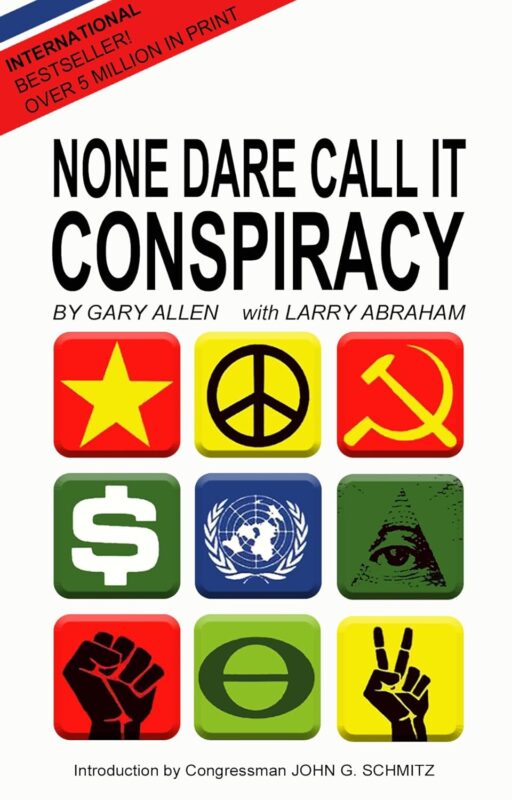
None Dare Call It Conspiracy by Gary Allen with Larry Abraham opens with a thesis: the world's political and economic events follow not random coincidence or the spontaneous desires of the masses, but the deliberate orchestration of a tightly connected elite. Gary Allen, a journalist and former history student, argues that the public understanding of socialism, communism, and capitalism has been manipulated to serve the interests of what he calls "Insiders"—an oligarchy that controls both the political left and right, banking institutions, and multinational corporations.
The Manufactured Crisis of Governance
The book begins by asserting that major social and political transformations are not accidental. Allen cites Franklin D. Roosevelt’s statement that in politics, "nothing happens by accident" as foundational. He critiques the mass media for painting a distorted image of world affairs, a smokescreen that conceals the true mechanics of power. Each political administration, regardless of party, perpetuates the same policies that increase central government control and diminish individual liberties. This continuity, Allen contends, is no coincidence but part of a long-term strategy by Insiders to consolidate global power through socialism.
The Role of Socialism in Elite Strategy
Socialism, according to Allen, serves not the poor or working class, but the wealthiest individuals and institutions who use it to centralize power and control. The state ownership of property, regulation of enterprise, and social welfare programs do not threaten the rich; they enhance their power by eliminating competitors and controlling the masses. These super-rich elites, by supporting socialist legislation, ensure their position atop an unchallengeable hierarchical structure.
International Bankers and Financial Power
One of the core mechanisms of control outlined in the book is international banking. Allen argues that powerful banking families—through institutions like the Federal Reserve and the World Bank—control the issuance of money and credit, and thereby control governments. Debt becomes a tool of domination. When governments borrow beyond their means, they become beholden to their creditors. Allen describes how this creates a cycle where political leaders can be pressured or replaced, if necessary, by those who control financial flows.
The Bolshevik Revolution and Financial Backing
Allen controversially claims that the Bolshevik Revolution was funded not by grassroots revolutionary zeal but by Western bankers. He presents this as evidence that communism is not a genuine proletarian movement, but a weapon wielded by elites. These financial backers saw in communism a tool for dismantling traditional structures and imposing new regimes that would be more easily manipulated from afar.
The Rise of the Establishment
The term “Establishment” refers to a network of elites embedded in media, education, government, and finance. These actors, Allen claims, are coordinated through organizations like the Council on Foreign Relations (CFR). He dedicates much of his analysis to how this establishment functions to obscure real power relations, promote wars, and foster a climate of managed dissent that never threatens their control.
The Rockefeller Nexus
Allen identifies the Rockefeller family as emblematic of this convergence of wealth and ideological manipulation. Through foundations and think tanks, the Rockefellers have exerted influence over educational content, foreign policy, and scientific research. The family’s activities are presented not as philanthropic, but as strategic investments in social engineering and global control.
Controlled Opposition and Pressure Politics
The concept of “pressure from above and below” is central to Allen’s framework. Elites simultaneously support radical street movements and authoritarian legislation to create crises that only centralized authority can resolve. This dialectical approach ensures that regardless of the outcome, the power of the state—and thus of the Insiders—increases.
The Individual’s Role
Allen calls for an “end run” around the media and political apparatus. He urges readers to distribute the book, educate others, and organize locally. The precinct system, he explains, allows grassroots change if voters are mobilized and informed. He promotes this as the only viable counterstrategy to the entrenched elite.
Tactical Recommendations
None Dare Call It Conspiracy ends with a program of action. It includes identifying and supporting congressional candidates who oppose the CFR and the elite's agenda. The book encourages readers not to rely on traditional party structures but to become politically active in a decentralized, citizen-driven manner. It outlines steps to disseminate information, build community resistance, and ensure that representatives remain accountable.
Cultural and Political Stakes
The stakes, as described by Allen, are existential. He warns that failure to act will result in a totalitarian regime marked by surveillance, economic slavery, and loss of personal freedoms. His language is uncompromising, depicting a choice between action and submission to a global oligarchy. The reader is positioned not merely as a political agent, but as a moral actor in a high-stakes historical drama.
Appeal and Legacy
Since its publication, the book has polarized readers. Supporters view it as a prescient critique of globalist politics and media manipulation. Critics argue that it relies on speculative associations and unfounded conspiracies. Nevertheless, the book has remained influential in libertarian and anti-globalist circles, cited for its synthesis of economic critique and populist call to action.
None Dare Call It Conspiracy remains a significant text for understanding the roots and rhetoric of American conspiracy literature. Its thesis challenges the reader to reconsider the visible structures of power and to investigate the alliances that shape policy from behind the curtain. Allen asserts not only that conspiracy exists but that it operates with impunity, enabled by ignorance and passivity. The antidote, he argues, lies in knowledge, vigilance, and the courage to question even the most sacrosanct institutions.
Carroll Quigley on None Dare Call It Conspiracy:
“None Dare Call It a Conspiracy” had claimed that “Tragedy and Hope” had unearthed the existence of a “power-mad clique (that) wants to control and rule the world,” put in a generic fashion. Quigley’s assertion was that this was not precisely the case, and that this portrayal was an oversimplification of the actual nuance contained in his research and books. He also voiced serious concern that people were trying to link every single secret society throughout history to the “Anglo-American establishment” he had spent much of his life researching, even having personal access to its historical archives over a period of several years. He made very clear that the group he was exposing was not the “Bavarian Illuminati” and that those trying to make the connections between the Council on Foreign Relations and the 18th Century Illuminati were guilty of believing that “all secret societies are the same secret society,” continuing that “these people say they are all one.”