The Slaughter of Cities
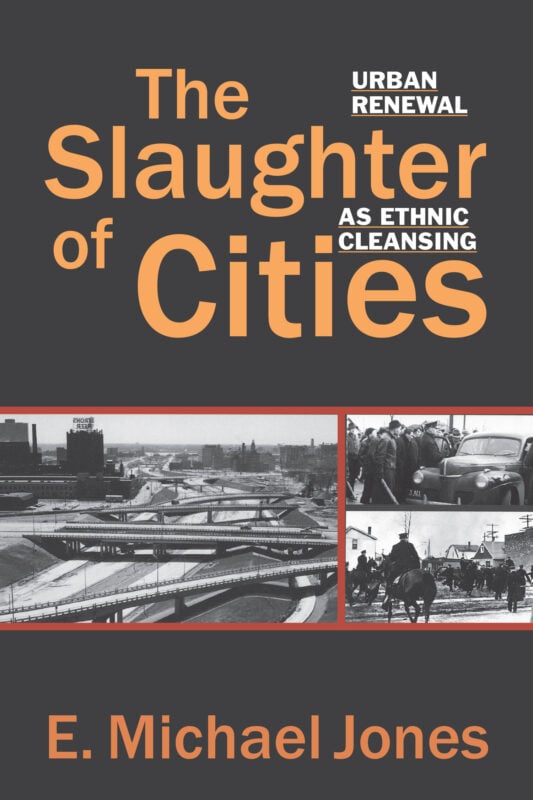
The Slaughter of Cities: Urban Renewal as Ethnic Cleansing by E. Michael Jones exposes a politically charged reconfiguration of American cities through a methodical displacement of Catholic ethnic communities during the mid-20th century. In this detailed historical and sociological analysis, Jones traces the orchestrated strategies by urban planners, federal agencies, and philanthropic foundations that dismantled tightly knit neighborhoods under the guise of modernization.
The Ethnic Composition of the Targeted Urban Core
Philadelphia, Detroit, Chicago, and Boston housed working-class Catholic communities—Poles, Italians, Irish—who built their neighborhoods around parishes, schools, and local industry. These communities formed strong social ecosystems centered on the Catholic Church, bound by language, religious rites, and communal life. Their neighborhoods did not sprawl. They concentrated, stabilized by homeownership, multi-generational families, and ethnic-specific institutions. This cohesion created demographic resilience, cultural distinctiveness, and political solidarity. These enclaves were legible in census data, voting blocs, church attendance, and urban geography.
Urban Renewal as Administrative Ethnic Engineering
Federal housing policies through the 1949 Housing Act enabled city governments and redevelopment authorities to classify vast tracts as "blighted," triggering eligibility for clearance and new construction. Jones presents this legal designation as a pretext, not an objective assessment of housing quality. Planners marked entire zones for demolition based on their ethnic character, not structural decay. Areas like North Philadelphia, East Side, South Philadelphia, and Bridesburg—home to Irish and Polish Catholics—became targets for state-engineered disintegration. Zoning maps and confidential redevelopment plans illustrate the preemptive intentions of the authorities. Community resistance delayed or modified outcomes, but the overarching policy trajectory remained.
Institutional Actors and the Ideological Infrastructure
Figures such as Edmund Bacon, Oscar Stonorov, and Walter Phillips emerge as primary agents of Philadelphia’s planning establishment. Jones shows that these men, educated in Bauhaus modernism and influenced by Enlightenment universalism, viewed rowhouse neighborhoods as relics of a parochial past. Their architectural vision rejected the vernacular forms of Catholic ethnics in favor of high-rise public housing, modernist geometry, and open-space urban design. The Ford Foundation, Quaker groups, and the Council on Foreign Relations provided financial and ideological scaffolding. The goal was not efficiency. It was transformation—cultural, demographic, and political.
Displacement as a Mechanism of Control
When urban renewal projects razed neighborhoods, they severed the networks that sustained Catholic ethnic life. People were not relocated as communities. They were scattered across housing projects, suburban developments, and distant districts. Public housing seldom replaced what was lost. Migration patterns triggered chain reactions. Black families displaced by highway construction or university expansions were relocated to adjacent Catholic neighborhoods, where rising tensions followed. These tensions, often portrayed as spontaneous racial conflict, followed predictable paths laid out by government demolition schedules.
Demographic Targeting and the Politics of Birthrate
Jones grounds the conflict in demographic strategy. Catholic communities had higher birthrates, driven by religious teachings and resistance to contraception. Protestant elites perceived this as a long-term threat to their cultural hegemony. Paul Blanshard and others framed Catholicism as politically incompatible with American democracy, identifying the parochial school system and the Church’s sexual teachings as barriers to assimilation. Urban renewal emerged as a tool to dissolve this resistance, to scatter the institutional bases of Catholic ethnic solidarity, and to dilute demographic strength.
Detroit’s Poletown and the Violent Logic of Redevelopment
The Poletown neighborhood of Detroit provides a stark example of industrial collusion with city planning. In 1980, General Motors and Mayor Coleman Young partnered to demolish 1,500 homes and 15 churches to construct a Cadillac plant. This decision reflected no economic desperation—Poletown remained viable. It reflected policy convergence: ethnic erasure through capital-backed urban restructuring. The Polish community resisted with church occupations and legal battles, but the machinery of redevelopment prevailed. The neighborhood vanished.
The Long War Against Bridesburg
Bridesburg, another Polish stronghold in Philadelphia, resisted demolition for decades. The Planning Commission marked it for clearance, but the community’s internal cohesion, refusal to relocate, and resistance to government subsidies delayed its destruction. Jones attributes this persistence to ethnic determination—the refusal to assimilate or disperse. Where Irish neighborhoods eroded under liberal political cooptation and housing migration, the Poles retained their enclave by rejecting government overtures.
Sexual Liberation as Social Disruption
Urban renewal worked in tandem with a parallel campaign to dismantle Catholic moral authority. Foundations funded family planning clinics, promoted birth control education, and backed liberalizing policies on sexuality and abortion. Jones identifies a direct linkage: those institutions undermining parochial schools and church influence also funded population control initiatives. Birth control became a strategy of demographic stabilization through cultural penetration. For urban elites, the collapse of Catholic sexual ethics was a precondition for political convergence.
Relocation, Busing, and Cultural Disassembly
When renewal failed to clear neighborhoods directly, policymakers turned to busing and school consolidation. Federal court orders and municipal decrees forced children from Catholic ethnic areas into racially and ideologically hostile schools. These policies dissolved parish-centered schooling and dispersed youth identity. Jones argues that busing functioned as soft renewal—breaking ethnic neighborhoods by fracturing their educational nucleus. Resistance flared in Boston, Philadelphia, and Detroit. Parental protests and community activism slowed implementation but rarely reversed outcomes.
The Decline of Catholic Political Power
Jones tracks the transformation of ethnic Catholic leaders into agents of the very policies their communities resisted. Figures like Dennis Clark, originally defenders of Catholic integrity, joined housing authorities and reform commissions. Their careers reflected the new cultural consensus. The former ethnic politicians assimilated into technocratic liberalism. Their constituents scattered, their parishes shuttered, their neighborhoods repurposed. The machine politics of Catholic urban power collapsed without its social base.
Urban Modernism as a Theology of Control
The modernist rejection of neighborhood organicism expressed more than aesthetic preference. Jones frames it as a theological replacement. The spatial order of Catholic life—parishes, schools, local businesses—competed with the managerial vision of rationalized cities governed by planning authorities. Modernist architecture imposed abstraction and disconnection. Where Catholic neighborhoods built continuity and identity, modernism enforced fluidity and impermanence. The destruction of streetscapes followed the destruction of beliefs.
The Resulting Landscape of Fragmentation
The outcome is visible in the decay and disintegration of post-renewal urban centers. Philadelphia’s abandoned lots, Detroit’s hollowed-out corridors, and Chicago’s ruined public housing projects document the trajectory. Renewal produced no equivalent stability. It erased working-class ethnic communities and replaced them with social disarray. The decline was measurable: crime rose, schools failed, civic engagement disappeared. The very neighborhoods that once organized block parties and parades became epicenters of withdrawal and despair.
Reconfiguring the Narrative of Postwar Progress
The dominant narrative of postwar urban development promotes integration, modernization, and opportunity. Jones offers a counter-narrative grounded in planning documents, demographic analysis, and case studies. He redefines urban renewal as strategic warfare against cultural continuity. The tools were zoning, eminent domain, and federal subsidies. The target was ethnic Catholic resilience. The agents were planners, philanthropists, and policy reformers united by a managerial vision and secularizing agenda.
Can Cities Remember What Was Destroyed?
The question emerges at the edge of visible ruins. What social structures replaced the parishes, schools, and neighborhoods that planners erased? Jones asserts: nothing equivalent. Renewal severed lineage. Urban memory survives only in displaced families, church records, and archival maps. The planners imposed erasure. The communities did not surrender. Their story waits in the margins of the official record, in the silence after the final demolition order.