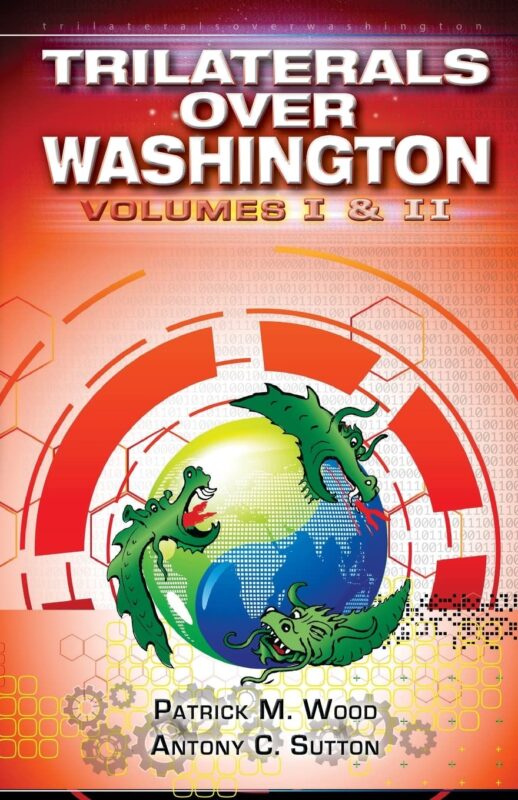
Trilaterals Over America

Trilaterals Over America by Antony Sutton investigates how a private international organization, the Trilateral Commission, shapes U.S. domestic and foreign policy through influence over political appointments, media, economic institutions, and long-term global strategies. Founded in 1973 by David Rockefeller and Zbigniew Brzezinski, the Commission operates outside democratic structures yet embeds itself into key policy mechanisms within governments, particularly the United States. Sutton documents the Commission’s goals, its methods, and the structural implications of its presence in global governance.
Origins of a Global Planning Network
David Rockefeller used his financial clout and personal networks to construct the Trilateral Commission as a means of fostering "cooperation" among Western Europe, North America, and Japan. Zbigniew Brzezinski supplied the ideological blueprint, envisioning a technocratic world order responsive to elite-managed systems rather than democratic input. The Commission began with 200 members; by the 1990s, it had expanded to over 300, drawing from banking, media, academia, government, and corporate boards. Members do not represent their nations. They are chosen for their alignment with strategic long-term goals.
This organizational design prioritizes continuity of influence over electoral legitimacy. Rockefeller chairs the Executive Committee and selects most of its members, ensuring alignment with the Commission’s global vision. Annual meetings in cities like Lisbon, Washington, and Tokyo serve as policy incubation labs. Reports drafted there form the backbone of Commission strategy documents that inform member governments' policies.
Embedding Policy Through Personnel
The most effective power the Trilateral Commission exercises is personnel placement. Sutton traces a pattern: individuals participate in the Commission and then enter government in strategic positions. This is not accidental convergence. During the Carter administration, at least 18 key positions were filled by Commission members, including Brzezinski himself as National Security Advisor. The same dynamic reappeared under President Bill Clinton. Warren Christopher, a Trilateralist, directed the transition team and appointed more than 20 fellow members into high offices.
These appointments do not emerge from open contests of ideas or meritocratic vetting. They follow an internal referral system rooted in ideological compatibility with Trilateral goals. Sutton shows how Cabinet-level officials, ambassadors, and undersecretaries maintain ties to Trilateral circles during and after government service, creating a revolving door that consolidates influence across decades.
Controlling Public Discourse Through Media and Academia
Commission-affiliated individuals populate editorial boards, direct academic programs, and control broadcast networks. These roles do not merely inform public debate—they shape the boundaries of acceptable discourse. Trilateral influence at The New York Times, CBS, Time, and PBS creates a feedback loop where policies conceived by the Commission reappear as media consensus.
Think tanks and universities play a complementary role. Institutions like the Brookings Institution, the Aspen Institute, and Harvard University receive funding and intellectual direction from Commission members. These centers generate research aligned with long-term goals, disseminate strategic narratives, and train new members for integration into the policy apparatus.
The New World Order as Operational Goal
The Trilateral Commission’s explicit goal is the construction of a New World Order—defined as a managed global system governed by multinational coordination, technocratic control, and elite oversight. Sutton traces this goal to Brzezinski’s 1970 book, Between Two Ages, where he rejects the U.S. Constitution as inadequate for the emerging technetronic age. Brzezinski proposes replacing national sovereignty with international planning institutions. This is not an abstract vision. Sutton documents how the Commission supports supranational organizations, economic harmonization, and institutional reforms that erode national legal authority.
This process does not wait for democratic validation. Rather, it proceeds incrementally, through institutional layering, administrative integration, and strategic appointments. Sutton emphasizes the role of policy papers that recommend coordination on international finance, trade, and regulation. These documents shape the agendas of the World Bank, IMF, and GATT/WTO—structures that reflect Trilateral priorities.
The Nexus of Finance, Law, and Lobbying
Sutton describes how Commission-linked law firms and financial institutions act as operational arms of policy execution. Firms such as O'Melveny & Myers and Kissinger Associates offer clients access to the U.S. policy process. Their partners, often Commission members, rotate between private practice and government, carrying influence into both realms. This model enables foreign and domestic clients to secure favorable decisions, bypassing public scrutiny.
Kissinger Associates, founded by Trilateralist Henry Kissinger, epitomizes this dynamic. It operates as an influence brokerage, leveraging relationships formed in government service. The Carlyle Group follows the same model. Sutton highlights its roster of former Cabinet members, all of whom use their government experience and Trilateral ties to secure lucrative contracts and privatization deals.
These entities operate in the shadow of lobbying regulations. Legal loopholes shield them from scrutiny while their associates write or shape the very laws that could restrict them. Sutton identifies this feedback loop as structurally embedded corruption.
Technetronic Ideology and the Post-National Future
Brzezinski’s framework sees human development as a linear progression through religious, national, Marxist, and finally technetronic phases. In this final phase, information technology and elite expertise govern a global order. Sutton dismantles this theory by pointing to real-world countertrends: decentralization, resurgence of ethnic self-determination, and the revival of spiritual and communal life.
He argues that the technetronic model underestimates the persistence of cultural identities and overestimates the ability of centralized systems to resolve systemic crises. Nevertheless, the Trilateral Commission pursues its goals with the confidence of historical inevitability. Sutton warns that this ideological certainty blinds its architects to the organic dynamics of resistance and fragmentation.
Policy by Oligarchy, Masked as Expertise
The Commission frames its role as one of disinterested expertise. It publishes papers, organizes conferences, and holds debates. Sutton shows how this mask conceals oligarchic strategy. These actions serve as procedural legitimizers for pre-decided policies. The Commission does not seek broad input. It selects members for alignment, drafts reports for circulation among elites, and uses media influence to position its agenda as commonsensical.
Through this method, the Commission bypasses public resistance. It shapes the Overton window to exclude nationalist, populist, or decentralized alternatives. Sutton shows how democracy is redefined not as participation but as elite stewardship.
Expansion Through Crisis
Crisis functions as a mechanism for expanding Trilateral influence. Sutton traces how oil shocks, financial instability, and geopolitical conflicts generate new rounds of integration. Each disruption invites new coordination mechanisms, often designed by Commission affiliates. These include monetary harmonization, joint military actions, and global regulatory frameworks.
The pattern becomes self-reinforcing. Each problem produces a solution that consolidates control. Over time, the policy spectrum narrows. Democratic options contract. The electorate becomes a passive audience to a technocratic performance directed offstage.
Documented Power, Unaccountable Governance
Sutton presents rosters, funding records, meeting minutes, and career trajectories. He tracks connections between Commission membership and key decisions affecting trade, war, finance, and law. His method is empirical. His argument does not rest on speculation. It rests on institutional design and observed outcomes.
The Trilateral Commission has no electoral mandate. Its members operate in multiple countries but face no cross-national accountability. They influence tax policy without standing for tax votes. They regulate markets without representing producers or consumers. Sutton identifies this as a structural threat to republican governance.
Conclusion: Policy Capture in Plain Sight
Trilaterals Over America concludes with a warning. Sutton argues that the Commission does not merely propose policy. It captures state power and directs it toward global integration on elite terms. The U.S. executive branch, under multiple administrations, has become a vehicle for implementing decisions shaped in private meetings far removed from the electorate.
This system persists through credibility, continuity, and the strategic placement of personnel. It survives criticism by denying coordination, yet delivers results through structured influence. Sutton calls for public recognition of the pattern, not to incite conspiracy fears, but to restore institutional transparency and democratic control. The challenge is not exposure. It is action. Who governs, and on whose behalf? The answer, Sutton insists, lies in the structure we allow to endure.