Democratic Ideals and Reality: A Study in the Politics of Reconstruction

Democratic Ideals and Reality by Halford J. Mackinder redefines the terms of global strategy by aligning geopolitical structure with the pursuit of international peace. The book asserts that power, geography, and human organization determine the future of civilization, not the abstract promises of law or justice. Mackinder moves beyond the conventional frame of diplomacy to examine the material forces shaping empires and the existential risk posed by strategic imbalance.
The Geopolitical Imperative
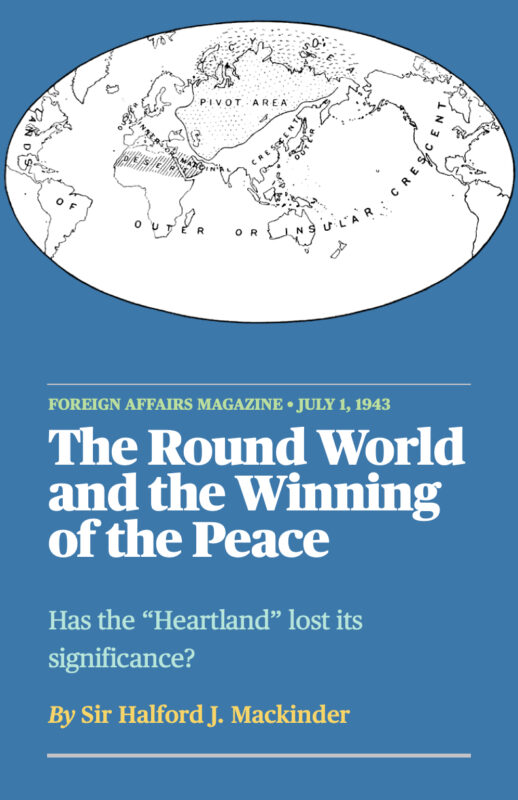
Geography conditions power. Strategic configurations—land, sea, and corridor—dictate the potential for expansion, cohesion, and conquest. Mackinder identifies the central Eurasian landmass as the Heartland, a contiguous region of internal rivers, arable basins, and impenetrable by sea. He names it the geographical pivot of history. Control over the Heartland grants logistical and military access to the surrounding peninsulas of Europe, the Middle East, South Asia, and East Asia. The power that organizes and industrializes the Heartland can encircle the world’s coastal powers from within.
The Heartland extends from the Volga to the Yangtze and from the Himalayas to the Arctic. It holds the resources and strategic depth to withstand blockade, absorb attack, and project force in all directions. Mackinder warns that any one power controlling this space gains an unmatched advantage. From this core, rail networks, supply lines, and troop movements operate without external disruption. The World Island—Eurasia and Africa—emerges as the central stage of global conflict. Sea power surrounds it, but cannot penetrate it. Air power may eventually neutralize its insulation, but in 1919, ground logistics still dominate.
Momentum and Discipline in Human Societies
Societies grow according to patterns of habit, interdependence, and organized labor. Mackinder defines social momentum as the cumulative effect of shared routines. As industrialization progresses, labor divides and integrates. Dependencies increase. Every worker’s output supports the next. Disruptions trigger cascade failure. This social machine resists abrupt redirection. Sudden reforms, revolutions, or wars threaten collapse. The risk lies not only in destruction, but in disorganization. Once coordination fails, systems of production, distribution, and defense unravel.
Discipline alone enables constructive change. Mackinder distinguishes two types of organizers: the administrator, who maintains order, and the creator, who redesigns systems. Progress requires creative reorganization. The organizer must align thousands of routines toward a new structure. He must impose pattern where momentum resists. Such effort demands authority, clarity, and precision. Without discipline, idealism dissolves into chaos. Where discipline fails, force follows. Order returns only through domination.
The Strategic Legacy of Napoleon and Bismarck
Napoleon and Bismarck shaped Europe not by ideals, but by systems. Napoleon transformed France through codification and conquest. His armies reorganized continental laws and borders. He mobilized man-power, finance, and national purpose into coordinated expansion. Bismarck unified Germany through calculated war and strategic diplomacy. He orchestrated alliances, isolated adversaries, and redesigned Europe’s balance. Both men wielded strategic imagination. They did not improvise. They imposed form.
Mackinder evaluates these figures not as aberrations, but as expressions of geopolitical force. Each seized opportunity when structure permitted it. Napoleon emerged from the entropy of post-revolutionary France. Bismarck rose within the precision-engineered machinery of Prussia. Their influence derived not from charisma but from mastery of systems—military, administrative, and geopolitical.
The Role of Geography in National Fate
Natural resources, transport corridors, and access to open seas define a nation’s options. Mackinder tracks the unequal growth of states to these structural advantages. Fertile land, mineral wealth, navigable rivers, and defendable borders combine to produce strength. Population alone does not guarantee power. Productivity, mobility, and security translate numbers into force. When growth concentrates in one power, tension builds. Expansion becomes inevitable. War follows.
The major wars of history mark these surges of imbalance. Strong powers seek outlets. Weak neighbors fall. Only strategic foresight can prevent the cycle. Equilibrium depends on proactive architecture, not reactive law. Juridical frameworks fail without structural support. No treaty enforces itself against power. A League of Nations must rest on strategic foundations, not ideals alone.
The Closed World and the End of Expansion
By the early twentieth century, the globe had become a closed system. There remained no unclaimed land, no external spaces for release. All growth now collided within existing borders. This closure magnified conflict. Every crisis in one region rippled through the global structure. The end of spatial elasticity forced nations into competition over shared terrain. Expansion required displacement.
Mackinder asserts that in a closed world, the balance of power becomes urgent. Without it, a dominant Heartland power could consolidate control over the World Island. From that base, it could eliminate resistance in stages—Europe, the Middle East, South Asia, East Asia—until sea powers could no longer intervene. He envisions this sequence as structurally probable, not ideologically driven.
The Strategic Necessity of Buffer States
Mackinder proposes a cordon of independent nations stretching from the Baltic to the Black Sea. These buffer states—Poland, Czechoslovakia, Romania, Yugoslavia—would separate Germany from Russia. Their purpose is strategic dissipation: to fragment power, slow movement, and complicate coordination. No single power should dominate the eastern European plain. This space must act as a breakwater.
The stability of these states requires external support. Sea powers must commit to their sovereignty. The failure to guarantee their independence invites absorption. Once either Germany or Russia controls this zone, the path to Heartland unification reopens. Mackinder regards this risk as definitive. Strategic ambiguity invites conquest.
Sea Power and the Limits of Reach
Naval strength secures mobility, access, and supply. It projects influence across continents. Yet it cannot conquer interiors. Fleets operate at the edge. They support, disrupt, and reinforce. They do not hold terrain. Land power, once organized and mobile, penetrates. It encircles, sustains, and absorbs.
Mackinder positions sea power as necessary but insufficient. British and American command of the seas must coordinate with continental allies. The freedom of peninsulas—Western Europe, South Asia, East Asia—depends on inland resistance. Korea, Greece, and the Middle East form key nodes. Holding these positions deters Heartland expansion. Abandoning them invites encroachment.
Strategic Imagination and Political Responsibility
Democratic societies tend toward moral abstraction. They legislate justice. They negotiate rights. They celebrate process. Mackinder warns that without strategic imagination, democracies drift into reactive weakness. Power structures demand anticipation. They respond to opportunity, not sentiment.
He calls for a synthesis of strategic clarity and democratic ideals. Survival requires both freedom and structure. States must govern with insight into space, force, and momentum. Education must produce not only lawyers and economists, but strategists. Geography must reenter political thought. Without maps, laws fail.
Economic Balance as Strategic Defense
Industrial equilibrium reinforces autonomy. Mackinder adopts Hamilton’s vision of a self-sufficient nation-state. Balanced production secures independence. Economies built entirely on export or import create dependence. Strategic pressure exploits asymmetry. A balanced state can feed, equip, and defend itself. It resists coercion.
This economic vision supports political freedom. Where nations control their supply chains, they negotiate from strength. Mackinder connects material independence to democratic resilience. Without control over infrastructure, production, and logistics, political will collapses under pressure.
The Future of Strategy in a Technological World
Mackinder anticipates the rise of air power and long-range weapons. He recognizes that technology will alter the geometry of conflict. Yet he insists that geography retains primacy. Terrain shapes deployment. Supply lines follow topography. Human societies live on land, not in abstractions. Strategic thought must evolve with tools, but never discard the map.
His theory persists not through static diagrams but through dynamic structure. The principles of convergence, corridor, and containment translate across eras. As air and digital infrastructure grow, so does the importance of nodal control, bandwidth logistics, and strategic redundancy.
The Strategic Foundation of Democratic Ideals
Freedom endures only where structure supports it. Mackinder does not reject ideals. He reinforces them through geopolitical realism. Peace emerges from balance. Justice follows security. Civilization thrives within strategic architecture. Vision alone does not suffice. Without control over space, movement, and force, ideals remain vulnerable.
He concludes with a call for strategic citizenship. States must educate their leaders and publics in the material structures of power. Only then can democracies act with foresight. The alternative lies in reaction, collapse, and domination. Mackinder offers a map of the future—not as prediction, but as directive. Strategic structure enables political choice. Without it, freedom vanishes into history.