The Brothers: John Foster Dulles, Allen Dulles, and Their Secret World War
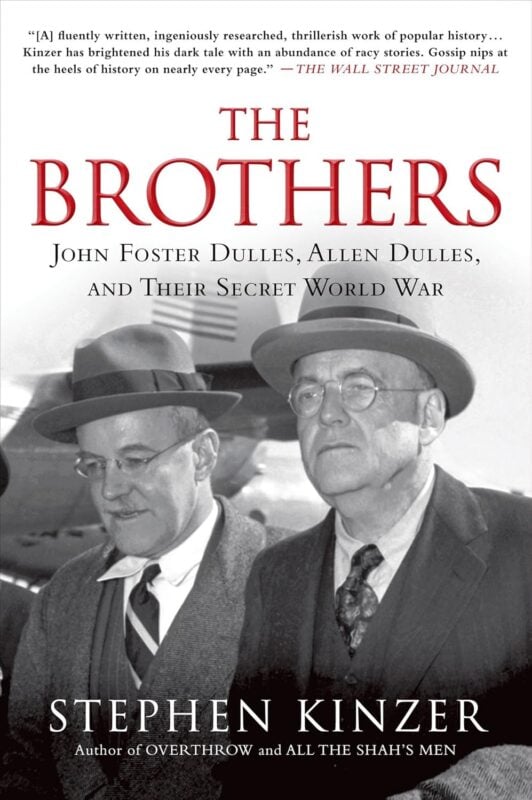
The Brothers by Stephen Kinzer reveals how John Foster Dulles and Allen Dulles shaped American foreign policy during the Cold War. As Secretary of State and CIA Director, respectively, they executed a vision grounded in corporate power, religious absolutism, and imperial ambition. Their actions triggered cascading consequences across Asia, Latin America, and the Middle East. This dual biography explores how two men, drawing on family legacy and elite education, leveraged personal beliefs into global interventions.
The Dulles Lineage: Inheritance of Power
John Foster and Allen Dulles emerged from a lineage of diplomats and religious leaders. Their grandfather, John Watson Foster, served as Secretary of State and brokered the overthrow of the Hawaiian monarchy. Their uncle, Robert Lansing, succeeded Foster’s mentor Woodrow Wilson as Secretary of State. These ancestral connections cemented the boys’ immersion in statecraft. At summer gatherings in Watertown, New York, they absorbed sermons from their father and foreign policy lessons from Foster and Lansing. As children, they debated geopolitics with statesmen over formal dinners. These formative environments bound Calvinist certainty to imperial logic.
The Education of Missionaries and Strategists
Foster Dulles attended Princeton and later served as secretary to the Chinese delegation at The Hague Peace Conference. Allen studied at Princeton, served in India, and developed an early interest in espionage inspired by Kipling’s Kim. Both received elite legal training, but their formative influences were not legal doctrines—they were exposed to global diplomacy, missionary zeal, and corporate legal work that fused capitalism and foreign policy. The family’s Presbyterian doctrine taught moral duty as destiny. The brothers internalized a belief in the righteousness of spreading American principles.
Sullivan & Cromwell: Engine of Empire
Foster Dulles spent nearly four decades at the law firm Sullivan & Cromwell, which specialized in international finance, cartel agreements, and the expansion of U.S. corporate interests abroad. His legal career functioned as a policy laboratory. He structured deals that enabled foreign governments to borrow from U.S. banks under conditions favorable to American control. He worked with United Fruit, Merck, and oil giants. His legal practice aligned national diplomacy with corporate profit, treating American economic dominance as a form of geopolitical stability.
Espionage and Shadow Strategy
Allen Dulles used his diplomatic post in Bern during World War I to gather intelligence from revolutionaries, double agents, and exiles. He built networks and mastered psychological manipulation. After World War II, he led Operation Sunrise, which negotiated German surrender in Switzerland and allowed Nazi officials to integrate into Western intelligence networks. This operation became the template for Cold War intelligence: pragmatic, covert, and morally flexible.
Formation of the Cold War Ideology
In the wake of World War II, Foster Dulles framed the Soviet Union as a theological enemy. He believed neutrality constituted moral treason. His speeches as a senator and foreign policy advisor to Thomas Dewey promoted global polarization. He helped construct NATO, rearmed West Germany, and advanced the doctrine of massive retaliation—America’s pledge to respond to any Soviet aggression with nuclear force. Foster’s foreign policy was doctrinal. He envisioned containment as religious obligation and treated foreign governments as morally graded actors.
Central Intelligence Agency: Tool of Intervention
As CIA Director from 1953 to 1961, Allen Dulles oversaw coups in Iran (1953) and Guatemala (1954), operations that removed democratically elected leaders and installed autocratic regimes friendly to American corporate and strategic interests. The Iran coup restored the Shah and preserved oil concessions. In Guatemala, the removal of Jacobo Árbenz secured United Fruit's holdings. Both operations combined local disinformation, bribery, and psychological warfare. These tactics defined CIA conduct for the next two decades and destabilized regions for generations.
Colonial Logic Repackaged
Both brothers viewed the non-Western world through colonial assumptions. They treated leaders like Iran’s Mossadegh, Guatemala’s Árbenz, and Congo’s Patrice Lumumba as existential threats for asserting national control over resources. The Dulles doctrine interpreted nationalism as communism. Their actions produced failed states and civil wars under the rubric of freedom. They believed order required elites friendly to Western finance, and democracy was tolerable only when it produced compliant governments.
Legacy in Latin America, Africa, and Asia
The long-term effects of the Dulles brothers’ interventions manifest in regime instability, human rights abuses, and anti-American resentment. Iran’s 1953 coup led to the 1979 revolution. The Guatemalan coup sparked a civil war that lasted over three decades. In the Congo, CIA-backed operations against Lumumba fueled chaos. These operations derived from a consistent logic: protect American investment, suppress leftist movements, and frame economic nationalism as Soviet proxy warfare.
Mythology of Exceptionalism
The Dulles brothers operated within a framework of American exceptionalism. They believed the United States possessed moral authority to shape global events. This belief justified clandestine actions and suppression of democratic movements. Their worldview integrated Calvinist predestination with Cold War absolutism. They treated dissent as deviance and subordinated international law to strategic necessity. Their blend of religious fervor and geopolitical calculation set the template for American behavior during the Cold War.
Disappearance and Reassessment
John Foster Dulles died in 1959, widely celebrated. Dulles International Airport bears his name. Allen Dulles remained at the CIA until 1961, when he was forced to resign after the failed Bay of Pigs invasion. In later decades, their reputations diminished. Revisionist historians questioned their legacy. The once-heroic bust of Foster Dulles vanished during airport renovations. Allen Dulles became a controversial figure in JFK conspiracy theories. The arc of their historical memory mirrors the trajectory of American Cold War policy—from triumphalism to reckoning.
Posthumous Reckoning and Historical Impact
Stephen Kinzer’s work anchors the Dulles brothers within a genealogy of American power. Their legacy persists in U.S. support for authoritarian allies, covert regime change, and global military presence. Kinzer presents a case study in the institutionalization of intervention. The brothers did not simply respond to history; they engineered it. Their influence reshaped international law, foreign policy, and the relationship between public institutions and private enterprise. Their careers demonstrate how moral conviction can produce violence, and how ideology, when fused with institutional power, can transform the world’s political landscape. The Dulles brothers believed in an ordained mission. They built the machinery to enact it. Their lives define a century. Their consequences remain.