Nazi International: The Nazis’ Postwar Plan to Control the Worlds of Science, Finance, Space, and Conflict
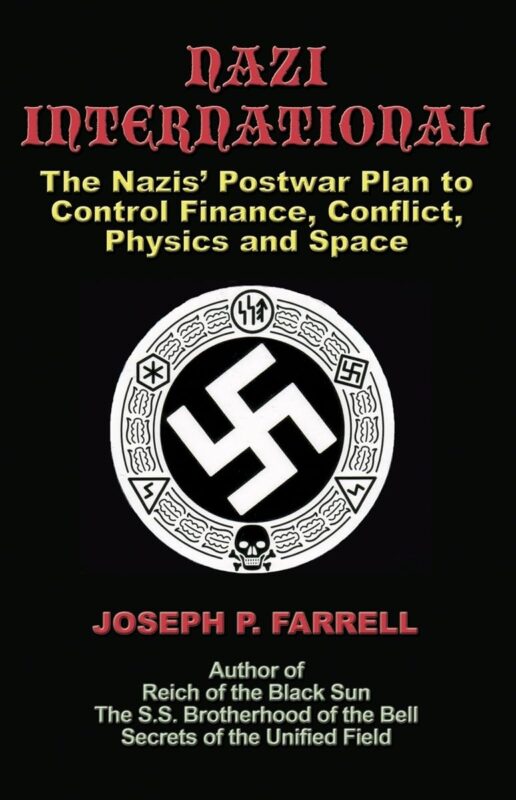
Joseph P. Farrell’s Nazi International: The Nazis’ Postwar Plan to Control Finance, Conflict, Physics and Space investigates a covert postwar Nazi network that Farrell argues endured beyond Germany’s 1945 military defeat. The book claims this network reorganized, relocated, and reactivated itself through financial operations, advanced scientific research, geopolitical infiltration, and strategic alliances.
The Mythos and Its Machinery
Farrell begins with a dissection of the ideological and esoteric roots of Nazism through the lens of Wilhelm Landig’s postwar science fiction novels. These works, blending myth and alleged reality, portray secret Nazi bases, exotic technologies, and underground efforts to reorganize global power. Farrell treats these novels not as speculative fiction but as cryptic declarations of ideological continuity. The symbolism—Black Sun iconography, Arctic and Antarctic enclaves, and elite SS technological teams—anchors the argument: Nazi ideology survived by going underground and transforming into a transnational project.
Strategic Evacuation and Parallel Bureaucracies
The book centers on Martin Bormann’s alleged escape and the strategic evacuation of Nazi personnel and assets before the war's conclusion. Farrell identifies a structured process involving financial transfers, corporate partnerships, and ratlines—escape routes through Spain and Argentina. He claims the Nazi Party, which operated as a parallel structure to the German state, was never formally dissolved. The military surrendered; the Party did not. This legal and organizational ambiguity, he argues, enabled continuity. Farrell highlights meetings like the 1944 Hotel Maison Rouge conference, where top Nazi officials reportedly coordinated postwar operations involving German industry and global banking entities.
Bankers, Industrialists, and the Continuity of Capital
Bormann’s postwar survival, Farrell asserts, was inseparable from the Reich’s deep alliances with international finance. The book explores cooperation between Wall Street firms, major American corporations, and Nazi industry, especially I.G. Farben. Farrell traces how capital flows were managed through Swiss banks and Latin American institutions, making Nazi flight capital indistinguishable from global investment. He argues that this financial web served as the skeleton for what he calls Nazi International—a corporate-fascist cartel with operational autonomy.
Scientific Networks and Suppressed Physics
In Argentina, Farrell focuses on Dr. Ronald Richter’s failed Huemul Island nuclear fusion project. Official histories portray it as a scientific embarrassment, but Farrell reads the anomalies surrounding Richter’s behavior, secrecy, and the facility’s infrastructure as indicators of deeper military-scientific objectives. He connects Richter’s work to Germany’s wartime experiments with torsion fields, zero-point energy, and the Bell device. These links support his thesis that postwar Nazis preserved and advanced secret physics projects in South America, protected by friendly regimes and supported by transnational industrial backers.
Covert Reunification and Tactical Alliances
Germany’s postwar reunification, according to Farrell, was more than political reconciliation. He documents links between neo-Nazi groups, West German politicians, and Cold War power structures. He describes the role of former SS officers like Otto Skorzeny in facilitating covert alliances with Middle Eastern leaders such as Gamal Abdel Nasser and Mohammar Qaddafi. These networks, Farrell argues, expanded the reach of Nazi International by aligning with anti-Western elements under the rubric of a "Third Position"—a geopolitical ideology rejecting both Soviet communism and Western liberalism.
Esoteric Cores and Occult Engines
Farrell threads an occult dimension into the narrative, positioning Nazi International as inheritor of Thule Society and Ahnenerbe traditions. These esoteric roots inform the mythos of Nazi science as an application of ancient knowledge. He explores claims of channeled communications, Vril energy, and ritualized space programs, drawing from fringe but influential sources such as the works of Wilhelm Landig and the Vril Society mythologies. Farrell insists that these esoteric elements served as both ideological fuel and psychological warfare—embedding occult systems of belief within technological research to radicalize commitment.
Technological Continuity and Corporate Infrastructure
The book posits a technological arc stretching from wartime Germany through postwar South America into Cold War aerospace programs. Farrell argues that Operation Paperclip did not extract all key personnel or knowledge. Instead, a parallel flow of engineers, led by SS officers like Hans Kammler, developed technologies in secrecy, shielded by host governments and corporate partners. Farrell identifies connections between these scientists and postwar corporations such as Siemens and Krupp, framing these firms as postwar lifelines for Nazi technological initiatives.
Space Programs and Ritual Geopolitics
Farrell integrates NASA into this trajectory. He explores the arguments of Richard C. Hoagland and Mike Bara, who claim that NASA operated under a hidden Masonic and Nazi influence. Mission patches, launch timings, and project nomenclature, Farrell contends, reveal patterns of ritual alignments. He argues that these are not decorative coincidences but clues to a concealed ideological structure embedded in the space program, aligning technological advancement with symbolic conquest.
Conflict Engineering and Market Manipulation
The Nazi International, Farrell writes, mastered conflict as a tool of strategy and finance. He presents evidence that the organization orchestrated or manipulated postwar conflicts to generate instability, drive arms trade, and influence political alignments. He identifies patterns of covert participation in terrorism, state-sponsored violence, and proxy wars. These operations, he argues, produced a recurring motif: chaos precedes consolidation. Farrell frames these events as applications of geopolitical alchemy—engineered crises used to reshape global markets and political structures.
The Global Chessboard and Hidden Players
Farrell rejects the notion of a single omnipotent conspiracy. He presents Nazi International as one faction among several—financial elites, intelligence cartels, clerical networks, and ideological orders—all vying for influence. His analysis treats postwar history as a multi-board chess game where apparent randomness conceals method. Nazi International, with its corporate wealth, covert technologies, and ideological coherence, remains a significant player in this competition.
A Timeline of Strategic Persistence
The book concludes with a synthesized timeline of activity. It traces origins in prewar occultism and alchemical physics, pivots through wartime evacuations and financial restructuring, and extends through Cold War conflicts, postwar industry, and covert science. Farrell describes this trajectory as intentional. He claims that Nazi ideology adapted, shed its uniforms, and pursued its original ambition—global domination—through infiltration, manipulation, and scientific dominance.
Operational Sophistication and Historical Blind Spots
Farrell attributes the persistence of Nazi International to operational discipline and the West’s conceptual blindness. Liberal democracies focused on institutions, not the survival of ideologies detached from state apparatuses. While the world celebrated victory in 1945, Farrell argues, a networked enemy reorganized its assets, mapped new fronts, and resumed its mission with stealth and patience.
The Stakes of Acknowledgment
Who benefits from denying the possibility of Nazi continuity? Farrell suggests that failure to investigate these claims leaves democratic societies vulnerable to internal subversion. He challenges readers to ask whether technological anomalies, policy trends, and economic realignments show the fingerprints of an embedded adversary. The book ends not with a final proof, but with an open demand: if the Nazi Party never formally surrendered, what systems have replaced the tanks and uniforms to achieve the same strategic goal?
The Structure of Influence
Farrell draws no final diagram but offers a layered matrix: hidden ideologies, recycled personnel, shadow economies, secret physics, and ritual symbolism. He assembles these not as metaphors, but as infrastructure. His thesis moves from speculative to forensic. Influence becomes measurable—by capital flow, technological residue, geopolitical alignment, and institutional behavior. Nazi International, by this account, operates through structural convergence rather than central command. It thrives in opacity, recruits through loyalty and access, and advances through exploitation of systemic assumptions.
Reading Against the Archives
The narrative presses the question: what kind of history do official records conceal? Farrell calls on researchers to reframe the boundaries of evidence. He elevates secondary literature, obscure documents, and suppressed testimonies into primary sources for geopolitical revisionism. Nazi International becomes a case study in how subterranean movements generate above-ground consequences. Farrell urges readers to develop analytical tools that detect not just surface patterns, but the buried systems that produce them.