Compromised: Clinton, Bush and the CIA
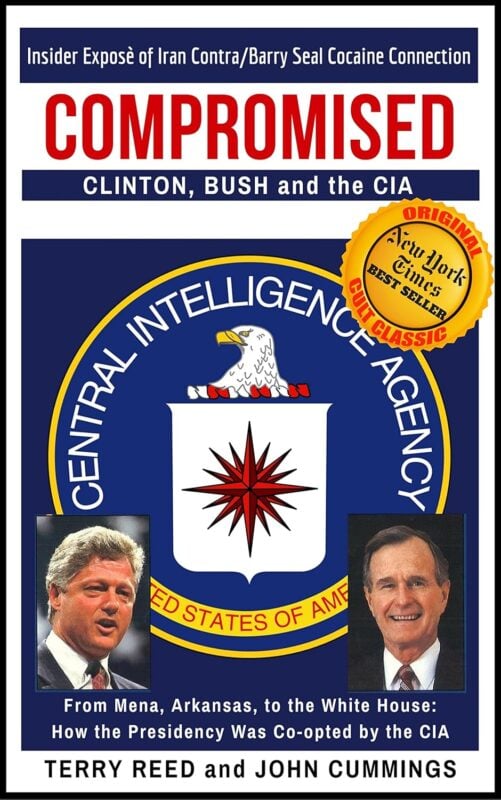
Compromised: Clinton, Bush and the CIA by Terry Reed and John Cummings examines the deep and often hidden relationships between intelligence agencies and American political power, focusing on the clandestine operations that shaped late 20th-century history. Reed, a former Air Force intelligence officer and later a CIA asset, delivers a detailed, first-person account of how covert actions within the United States intersected with the ambitions of politicians such as Bill Clinton and George H.W. Bush.
The Hidden Machinery of Power
Terry Reed traces his journey from the patriotic heartland of Missouri into the shadows of Cold War intelligence. Trained by the Air Force, he joined secret projects designed to control the flow of information and arms in Southeast Asia, including Project Igloo White, which used advanced computing and surveillance technology to target supply lines on the Ho Chi Minh trail. Reed describes the inner workings of U.S. intelligence, revealing how technological innovation and secrecy gave rise to a new kind of power—one that would persist after the collapse of the Soviet Union.
The CIA’s Mission and Its Drift
The Central Intelligence Agency, founded to serve the President by providing information, expanded its influence beyond analysis and collection. Reed recounts how the agency’s “black operations” metastasized into other branches of government, creating feedback loops of secrecy and control. Former President Harry Truman’s warning, cited in the book’s early pages, frames the narrative: the CIA exceeded its original mandate and began to operate as an autonomous actor, shaping both foreign and domestic events according to its own logic.
Convergence of Iran-Contra and Arkansas
As the book moves into the 1980s, Reed situates Arkansas as a central node in the Iran-Contra network, where clandestine flight operations, arms shipments, and drug trafficking coalesced under the watch of both state and national figures. The narrative connects the Mena, Arkansas airport to covert support for the Contras in Nicaragua. Barry Seal, Oliver North, and Felix Rodriguez appear as operatives working the edges of official policy, blending military action with illegal enterprise. Reed claims Bill Clinton, then governor, facilitated or ignored these operations in exchange for political favors and campaign support.
Drug Money and the Shadow Economy
A major thrust of the book exposes how drug money fueled clandestine operations. Reed provides first-person testimony about the logistics of running arms and laundering cash, painting a vivid picture of “powdered money” flowing through banks and bond deals in Arkansas. He argues that the CIA’s pursuit of untraceable funding for secret wars undermined the official “War on Drugs,” creating a situation where profits from cocaine and heroin moved directly into the apparatus of American power. Through this lens, Reed indicts both the intelligence community and political leadership for leveraging the shadow economy to achieve their objectives.
Personal Compromise and the Cost of Conscience
Reed details his own evolution from committed intelligence asset to government liability. Initially, he accepted the logic of compromise, believing he acted in service to the nation. Over time, he recognized that the values he cherished—honor, service, patriotism—were used as tools by those wielding secret power. His refusal to participate further in illegal activities led to direct retaliation: legal harassment, media smears, and threats against his family. The narrative tracks a family forced to move over 30,000 miles, evading both the FBI and the CIA. Why did government agencies, designed to serve, transform into adversaries for a loyal citizen?
The Media’s Gatekeeping Function
A defining element in Reed’s account concerns the role of the mainstream media. After his acquittal in federal court, Reed saw his reputation systematically dismantled by a coordinated disinformation campaign. TIME magazine, in particular, is named for a full-page article branding Reed a liar and a charlatan. He explores the mechanics of narrative management, showing how critical news stories are filtered, delayed, or reframed to protect institutional interests and political candidates. As the mainstream press sidelined his story, Reed found support among alternative media, especially talk radio, which enabled him to reach an audience that rejected conventional gatekeeping.
Profiles in Complicity
The book’s detailed cast of characters blurs the lines between government, law enforcement, private business, and the underworld. Figures such as Oliver North, Barry Seal, Felix Rodriguez, Bill Clinton, and George Bush operate in overlapping spheres. Reed describes clandestine meetings, false identities, and code names—John Cathey for North, Max Gomez for Rodriguez. State employees, industrialists, law enforcement, and pilots all enter the frame, their stories converging in Arkansas and radiating outward through networks of covert influence.
Judicial and Political Systems Under Stress
Reed’s legal battles demonstrate the lengths to which institutions will go to suppress dissent. Despite being acquitted of criminal charges after a federal judge exposed government misconduct, Reed continued to face attempts to strip him of his credibility through media attacks and civil litigation. His account raises the question: How does the legal system function when it collides with covert operations? He describes a system in which “justice is often just an illusion” and where power, when threatened, seeks to discredit rather than debate.
The Architecture of Clandestine Governance
The book posits that black operations created an informal structure running parallel to official government. Reed likens his experience to a trim tab on an airplane—a small but decisive correction intended to shift the entire system. As he and Oliver North debated how to save the nation’s founding principles, they confronted the reality that secret government had evolved beyond oversight. The infrastructure—covert funding, compromised officials, deniable operations—replaced the accountability mechanisms designed by the Founders.
Redemption, Witness, and Warning
Reed’s journey unfolds as both a personal redemption and a public warning. Forced into hiding and denied institutional protection, he found relief and agency by chronicling his story. The act of writing and publishing, spurred by his coauthor John Cummings, served as a bulwark against the erasure of truth. Reed frames his experience as emblematic of a broader crisis—a nation sliding from “the acme of freedom and self-government to the complex, fragmented form of governmental gridlock and compromise” visible at the close of the 20th century.
Cultural and Generational Transmission
Reed’s reflections on raising his sons amidst these revelations expose the dilemma faced by citizens who want to instill patriotic values without exposing them to manipulation. Should he teach obedience, or prepare them to resist institutional exploitation? His answer, shaped by hardship and disillusionment, urges vigilance and critical engagement with the realities of American governance.
Systemic Corrosion and Public Responsibility
Reed maintains that unchecked secrecy leads to systemic decay, eroding the feedback mechanisms essential for democracy. He points to the budget deficit, credit addiction, and the professionalization of political power as symptoms of a deeper malaise. He advocates for a return to personal and fiscal responsibility, grounded in the founding principles of “pay as you go” and shared sacrifice.
The Power of Alternative Media
Reed concludes that institutional media no longer monopolizes public discourse. Grassroots channels—talk radio, alternative publishing, citizen activism—enabled his message to escape suppression and reach a mass audience. This shift, he argues, represents both an opportunity and a challenge for those who seek to hold power accountable.
Legacies of the Cold War
The book closes by considering the global legacy of the Cold War and the vacuum created by the USSR’s collapse. Reed warns that the new instability presents dangers not seen under bipolar competition. The structures built in secret now confront a world with diffuse threats and unclear boundaries, raising the stakes for those who operate both inside and outside the law.
Why Does Compromised Endure?
Terry Reed’s account endures because it maps the convergence of intelligence, politics, and organized crime with unprecedented specificity. He challenges the boundaries of patriotism and obedience, forcing readers to ask: Who benefits from secrecy? What is the cost of compromise? How do ordinary citizens reclaim agency in the face of structural deception?
Compromised: Clinton, Bush and the CIA insists that public vigilance and historical memory form the last line of defense against the corrosion of democratic institutions. Reed calls for accountability, transparency, and a revival of the values that once defined American self-government. His testimony stands as both a chronicle of lost innocence and a call to action in the ongoing struggle to define the boundaries of American power.

About the Book
https://youtu.be/nCSCCGLCNYA