War for Eternity: Inside Bannon’s Far-Right Circle of Global Power Brokers
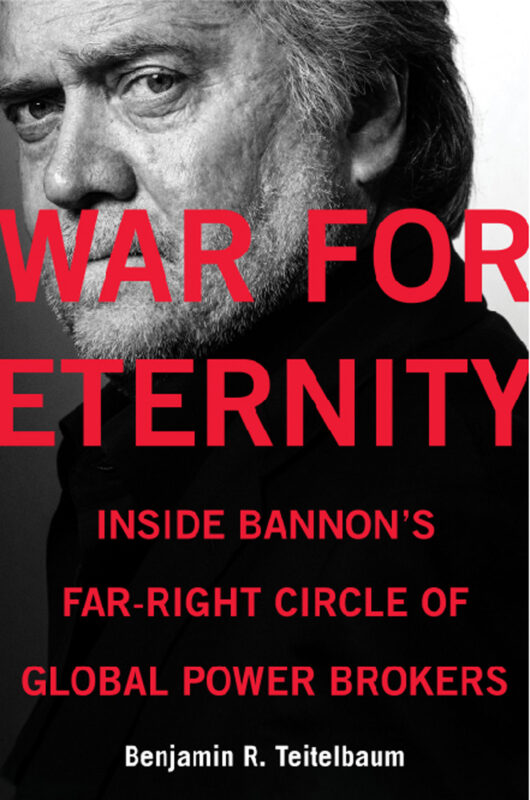
War for Eternity: Inside Bannon’s Far-Right Circle of Global Power Brokers by Benjamin Teitelbaum examines how esoteric philosophies, metaphysical doctrines, and secretive alliances shape the worldviews and actions of far-right leaders whose influence extends across continents. Teitelbaum, trained as an ethnographer, embeds himself in the ideological and personal spheres of figures like Steve Bannon, Aleksandr Dugin, Olavo de Carvalho, and Jason Jorjani, tracing their spiritual and political journeys through a web of face-to-face meetings, private interviews, and historical inquiry. The narrative explores how Traditionalism, an anti-modernist, cyclic philosophy, fuels a global network of power brokers intent on reordering politics, society, and the very meaning of civilization.
Origins of a Spiritual War
The core of the book pivots on the philosophy of Traditionalism, a set of spiritual beliefs grounded in the works of thinkers like René Guénon and Julius Evola. Traditionalism claims that history operates in recurring cycles—golden, silver, bronze, and dark ages—each defined by a prevailing caste, from priest to warrior, merchant to slave. As the cycle devolves toward a dark age, the only path to renewal, the Traditionalist asserts, lies in total collapse followed by an explosion of transcendental renewal. This belief system values hierarchy, spirituality, and rootedness above material progress, rationality, or equality. Such convictions foster a worldview that prizes mysticism, sacred lineage, and ancient wisdom. Traditionalists find kinship in Hindu cosmology and the Indo-European religious legacy, claiming that lost fragments of a primal tradition survive across faiths and cultures. Within this framework, present-day society appears as the decadent terminus of a cycle—a time that demands metaphysical resistance, not incremental reform.
Steve Bannon’s Spiritual and Political Trajectory
Steve Bannon’s rise, as chronicled in the book, originates in a convergence of spiritual curiosity and military discipline. Bannon, a Navy officer stationed in Hong Kong in the late 1970s, pursues Eastern religious texts, meditation, and self-improvement as means to fortify his mind, body, and spirit. His spiritual search begins in Zen Catholicism and expands to include the Tao Te Ching, the Hindu Vedas, and later, works of Traditionalist doctrine. Bannon draws intellectual sustenance from these sources, nurturing a desire to merge ancient metaphysical wisdom with strategic political action. His forays into investment banking, Hollywood, and media further intensify his quest to wield influence across domains. He cultivates private libraries, consults with spiritual scholars, and maintains an inward detachment from institutional norms, channeling energy into a mission to re-enchant Western politics with spiritual force. Bannon’s attraction to the ideas of Guénon and Evola deepens, eventually forming the basis for his worldview and strategies as a political operator, media executive, and White House adviser.
Aleksandr Dugin and the Russian Project
Across the Eurasian frontier, Aleksandr Dugin crafts a role as both philosopher and agitator. Rooted in the underground Yuzhinsky Circle of Moscow’s late Soviet era, Dugin weaves together fascism, occultism, nationalism, and Eurasianism. His doctrine, Eurasianism, envisions a geopolitical struggle between rooted, spiritual civilizations and a decadent, materialist “Atlantist” West. Dugin’s worldview blends Traditionalism with Russian nationalism, advocating the revival of spiritual hierarchies, the elevation of Orthodox Christianity, and the assertion of Russian destiny as a bulwark against Western modernity. His influence reaches separatists, soldiers, and even the Kremlin, shaping Russia’s interventions in Georgia and Ukraine. Dugin’s meetings with Bannon, staged in secret locations, symbolize the growing intellectual alliance between American and Russian far-right thought leaders who see themselves as participants in a global metaphysical war.
Forging the Far-Right International
The book tracks how Bannon, Dugin, and their counterparts build a network of relationships that crosses national boundaries. These actors reject the conventional norms of mainstream conservatism, populism, or party politics, instead seeking alliances based on shared metaphysical convictions. Bannon and Dugin meet privately in Rome, exchanging views on the necessity of spiritual revolt, the value of differentiation, and the strategies required to exploit moments of crisis for Traditionalist aims. This alliance is not merely symbolic—it translates into real-world actions, including campaigns to destabilize the European Union, promote Brexit, undermine liberal internationalism, and support populist movements across the U.S., Europe, and Brazil. The network draws in diverse figures, from metaphysical publishers to Aryan nationalists, from Brazilian ideologues to exiled Chinese dissidents, who all recognize a convergence in their rejection of modernity and faith in spiritual hierarchy.
Traditionalism’s Core Doctrines
Traditionalism, as explained in the narrative, centers on several foundational doctrines. The philosophy divides humanity into spiritual and material castes, advocating a strict social hierarchy that values priests and warriors over merchants and slaves. It asserts the cyclicality of history, demanding collapse as a precursor to rebirth. It places supreme importance on initiation, ritual, and mystical knowledge, often blending aspects of Hinduism, Sufi Islam, and Indo-European paganism. The narrative identifies key agents—Guénon, the French Sufi convert; Evola, the Italian baron with racial theories; and their modern acolytes—who transmit these ideas through underground publications and spiritual circles. The result is a doctrine that both attracts and repels, its secrecy and complexity functioning as both a barrier and a lure.
Spiritual Doctrine in the Theater of Politics
Bannon’s practical use of Traditionalist ideas shapes his political career and strategies. He reimagines populism as a vehicle for spiritual restoration, advocating for a return to “eternal” values and a revolt against the forces of liberalism, secularism, and global finance. Bannon calls for a conservative revolution that targets not leftist opponents, but the establishment right, whom he sees as complicit in the decay of the West. He extols the virtues of nation-states, sovereignty, and spiritual identity, presenting alliances with nationalist movements in Europe as both strategic and metaphysical. Dugin, likewise, infuses his geopolitical analyses with Traditionalist imagery, urging Russians to embrace their spiritual inheritance and resist the encroachments of a soulless West.
Networks of Influence and Action
The book explores how these ideas move beyond private discussion to affect public policy, international relations, and popular movements. Teitelbaum documents Bannon’s attempts to elevate nationalist leaders in France, Italy, the UK, and Brazil. Dugin’s influence spreads through think tanks, advisory roles, and media channels that bridge intellectual and political spheres. Brazilian philosopher Olavo de Carvalho emerges as a key Traditionalist voice in South America, influencing the ideological direction of Jair Bolsonaro’s government and shifting Brazil’s international alignments. These networks thrive on secrecy, code words, and elite gatherings, weaving together metaphysical doctrine and practical action in a single movement.
The Metaphysics of Crisis and Renewal
Teitelbaum frames the contemporary global crisis as both a challenge and an opportunity for Traditionalist actors. The accelerating decline of institutions, the erosion of faith in democracy, and the polarization of societies all serve as signals and catalysts for action. Traditionalists interpret these signs as evidence of a world entering its darkest age—Kali Yuga—where collapse is both inevitable and necessary. Within this logic, political chaos, social unrest, and cultural disintegration do not deter but embolden those who see themselves as agents of renewal. Bannon’s strategies focus on harnessing chaos to produce new forms of order, channeling populist energy into metaphysical direction.
Ritual, Secrecy, and Power
The narrative reveals the importance of ritual and secrecy within the Traditionalist milieu. Meetings occur behind closed doors, communications use coded language, and alliances depend on trust forged in private, often religious, contexts. Books and texts function as sources of authority and initiation, granting knowledge to those who seek and persist. Figures like Bannon adopt the posture of the esoteric initiate, simultaneously guiding movements and withholding their deepest convictions from public scrutiny. These rituals of secrecy and exclusion create a sense of mission and destiny among participants, heightening their sense of historical purpose.
Transformation of the Right
Teitelbaum’s account identifies a structural shift in the global right. Far-right movements no longer root their identity solely in ethnonationalism, economic grievance, or social conservatism. Instead, their leaders embrace metaphysical doctrines, spiritual missions, and a sense of transnational brotherhood based on a rejection of modernity. The transformation encompasses rhetoric, policy, and recruitment, as networks work to align international movements with the cycles and hierarchies of Traditionalist belief. The spiritual dimension adds both cohesion and volatility to the movement, encouraging bold, even reckless, strategies in pursuit of epochal change.
Ethnographic Insight and Narrative Tension
The book’s unique value lies in Teitelbaum’s ethnographic immersion, which produces both proximity and tension. His position as observer, confidant, and analyst grants him access to candid dialogues and hidden motives. Through detailed description, he traces the evolution of Bannon’s thought, the peculiarities of Dugin’s circles, and the alliances that operate outside public view. The narrative does not resolve its tension but intensifies it, as the convergence of metaphysics and politics continues to unfold across the stage of global crisis.
Legacy and Consequence
War for Eternity traces the flow of esoteric ideas from marginal texts and secret societies into the centers of political power. The book contends that the far-right’s spiritual ambitions, its philosophy of cyclical time and necessary collapse, now shape the agendas of influential actors across continents. Bannon, Dugin, Carvalho, and others pursue a metaphysical war whose outcome they believe will determine the fate of civilization. The convergence of Traditionalist doctrine, strategic action, and international coordination produces a dynamic with far-reaching implications, as spiritual conviction fuses with political opportunity in a war for the future of eternity.