The Secret School of Wisdom: The Authentic Rituals and Doctrines of the Illuminati
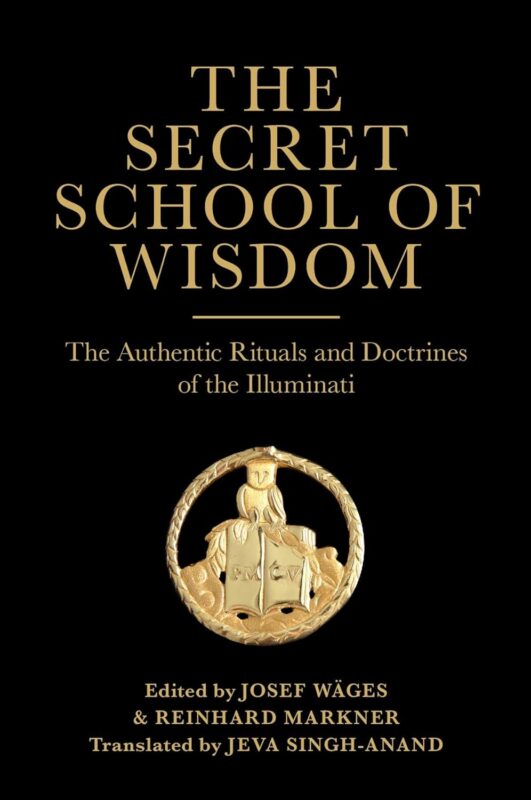
The Secret School of Wisdom by Josef Wäges and Reinhard Markner reconstructs the full degree system of the Bavarian Illuminati using original documents, providing the most authoritative reference for understanding its inner structure and esoteric rituals. Drawn from previously unpublished manuscripts, this volume delivers a complete and chronological presentation of the society's teachings, initiation ceremonies, administrative protocols, and strategic objectives.
The Genesis of a Revolutionary Brotherhood
Adam Weishaupt founded the Order of the Illuminati in 1776 with the goal of creating a moral elite that would lead humanity to enlightenment. His vision emerged from an academic milieu shaped by Jesuit discipline and Enlightenment rationalism. Early experiments such as the “School of Humanity” aimed at building ethical communities through shared education, mutual aid, and meritocratic advancement. These ideals coalesced into the Perfectibilist system, where members pursued self-improvement within a tightly controlled hierarchy.
What compels a man to construct a secret system to reform society? Weishaupt’s writings and the first generation of statutes illuminate the answer. They reveal an effort to simulate religious orders with secular goals, a brotherhood designed for quiet cultural revolution, enacting change through intellectual ascent rather than political confrontation. By 1778, the organization adopted the name Illuminati to embody its commitment to spiritual and intellectual light.
Structured Ascent Through Esoteric Degrees
The degree system outlined in the book divides into three major classes—Minerval, Freemasonic, and Mysteries—each with multiple levels that initiate the candidate into progressively deeper knowledge and responsibilities. The Minerval Class served as the foundation. Noviciates learned surveillance techniques, journal writing for introspection, and the coded language of secret correspondence. Minerval degrees introduced allegories drawn from classical mythology and Egyptian mystery schools, instilling symbolic reasoning and group discipline.
The structure advanced through Freemasonic degrees which the Illuminati modified to align with its ideological goals. Entered Apprentice, Fellow Craft, and Master Mason rituals served both as educational tools and instruments of social filtration. Rituals emphasized obedience, secrecy, and self-control. Catechisms, tracing boards, and symbolic penalties reinforced the gravity of the commitments. What moral transformation does a man undergo when kneeling blindfolded in a chamber of symbols? The answer lies in the orchestrated drama of the rites, designed to burn lasting impressions on the initiate’s conscience.
The Mysteries Class—Presbyter and Regent degrees—represented the apex of the Illuminati curriculum. These degrees taught leadership, applied philosophy, and human psychology. Members explored the mechanisms of influence, emotional control, and institutional governance. The Illuminati defined mastery not as mere enlightenment, but as the ability to steer the passions of others toward communal progress.
Mechanics of Control and Expansion
The Order’s administrative model mirrored its pedagogical one. Superiors received reports from subordinates in an unbroken chain of surveillance. Minerval Churches, Prefectures, Provinces, and National Inspections created a territorial grid that ensured every member, document, and ritual remained traceable. Members submitted personal diaries and essay assignments, subject to scrutiny and feedback. Internal newsletters circulated anonymized analyses, fostering self-discipline and ideological uniformity.
To coordinate a growing network, the Illuminati adopted ciphers and pseudonyms, often drawn from classical and Near Eastern antiquity. Persian calendars, Zoroastrian references, and Masonic metaphors disguised the Order’s European rationalist agenda beneath an exotic veil. These symbols built cohesion while confusing potential infiltrators. The use of myth served a precise function—conveying ethical lessons through encrypted storytelling that bypassed rational skepticism.
Tensions in the Higher Degrees
Baron Adolph von Knigge, an influential Freemason and reformer, joined the Illuminati in 1780 and reshaped its higher degrees. His contributions brought organizational expertise and broader recruitment, especially among existing Masonic lodges. He authored large portions of the Freemasonic and Scottish degrees, blending standard lodge rituals with Illuminati doctrine. Knigge introduced the Agape, a table lodge ceremony inspired by early Christian communal meals, symbolizing spiritual fellowship and philosophical communion.
These modifications stirred debate within the Order. Weishaupt criticized Knigge’s elaborations as excessive and incoherent with the core philosophical mission. He sought to trim symbolic excess, streamline progressions, and maintain doctrinal clarity. Their disagreements escalated into a power struggle over the meaning and future of the Order. Weishaupt favored a streamlined educational structure aimed at societal reform. Knigge envisioned a majestic, quasi-religious fraternity with layered symbolism and sacred rites.
Do rituals shape belief or merely signal belonging? The conflict between Weishaupt and Knigge reframes the question in political terms: does a secret order serve best as a vehicle for reform or as an archetype of cultural initiation? The Illuminati fractured before resolving this question.
Recruitment, Secrecy, and Surveillance
Candidates entered through personalized initiation pathways. Superior members assessed moral character through behavioral observation, coded reports, and confessional correspondence. Preceptors administered psychological tests disguised as allegorical exercises. These mechanisms formed an early form of applied anthropology, categorizing personality traits and tracking intellectual development across time.
Instruction manuals detailed how to guide candidates through rites, monitor their moral progress, and detect signs of insubordination. Secretaries maintained minute-books, Quaestors oversaw financial contributions, and Superiors distributed assignments with ritualistic precision. Internal espionage systems documented every deviation. Knowledge flowed upward; directives flowed downward. In this pyramid of revelation and obedience, the Order embedded power in pedagogy.
Integration with Freemasonry
By 1782, the Illuminati had infiltrated or co-opted dozens of Masonic lodges. This strategy allowed rapid geographic expansion and access to established ritual systems. Lodges such as St. Théodore au bon conseil in Munich and Caroline zu den drei Pfauen in Neuwied adopted the Illuminati’s version of the three symbolic degrees. These adaptations included unique catechisms, cipher systems, and ritual symbols such as the owl of Minerva, olive branches, and pillars representing moral steadfastness.
Through this integration, the Illuminati replaced traditional Masonic cosmology with Enlightenment values disguised in ancient garb. Lodges became vessels for indoctrination. Members rarely realized how the rituals they performed had been subtly rewritten. As trust in hereditary nobility waned and clerical authority eroded, these rituals offered a parallel form of social initiation—one that conferred identity and hierarchy through merit.
Esoteric Doctrine and Ethical Allegory
The teachings of the Illuminati revolved around self-mastery, critical thinking, and ethical influence. The mirror and the sword—symbols found throughout the rituals—embodied dual imperatives: know yourself, then act with precision. Members studied texts on classical virtue, Enlightenment philosophy, and political economy. Higher degrees tasked them with applying these insights in real-world governance scenarios, often through simulated courts and administrative challenges.
In the Presbyter degree, initiates received lessons structured as dialogues and epistolary exchanges, reinforcing Socratic method and dialectical rigor. They engaged in guided debates on religion, power, and education. Their final examinations involved not just memorization but moral judgment. What would you do, confronted with a tyrant? How should you govern fools? Through these questions, the Order prepared leaders rather than believers.
Collapse Under Pressure
Between 1784 and 1786, increased scrutiny from Bavarian authorities led to arrests, raids, and the public exposure of secret documents. The government outlawed the Order and launched investigations into its members. These prosecutions revealed extensive surveillance records, encrypted correspondence, and instructions for covert influence. Public backlash followed. What had once seemed a noble experiment in moral governance now appeared a conspiracy to overthrow Church and State.
Internal divisions compounded the crisis. Knigge resigned in bitterness. Weishaupt fled into exile. The surviving members dismantled their assemblies or went underground. By 1790, the Order had ceased formal operations. Its documents dispersed across archives, its influence fractured into legend.
Enduring Significance
The Secret School of Wisdom provides unprecedented access to the complete Illuminati system. Its rituals, doctrines, and administrative structures offer a rare lens into Enlightenment-era experiments in ethical society-building. The texts speak with clarity and purpose. They show a secret society as a tool for pedagogical reform, psychological exploration, and political strategy. These documents anchor the myths. They transform speculation into structure, offering scholars and seekers alike a map of a vanished world built on disciplined imagination.