Lord Milner’s Second War: The Rhodes-Milner secret society; the origin of World War I; and the start of the New World Order
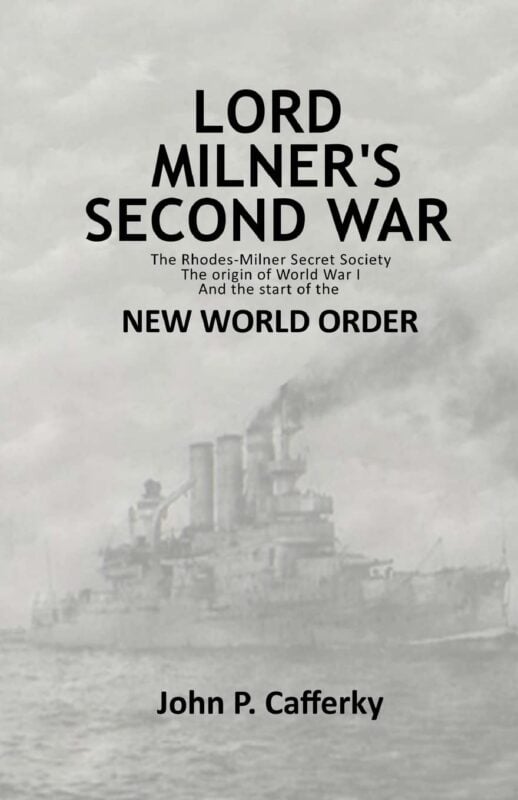
Lord Milner’s Second War by John P. Cafferky investigates how the Rhodes-Milner secret society transitioned from imperial consolidation to structural command of transnational policy. By embedding operatives across British political institutions, financial dynasties, and elite journals, the society aligned national purpose with global design. The book asserts that World War I emerged from deliberate architecture, not diplomatic drift. Each actor—Rhodes, Milner, Grey, Haldane—moved within a predefined strategy calibrated to provoke war and reap geopolitical reconstruction.
Elite Network Formation
Cecil Rhodes founded the society in 1891 with the objective of extending Anglo-Saxon supremacy through covert influence. Milner assumed leadership, converting Rhodes’ aspiration into functional apparatus. Under Milner, the group refined its recruitment within Oxbridge, secured media organs including The Times, and linked with financial powers such as Rothschild and J.P. Morgan. Milner’s control expanded beyond colonial administration; he shaped war policy, public narrative, and institutional legacy.
Operational Testing Ground
South Africa offered the first full test. Milner, as High Commissioner, provoked the Boer War by escalating minor grievances into strategic crisis. Collaboration with the mining syndicate Wernher-Beit ensured financial and logistical support. Newspapers steered public outrage. Political allies smothered dissent. The objective was not peace through reform, but dominance through destabilization. Cafferky details how war, once engaged, was used not for resolution but for transformation.
Institutional Capture
Postwar, Milner repositioned. He institutionalized his network through the Committee of Imperial Defence, the Round Table movement, and Chatham House. He inserted agents into the British Foreign Office and cultivated transatlantic ties. Sir Edward Grey, under Milner’s influence, conducted secret military coordination with France, circumventing parliamentary oversight. Richard Haldane restructured the British Army around continental deployment. Strategy dictated posture: Britain would present neutrality while readying for total engagement.
Pretext and Execution
The assassination of Archduke Franz Ferdinand activated a mechanism already assembled. Serbia’s actions, Russia’s commitments, and France’s guarantees existed within a framework that ensured escalation. Britain’s posture—ambiguous in public, explicit in planning—completed the circuit. Grey withheld critical information from Cabinet. Mobilization followed choreography. War began by design.
Outcome as Mechanism
Cafferky rejects casualty as consequence. He frames it as cost within a calculated schema. The war discredited monarchies, centralized finance, and justified supranational governance. Milner, positioned within the Imperial War Cabinet, shaped treaties and mandates. The League of Nations reflected his vision of layered authority: nominal sovereignty, directed oversight.
Transatlantic Extension
After Versailles, Milner’s allies founded the Royal Institute of International Affairs in London and the Council on Foreign Relations in New York. These were not think tanks. They were transmission centers. The policies they developed migrated directly into state departments and financial ministries. Governance detached from electorate. Expertise masked control. The Rhodes-Milner society did not dissolve; it rebranded.
Durability of Structure
The structure persisted. Its logic embedded itself in the IMF, World Bank, and NATO. Its agents became diplomats, journalists, executives. Its methods scaled with technology. Today’s global architecture—financial surveillance, military alignment, policy harmonization—follows the Milner pattern: embed, align, operationalize.
The Book’s Claim
Lord Milner’s Second War does not interpret events. It identifies a governing algorithm. It does not forecast conspiracy; it documents continuity. The names change. The design holds. War becomes adjustment. Institutions become carriers. Power no longer persuades; it configures.
Conclusion
Cafferky closes not with appeal but with demonstration. The war’s orchestration, the society’s concealment, the state’s absorption—all proceed from coherent structure. The twentieth century begins not with accident but with command. The Rhodes-Milner group did not react to crisis. It generated crisis, configured response, and captured outcome. The archive exists. The pattern is traceable. The result surrounds us.