The Power Elite
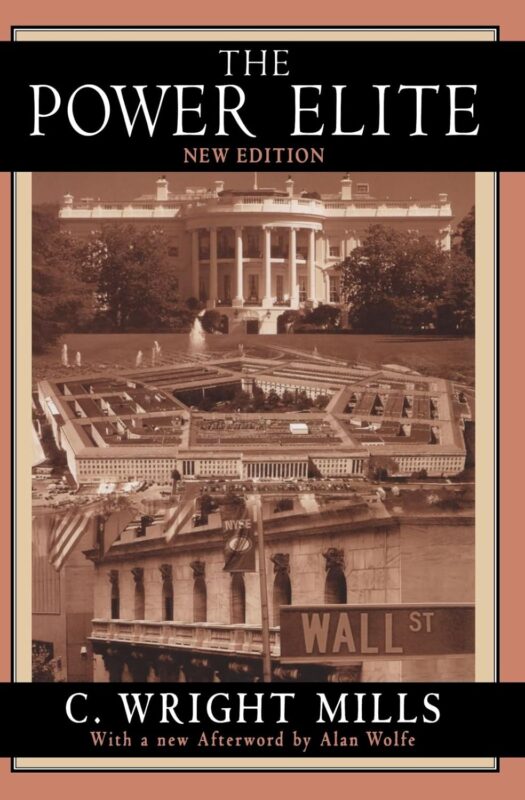
C. Wright Mills introduced the term “power elite” in his landmark work The Power Elite, where he mapped the interwoven dominance of political, economic, and military leaders in the United States. This network, centralized in command posts of key institutions, channels the trajectory of national life. By asserting that institutional power organizes itself around a small circle of decision-makers, Mills reframes the structure of American democracy. The elite shape society’s most consequential outcomes, not through backroom conspiracy, but through structural convergence and role concentration.
The Centralization of Command
National power in the United States consolidates in three major institutions: corporations, the military, and the political executive. These domains no longer operate in isolation. They intersect structurally, administratively, and ideologically. Mills identifies this triangle of dominance as a new institutional reality. Chief executives, warlords, and political directors coordinate decisions with vast, cascading consequences. They do so through an administrative apparatus fine-tuned for rapid execution and unified agendas.
The convergence of these sectors erodes traditional separations of power. Corporate leaders influence national policy, military leaders shape economic priorities, and political figures align with both to manage systemic coherence. Decisions move vertically from the top down, compressing the range of influence for secondary actors. This elite does not merely occupy high office—it directs the systems that define American public life.
Elite Reproduction through Institutional Gateways
Access to the power elite flows through select educational, social, and familial networks. These networks do not merely reflect privilege; they enforce continuity. Elite secondary schools, metropolitan clubs, and corporate boardrooms act as vetting grounds. These institutions shape outlooks, manage intergenerational succession, and facilitate the internal circulation of personnel across sectors.
Elite members rotate through high-level roles, moving from boardrooms to cabinet offices to advisory roles in the military. This interchangeability institutionalizes elite cohesion. The ideology of meritocracy overlays this structure, but structural access—not talent—determines entrance. Institutional roles, once occupied, shape the behaviors and worldviews of those within. Mills shows how institutions do not simply attract elites—they generate and legitimize them.
Public Relations and the Illusion of Democracy
The American political vocabulary masks structural realities. Politicians identify as public servants, yet their decisions reflect alignment with corporate and military priorities. Public relations replaces direct accountability. Political legitimacy hinges on performance narratives, not structural transparency. The language of democracy sustains faith in participation, even as decision-making narrows.
The public encounters policy through filtered presentations, curated by media aligned with elite interests. Policy debates within Congress address symptoms rather than structures. Mills identifies the middle levels of power—state legislators, local officials, lobbyists—as areas of movement without decision. The mass electorate watches decisions unfold from a distance, invited only to respond at the ballot box to choices shaped far upstream.
Mass Society and Disengagement
The underlying population becomes increasingly atomized. The social fabric weakens under bureaucratic expansion and institutional mediation. Voluntary associations—once mediating spaces between individual and state—diminish in influence. Civic life contracts to passive spectatorship. Citizens observe history rather than shape it.
Mills identifies a shift from community to mass. Individuals no longer experience social life through localized, interactive communities but through mass media and centralized institutions. As institutions absorb the functions of family, church, and school, individuals adapt but do not shape their social environments. The power elite leverages this adaptation. Structural passivity becomes a foundation of elite autonomy.
The Mechanics of Interlocking Power
Economic decisions affect political priorities. Political directives guide military strategy. Military demands structure economic production. These domains feed one another in a recursive loop. Large corporations contract with government for defense. Defense spending sustains economic growth. Political leaders facilitate both with policy and rhetoric.
This structural feedback system resists disruption. Crises—recession, war, scandal—do not rupture elite control. They invite recalibration. In crisis, the power elite reasserts itself as the only viable manager of complexity. Public fear converts into elite legitimacy. As each domain adjusts to the others, their leaders deepen collaboration. Strategic appointments, cross-institutional boards, and advisory councils reinforce coordination.
The Symbolic Role of Celebrities
Celebrities appear independent but serve a structural function. They divert public attention, personalize abstract systems, and symbolize democratic access. Celebrity culture creates illusions of upward mobility. Individuals with visibility appear to matter, even as visibility detaches from structural power.
Some celebrities gain informal influence, entering advisory roles or leveraging fame for political access. Yet even in these cases, they function as adjuncts to the core elite. They distract, not direct. Their narratives personalize power but never disclose its architecture. Media platforms elevate these figures, promoting identification over critique.
The Higher Immorality
The elite's insulation from accountability fosters a moral vacuum. Mills explores how institutional impunity transforms into ethical relativism. Decisions with mass consequences occur without public deliberation. Leaders rationalize outcomes as necessary, inevitable, or beyond their control.
Corporate fraud, military overreach, and political deception converge under a logic of expedience. The elite invoke national security, market efficiency, or strategic complexity to justify their actions. Moral language serves instrumental purposes. Institutions reward loyalty to system goals, not ethical coherence. The result is a culture of irresponsibility masked by rhetoric.
Historical Contingency and Epochal Transformation
Mills grounds his analysis in historical change. The elite emerged through a confluence of institutional growth, technological innovation, and geopolitical conflict. The industrial revolution centralized economic control. World wars expanded the military apparatus. The Cold War solidified national executive power. These developments produced a new institutional ecology.
The American elite operates with tools unavailable to previous rulers. Decisions reach global scale. Technology magnifies impact. Administrative structures accelerate execution. The consequences of elite action stretch across continents and generations. Understanding this transformation demands attention to structural shifts, not personalities.
Decision-Making and Accountability
Elite decisions reflect more than personal will—they emerge from institutional role constraints. Yet those who occupy command positions remain responsible for the outcomes they authorize. The ability to act implies the duty to consider consequences. Mills refuses to exempt elite actors from ethical responsibility.
Decision-makers cannot deflect blame to systems. They occupy positions precisely because of their capacity to choose. When they defer, delay, or deflect, their omissions carry weight. Structural location may shape decisions, but it does not eliminate agency. Accountability follows access. The power to act confers the burden to justify.
The Structural Imperative of Clarity
Mills concludes by calling for clear-eyed political analysis. Diagnosing elite power does not require conspiracy theories. It demands structural insight. Political imagination begins with institutional literacy. To challenge elite dominance, observers must map the architecture of power, trace its personnel, and decode its ideology.
The goal is neither celebration nor cynicism. It is comprehension. Understanding the power elite reveals the shape of American governance. It clarifies the relationship between individual fate and institutional design. It sharpens the stakes of democratic renewal. Responsibility begins with recognition. Recognition demands structural clarity. Mills offers the blueprint. The task remains to read it carefully and act accordingly.