Two World Wars and Hitler

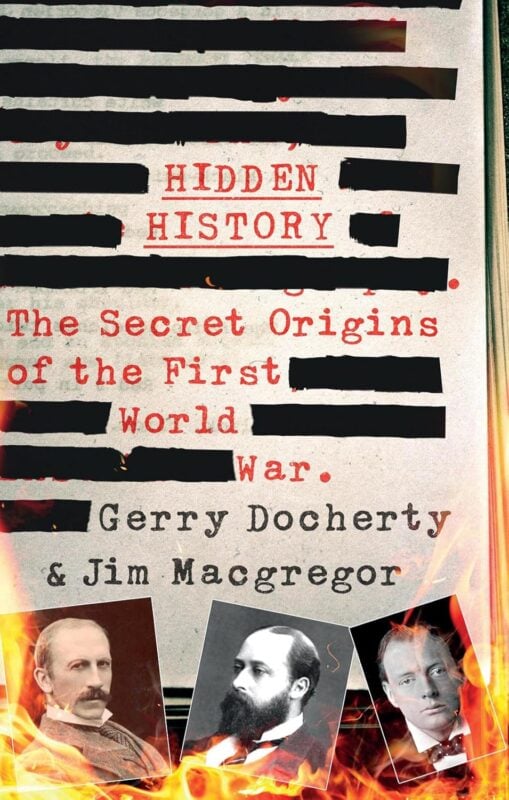
Two World Wars and Hitler: Who Was Responsible? by Dr. Jim Macgregor and Dr. John O’Dowd investigates the concealed mechanisms of power that shaped the 20th century. The authors argue that the world wars and the rise of Adolf Hitler resulted from deliberate orchestration by Anglo-American financial and political elites. Through archival research, academic testimony, and economic analysis, the book reconstructs the hidden structure that directed global conflict, revealing a network of financiers, policymakers, and ideologues whose coordinated actions produced the most violent century in modern history.
The Hidden Architecture of Power
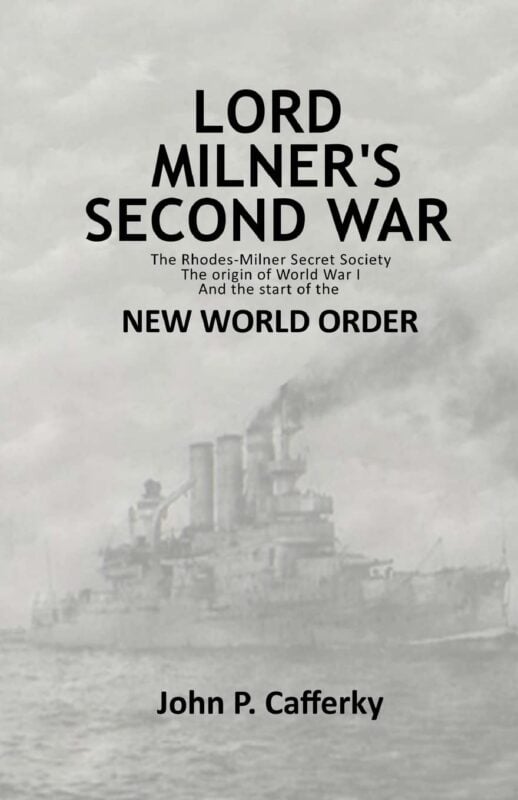
Dr. Jim Macgregor and Dr. John O’Dowd trace the origins of the twentieth century’s global wars to an organized system of influence embedded within British and American institutions. They identify a nexus of industrial magnates, banking families, and political strategists—centered in London’s financial district, the City of London, and extending through Wall Street—whose objective was imperial consolidation through economic dominance. The study situates the “Milner Group,” a secretive organization founded by British imperialist Cecil Rhodes and continued by Lord Alfred Milner, as the operational core of this network. This group, documented by historian Carroll Quigley, unified elite power across politics, education, and journalism, embedding itself within Oxford University, The Times newspaper, and the Royal Institute of International Affairs (Chatham House).
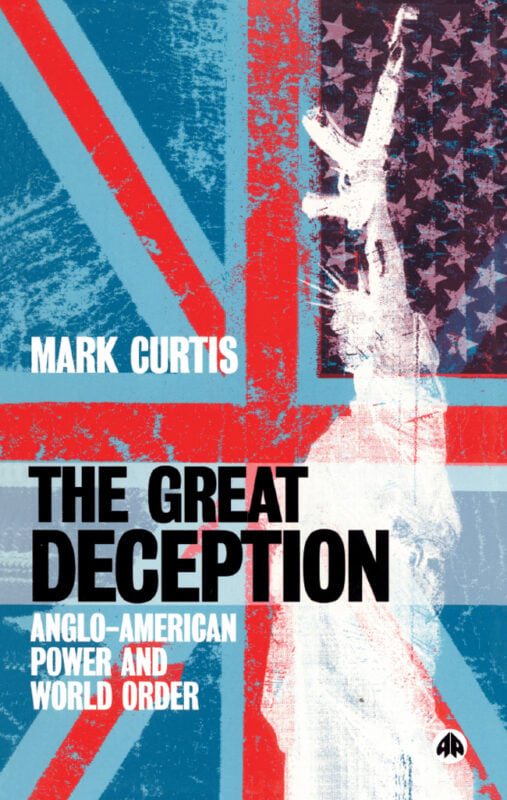
The book positions this network as the managerial system of the British Empire’s transition into an Anglo-American alliance. Through the formation of the Bank for International Settlements (BIS), it established a permanent mechanism for coordinating global finance. These institutions, the authors assert, engineered wars as instruments of restructuring: through conflict, they redrew boundaries, reallocated debt, and reestablished the supremacy of Anglo-American capital.
The Fabrication of German Guilt
The narrative opens with the Treaty of Versailles, where Germany accepted responsibility for World War I under Article 231. Macgregor and O’Dowd describe this clause as a coerced confession, extracted through blockade and starvation. They document how hundreds of thousands of German civilians died between the Armistice of November 1918 and the signing of the treaty in June 1919 due to Allied restrictions on food imports. This economic strangulation, according to the authors, forced Germany’s submission and framed the nation as the moral culprit of the war.
They trace the dissemination of this guilt narrative through Oxford University’s historians and theologians who, during and after the war, produced state-approved histories that sanctified Britain’s intervention. Works such as The Great War: The Standard History of the All-Europe Conflict and the Oxford Pamphlets propagated the idea of British righteousness and German barbarity. By aligning moral authority with imperial ambition, British academia transformed propaganda into doctrine. The authors document how these narratives shaped public consciousness, ensuring that generations of students absorbed a single interpretation of history that concealed the deeper structures of power.
Dissenting Voices and Suppressed Scholars
Macgregor and O’Dowd recover the work of American historians who challenged the official account. Harry Elmer Barnes, author of The Genesis of the World War (1926), presented archival evidence showing that Germany sought to prevent war in 1914 and that Austria-Hungary’s actions were provoked by Serbian nationalism supported by Russia. Barnes’s analysis, supported by later research from Sidney Bradshaw Fay and Emil Ludwig, demonstrated that Russia and France had mobilized their forces before Germany. These findings, which undermined the Versailles narrative, were suppressed in Britain. The British press denounced Barnes as a German agent, and booksellers refused to distribute his work.
The authors situate this suppression within a broader pattern of intellectual control. Institutions such as the British Foreign Office’s Political Intelligence Department and the Oxford History Faculty coordinated messaging to sustain the war’s moral justification. They argue that historical orthodoxy became an instrument of geopolitical management. In this environment, truth functioned as a liability, and academic dissent was reclassified as treason.
The Financial Mechanism Behind War
The book identifies the City of London as the command center of imperial finance. E.C. Knuth’s The Empire of “The City” provides the foundation for this analysis. Macgregor and O’Dowd describe how the City operated as a sovereign enclave—its police force answerable to the Corporation of London rather than the British state. Within this structure, banking dynasties such as Rothschild, Baring, and Morgan coordinated international loans and war financing. The system’s coherence derived from secrecy and mutual dependence: governments required credit to wage war, and banks required wars to expand credit.
The authors present this as an operational cycle. The First World War produced massive debt, which concentrated financial power. The Second World War restructured the same network under the pretext of rescuing civilization from tyranny. Both wars, they argue, consolidated the monetary hegemony of the Anglo-American bloc.
Carroll Quigley and the Anglo-American Establishment
The book devotes substantial attention to Carroll Quigley, the Georgetown University historian who documented the existence of the Rhodes–Milner Group. Quigley’s The Anglo-American Establishment and Tragedy and Hope are treated as essential to understanding how private networks directed foreign policy. Quigley described a “triple-front penetration” through politics, education, and journalism. The inner circle, “The Society of the Elect,” included Rhodes, Milner, William T. Stead, Reginald Brett (Lord Esher), and banker Lord Nathaniel Rothschild. Their outer circle, “The Association of Helpers,” extended influence across the Commonwealth, including the United States, Canada, and South Africa.
Macgregor and O’Dowd integrate Quigley’s documentation into their central thesis: that a unified Anglo-American elite engineered historical events through strategic manipulation of governments and the control of information. They recount how Quigley gained access to the group’s secret papers during the 1960s and recorded its involvement in major twentieth-century events—from the founding of the League of Nations to the policy of appeasement toward Nazi Germany.
The Manufacturing of Hitler
The authors trace the postwar reorganization of Germany under Allied supervision. They assert that Anglo-American intelligence and finance deliberately cultivated Adolf Hitler as a geopolitical instrument. Through agents such as Ernst Hanfstaengl, a Harvard-educated German-American with connections to both Roosevelt and Churchill, the Western elite maintained indirect influence over Hitler’s rise. Hanfstaengl introduced Hitler to international backers, facilitated propaganda channels, and helped shape his public image.
According to the authors, Hitler’s ascent served a dual function: to destroy the Weimar Republic, which threatened to rebuild Germany through economic nationalism, and to ignite another continental war that would again justify Anglo-American intervention. The book documents funding streams from British and American industrial interests, including the connections of the Bank for International Settlements and firms like Brown Brothers Harriman, whose partners included Prescott Bush. The analysis suggests that Hitler’s Germany functioned as a controlled detonation—a calculated collapse designed to eliminate a rival industrial power.
The Continuity of Power Through War
Macgregor and O’Dowd interpret the two world wars as phases of a single systemic process. The First dismantled the European monarchies and centralized global finance; the Second replaced empire with a new order of corporate governance under American leadership. They emphasize the continuity of personnel and institutions: the same banking houses, intelligence operatives, and diplomatic foundations that shaped the interwar period reemerged in the postwar framework of Bretton Woods, NATO, and the United Nations.
This structure, the authors contend, institutionalized global dependency. Nations no longer fought for territory but for economic access managed by transnational elites. The wars’ devastation enabled reconstruction financed through Anglo-American credit, securing a cycle of debt and dominance.
Academic Corruption and Historical Control
A central argument of the book concerns the weaponization of historiography. The authors describe how universities, foundations, and publishing houses became extensions of elite policy. Funding from the Rockefeller Foundation, the Carnegie Endowment, and the Rhodes Trust shaped curricula and research priorities. Historians who aligned with official narratives received promotion and publication; those who questioned them faced professional isolation.
Macgregor and O’Dowd regard this intellectual control as the most effective tool of empire. By controlling the production of history, elites controlled public memory. The authors reference David Hackett Fischer’s Historians’ Fallacies and John V. Denson’s writings on truthful historiography to demonstrate how repetition substitutes for evidence. They cite George Orwell’s dictum—“Who controls the past controls the future”—as an operational principle, not a metaphor.
The Legacy of Silence in Germany
The book concludes that postwar Germany remained shackled by the doctrine of Kriegsschuld, or war guilt. German law prohibits public challenge to the Allied version of the wars, a restriction the authors interpret as a symptom of continued subordination. They include testimony from an unnamed German researcher who assisted in the project but requested anonymity to avoid prosecution. Through this lens, the authors depict postwar Europe as an unfinished occupation, its intellectual freedom constrained by the victors’ moral narrative.
The Persistence of the System
Macgregor and O’Dowd trace the lineage of the imperial network into contemporary institutions. The City of London remains a sovereign enclave directing global finance. The Bank for International Settlements continues to coordinate monetary policy beyond democratic oversight. The military-industrial alliances of NATO preserve the geopolitical architecture first constructed under Milner’s vision of a global federation managed by Anglo-American elites.
They argue that the mechanisms identified by Carroll Quigley—secrecy, financial leverage, and educational control—persist in modern forms. Media conglomerates, think tanks, and philanthropic foundations continue the work of shaping perception, legitimizing conflict, and managing dissent. The authors treat this continuity as evidence of structural design rather than historical accident.
The Intellectual Courage of Inquiry
Dr. Jim Macgregor and Dr. John O’Dowd position their research within a lineage of independent scholarship that includes Quigley, Antony Sutton, and Guido Preparata. Their investigation demands a re-examination of the accepted historical canon. They present documentation, correspondence, and institutional links to demonstrate that the forces directing the twentieth century operated through coordination rather than coincidence.
The book’s tone reflects disciplined urgency. It seeks not to provoke conspiracy but to restore agency to historical analysis. The authors frame their work as an act of intellectual reclamation: by identifying the architects of global war, they aim to restore the integrity of historical understanding.
A Structure of Consequence
The narrative closes with the recognition that history functions as the architecture of power. Wars do not simply arise from national rivalry; they express systemic logic embedded within financial and political hierarchies. The authors treat the twentieth century as a single process of imperial evolution driven by design, maintained through secrecy, and sustained by consent manufactured through education and media.
Dr. Jim Macgregor and Dr. John O’Dowd’s investigation restores history to its operational dimension. Their evidence, argumentation, and moral intensity convert archival material into structural understanding. The book defines a pattern of coordination between finance, intelligence, and academia that directed the two world wars and shaped the modern world order. The claim stands as both indictment and revelation: power organizes itself through history, and the record of that organization lies hidden in plain view.