How the British Invented Communism (And Blamed It on the Jews)
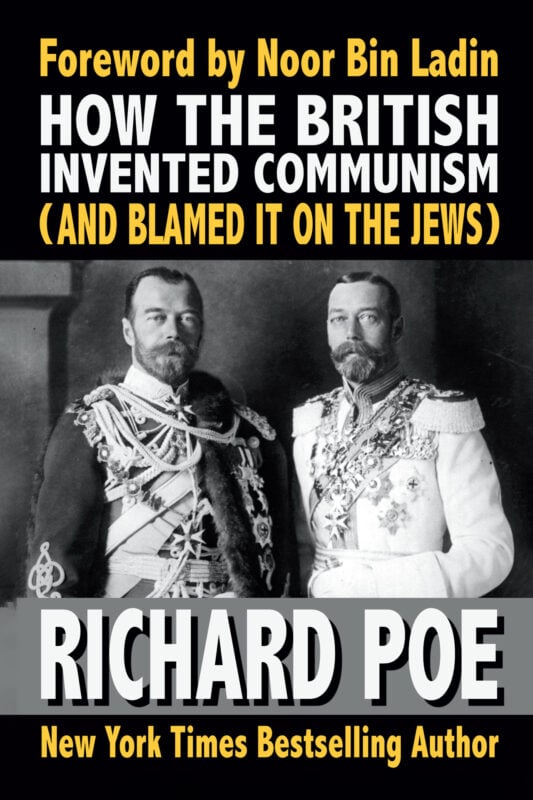
How the British Invented Communism (And Blamed It on the Jews) by Richard Poe reconstructs the architecture of modern revolution, identifying the British state as the prime mover behind the invention and deployment of communism as a tool of imperial strategy. In this account, the roots of twentieth-century upheaval, from the Russian Revolution to the rise of globalist ideologies, run through the intelligence networks, diplomatic intrigues, and propaganda engines of the British Empire. The argument synthesizes evidence from state archives, memoirs, propaganda campaigns, and eyewitness accounts to reveal a hidden hand shaping world events.
Revolution as Statecraft
This history proposes that revolutionary ideology, far from erupting organically, became a carefully honed weapon of British intelligence. During the long conflict with Russia, British officials recognized that subversion and regime change would serve imperial objectives better than conventional warfare. The Russian Revolution emerges as the apex of this strategy. In the chaos of 1917, the British government supplied support, guidance, and safe passage to key revolutionary actors, ensuring the collapse of the Russian monarchy and the emergence of a pliant regime in its place.
Blame and the Manufacturing of Scapegoats
Winston Churchill’s notorious 1920 article, which ascribes responsibility for Bolshevism and “subversive movements” to Jews, forms a centerpiece in this machinery of misdirection. At the direction of government officials, the British press unleashed a campaign promoting the “Protocols of the Learned Elders of Zion,” channeled through trusted publishers, military translators, and coordinated media placement. This orchestration shaped public opinion, manufactured outrage, and shifted scrutiny from imperial operations to ethnic scapegoats. The consequences of this strategy resound across decades, embedding suspicion and conspiracy in the collective mind while allowing the architects of upheaval to operate behind the curtain.
Agents, Assets, and Strategic Outcomes
The story of Leon Trotsky—his arrest in Halifax, the intervention of British intelligence for his release, his close ties to Churchill’s own cousin, and his rapid ascent to revolutionary command—illustrates the depth of British influence. Multiple sources, including diplomatic testimony and memoirs, confirm the pattern of intervention, favor, and strategic direction provided by British operatives. In the broader sweep of events, British agents embedded themselves within liberal and revolutionary circles, directing policy and events in Petrograd and beyond. Russian exiles, diplomats, and aristocrats repeatedly identified the British Embassy as the epicenter of revolutionary planning.
Geopolitics and the Great Game
Centuries of rivalry with Russia, stretching from Catherine the Great’s “Greek Plan” through the Crimean War and into the twentieth century, shaped Britain’s geopolitical priorities. The struggle for access to the Black Sea, the Mediterranean, and the resources of Asia drove British diplomats and generals to block Russian ambitions at every turn. The Gallipoli Campaign stands as a calculated maneuver: a military effort structured for failure, designed to keep strategic prizes from Russian hands and maintain imperial leverage. The evidence—drawn from diplomatic archives, the sequence of secret treaties, and the subsequent redistribution of Persian oil—demonstrates intentionality and method, not accident or incompetence.
Resource Capture and Economic Leverage
After the Bolshevik triumph, Trotsky’s repudiation of Tsarist agreements enabled Britain to seize the Persian oilfields, transforming the Anglo-Persian Oil Company into a global behemoth. Nationalization, the withdrawal of Russian claims, and the rise of British Petroleum represent the financial fruits of clandestine statecraft. These outcomes solidified British economic and military power, anchoring the empire’s influence in the oil-driven order of the twentieth century.
Operationalizing Revolution: The Color Revolution Template
A lineage emerges from the eighteenth-century “color revolutions” to contemporary regime change. The operational playbook—psychological manipulation, infiltration, and simulated mass uprisings—originated in British practice. Gene Sharp, whose doctrine of nonviolent action drew on British military mentors and Oxford scholarship, stands as a modern expression of these methods. The manipulation of institutions, the cultivation of key actors, and the orchestration of public spectacle combine to engineer outcomes favorable to imperial interests.
The French Revolution Re-examined
This approach recasts the French Revolution as an early theater of British intervention. Thomas Jefferson’s observations and the documented influence of the London Revolution Society reveal how British radicals catalyzed the formation of Jacobin clubs and steered events toward radicalization. The rhetoric of internationalism, cosmopolitanism, and class war functioned as vectors for destabilization. The resulting violence and regime change aligned with British strategic priorities, neutralizing a powerful adversary and reshaping the continental order.
Ideology as a Weapon
Communism, in this analysis, arises less as a spontaneous doctrine than as an instrument fashioned for geopolitical use. The development of Marxist ideology—its connections to aristocratic patrons, its transmission through revolutionary networks, and its use as a tool for social engineering—unfolds within the framework of British design. The alliance of Marx with figures such as David Urquhart signals a convergence of reactionary and radical intent: both sought the elimination of the middle class and the undermining of the nation-state.
Cover Stories and the Dynamics of Power
Throughout the narrative, the creation of scapegoats serves as a tool for obscuring the true centers of agency. By directing public suspicion onto Jews and other convenient targets, the British establishment shielded itself from scrutiny and preserved the secrecy of its operations. This pattern recurs across successive revolutions, regime changes, and ideological campaigns, embedding itself in the political culture of modernity.
Modern Implications and the Globalist Continuum
The methods and imperatives established in the era of empire persist in today’s global order. The continuity of elite families, the structures of organizations like the Round Table and the World Economic Forum, and the strategic targeting of the middle class reflect enduring priorities. Globalist programs—technocratic control, surveillance, the dissolution of national sovereignty—trace their genealogy to these historical precedents.
Psychological Control and Social Engineering
The tools of manipulation have evolved, but the logic remains intact. Education, media, technology, and psychological operations now function as instruments for the pacification and transformation of populations. A caste of managers, technocrats, and obedient enforcers advances the same project of centralized control, seeking to neutralize dissent and concentrate authority.
Toward Reclaimed Knowledge
The argument culminates with a call to recover the knowledge erased by decades of propaganda and manipulation. History, when accurately understood, reveals the mechanisms by which revolutions, ideologies, and global systems serve the ambitions of ruling elites. Understanding these patterns enables resistance, clarity, and the possibility of restoring autonomy in an engineered world.