Ancient Wisdom and Modern Misconceptions: A Critique of Contemporary Scientism
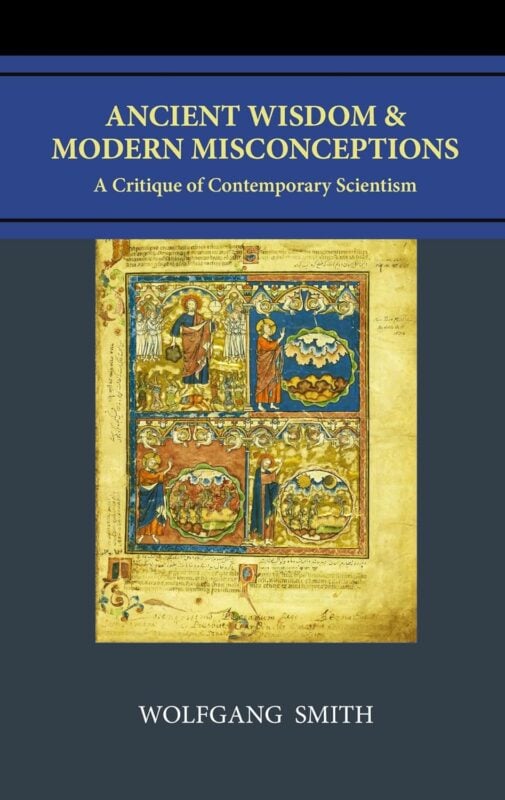
Ancient Wisdom and Modern Misconceptions: A Critique of Contemporary Scientism by Wolfgang Smith exposes the structural incoherence at the heart of contemporary scientific thought by confronting its foundational assumptions through metaphysical analysis grounded in perennial philosophy. Smith reveals how ancient cosmological insights provide not only a conceptual alternative but also a deeper interpretive coherence to scientific paradoxes that modern epistemology fails to resolve.
Scientism as Metaphysical Commitment
Scientism operates as a metaphysical dogma that conceals itself beneath the authority of empirical science. It asserts a worldview while denying that it is doing so. Smith uncovers this epistemological sleight of hand by distinguishing scientific discovery from ideological extrapolation. Quantum mechanics becomes the fulcrum for this critique. Smith highlights the interpretive crisis that quantum theory has provoked within physics itself. The apparent contradictions—particles in superposition, observer-dependent measurement—do not stem from flawed data but from faulty premises. Physics has reached the boundary where its foundational assumptions collapse into paradox.
Thomistic Metaphysics and the Structure of Reality
Smith offers Thomistic ontology as the conceptual key that unlocks the coherence within these paradoxes. The distinction between act and potency, form and matter, reestablishes ontological categories that modern science discarded but cannot function without. The concept of “substantial form” reasserts the unity of beings as wholes. Without it, quantum particles remain mathematical abstractions incapable of constituting corporeal reality. Smith argues that modern physics discovers physical systems but lacks the metaphysical vocabulary to describe them as beings. The physical universe, under the microscope of scientism, becomes a ghostly field of probabilistic states devoid of substance. Thomistic realism restores the intelligibility of this domain by identifying the corporeal object as a real entity unified by form and actualized in being.
Quantum Mechanics and the Illusion of Bifurcation
The Cartesian bifurcation between res extensa and res cogitans splits the object of perception into two irreconcilable realms: an external, mechanistic world and an internal, subjective experience. Smith traces the paradoxes of modern physics directly to this metaphysical fissure. Measurement in quantum mechanics terminates not in abstract states but in perceptible effects. The collapse of the wave function, inexplicable within the framework of Cartesian dualism, becomes intelligible when viewed as a vertical transition between ontological planes. Smith explains that the act of measurement crosses from the physical to the corporeal, from potency to act. The observed object is not an abstract probability cloud but a concrete reality made manifest through perceptual contact. This contact depends on the existence of substantial forms. Without them, measurement becomes an ontological absurdity.
Eddington, Frieden, and the Subjectivity of Measurement
Smith deepens his argument through engagement with figures like Arthur Eddington and Roy Frieden, who independently expose the epistemological role of the observer in constructing the physical universe. Eddington’s metaphor of the net and the fish demonstrates how the structures of perception and measurement shape the laws of physics. Frieden’s application of Fisher information theory confirms that these laws arise from the act of information extraction itself. Measurement does not merely reveal reality—it partially constitutes it. Smith shows that this does not imply relativism but demands metaphysical grounding. The universe described by physics is not the universe as such but the universe “so described” through a subjective frame. This frame becomes intelligible only when rooted in the hierarchical order of traditional cosmology, where man, as microcosm, stands in structural correspondence with the cosmos.
Tripartite Cosmos and the Rehumanization of Science
Smith reintroduces the tripartite structure of reality—body, soul, spirit—as an ontological map that aligns the human person with the order of the cosmos. This structure appears across sapiential traditions but finds its fullest expression in Christianity, where Christ, the Incarnate Logos, recapitulates the entire cosmic order within his person. The traditional doctrine of man as microcosm is not metaphor but metaphysical reality. In this framework, human knowing is possible because the knower participates in the structure of what is known. As Goethe said, the eye must be sun-like to see the sun. Smith interprets this reciprocity as the basis for epistemological realism. The mind does not project form onto chaos. It recognizes the intelligibility of being because it shares in the same ontological principles.
Cosmological Delusion in Astrophysical Extrapolation
Smith directs particular scrutiny at contemporary cosmology’s claims about the universe's origin, scale, and destiny. He critiques the Big Bang theory as an extrapolated construct unsupported by empirical necessity. Its theological appropriation by apologists only compounds the confusion. When scientists and theologians borrow from the same mythos without examining its philosophical roots, they propagate conceptual incoherence. Smith dismantles the ontological legitimacy of applying quantum or relativistic models to the entirety of existence. Physics, as a discipline, deals with experimental domains. When extended to the cosmos as a whole, it shifts from science to speculation. This extrapolation conflates mathematical model with metaphysical reality.
Geocentrism and the Restoration of Symbolic Space
Smith revisits geocentrism, not as a rival scientific hypothesis, but as a metaphysical statement about man’s place in the cosmos. The symbolic centrality of the Earth reflects a hierarchical order where meaning flows from the vertical axis of divine causation. Geocentrism in this context expresses the anthropological structure of the cosmos, where man occupies a privileged position by virtue of his mediating capacity. This symbolic grammar cannot be dismissed by spatial arguments. Smith asserts that space, as understood in traditional cosmology, possesses qualitative orientation. “Above” and “below” are metaphysical terms. When modern science strips space of all qualitative dimension, it loses the capacity to speak about meaning.
Intelligent Design and Vertical Causality
In his treatment of Intelligent Design, Smith distinguishes between horizontal and vertical causality. Horizontal causality explains events through chains of empirical interactions. Vertical causality grounds events in the hierarchy of being. Smith critiques the standard ID argument for failing to articulate this distinction. By remaining on the plane of empirical anomaly, it leaves the metaphysical implications undeveloped. He proposes that the phenomenon of biological order becomes intelligible only through vertical causality. This causality proceeds from the level of act, not merely from interaction among parts. Design implies the prior existence of form as an ontological principle, not a mechanistic inference. Smith’s intervention elevates the debate by situating it within the metaphysical framework required for coherence.
Anthropic Coincidence and the Misreading of Fine-Tuning
Smith addresses the anthropic principle, which claims that the universe appears finely tuned for life. He observes that proponents typically interpret this coincidence as evidence of a statistical anomaly or divine calibration. Both views rest on an empirical reductionism that treats life as an emergent property of matter. Smith reverses the direction of interpretation. He argues that the universe possesses the structure it does because it expresses man as microcosm. The cosmos is not adapted to man. It is intelligible through man. The anthropic principle becomes coherent only when understood as an expression of the traditional doctrine that man is the measure of the cosmos in symbolic and ontological terms.
The Path to Metaphysical Recovery
Smith concludes with a call for intellectual conversion. The path forward does not lie in creating new models or synthesizing science and religion through compromise. It requires a rejection of the metaphysical assumptions that produced scientism. Recovery begins with a recognition that truth is hierarchical, that knowledge presupposes being, and that the cosmos is structured by form. Physics cannot recover its intelligibility without rejoining the metaphysical tradition it once abandoned. Smith does not propose a retreat into the past but an ascent into a deeper order. The reactivation of perennial wisdom within scientific discourse marks the first step toward cultural renewal. Through critique, Smith reveals; through metaphysics, he restores; through tradition, he invites the reader to reenter a cosmos reenchanted by meaning.