Critique and Crises: Enlightenment and the Pathogenesis of Modern Society (Studies in Contemporary German Social Thought)
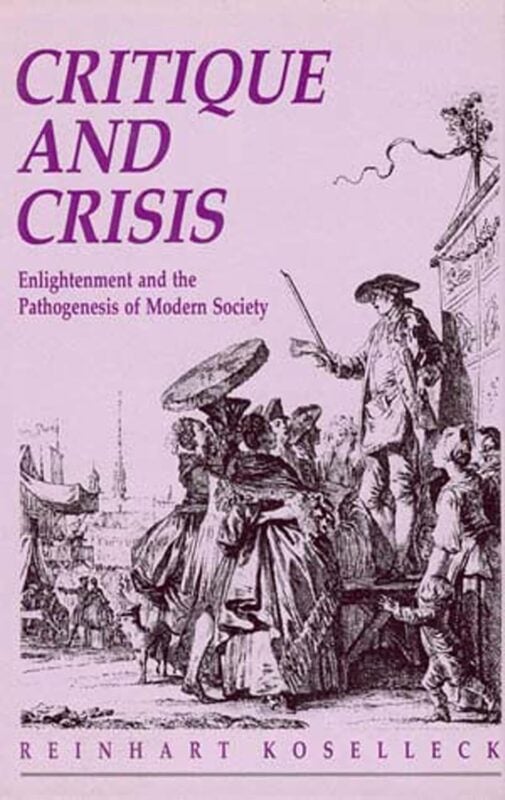
Critique and Crisis: Enlightenment and the Pathogenesis of Modern Society by Reinhart Koselleck investigates the roots of modern political and social upheaval within the fabric of Enlightenment thought and the structures of Absolutist power. Koselleck tracks the historical trajectory that forged modernity’s core dilemmas, tracing how a specific tension between critique and crisis became encoded within the West’s philosophical and political DNA.
Enlightenment Amidst Absolutism
In seventeenth- and eighteenth-century Europe, Absolutism rose in response to religious civil wars that devastated the continent. Monarchs, seeking stability, built centralized states that redefined authority by separating sovereign power from the moral and religious loyalties of their subjects. This realignment produced a dichotomy: rulers monopolized politics, while subjects—now subordinated as “society”—inhabited a domain of private morality and cultural endeavor.
Koselleck grounds his narrative in the conviction that Enlightenment thought materialized from this duality. As princes and bureaucracies absorbed public power, intellectuals and emerging bourgeois actors redirected their ambitions into critique—acts of judgment, moral evaluation, and philosophical speculation—which swelled outside the halls of direct governance. In this context, the Enlightenment’s legacy acquires new meaning: philosophy, literature, secret societies, and a “republic of letters” evolved not as distractions but as necessary responses to political exclusion. How did thinkers use their distance from power to create a new, assertive mode of intervention?
The Double-Edged Sword of Critique
The Enlightenment’s philosophical and moral critique grew in environments that shielded, yet constrained, its actors. Salons, Masonic lodges, clandestine journals, and a vast correspondence network fostered both solidarity and estrangement. Without the responsibility to govern, intellectuals developed a potent sense of righteousness that would inspire hopes for universal reform. This moral energy did not dissipate. It accumulated force as it judged the established order by standards of reason and natural justice.
In Koselleck’s analysis, critique operates both as a tool for intellectual liberation and as an instrument for delegitimizing existing power. The movement between these two functions creates a spiral of expectation and disappointment. The separation between politics and morality grows sharper as the critical spirit heightens its demands, often blind to the practical realities of rule, the dilemmas of decision, or the inertia of entrenched institutions. Koselleck observes that as critique intensifies, it begins to envision itself as a substitute for the authority it challenges.
Moral Utopianism and Political Disenchantment
The drive to subject the world to reason generates utopian projects—visions of a society regulated by pure justice and transparent laws. Koselleck asserts that these visions take shape precisely because Enlightenment actors, lacking power, relocate their energies into plans for an ideal future. By setting up an ethical court of history and projecting a rational order to come, the critical consciousness shapes a new mode of expectation. These hopes generate pressure on actual political structures and prepare the ground for rupture.
The desire for a moral world, sharpened through philosophical critique, exposes the paradox at the heart of Enlightenment thinking: it seeks to abolish the very dilemmas that make politics necessary. Koselleck defines the Enlightenment’s faith in progress as both an engine of transformation and a source of permanent dissatisfaction. When critical thinking advances ahead of political possibility, the risk grows that utopianism will replace prudent judgment and the ability to accept historical constraints. The narrative asks: When critique severs itself from political action, what forces does it unleash within the society it seeks to reform?
Revolution and the Birth of Crisis
The French Revolution crystallizes the convergence of critique and crisis. Koselleck presents this event not merely as a political convulsion, but as the moment when moral and philosophical critique, long accumulating outside the sphere of state power, breaks into the open and claims authority for itself. The structures of Absolutism buckle under the dual pressures of financial bankruptcy and the delegitimizing force of Enlightenment critique.
As the Revolution unfolds, the separation between morality and politics collapses. Revolutionary actors must confront the reality that exercising power brings dilemmas unimagined by the philosophical imagination. Koselleck demonstrates that this confrontation often results in disappointment, violence, and the rise of new forms of despotism—outcomes inseparable from the earlier idealizations of critique. The attempt to implement a utopian order generates conflicts and contradictions more acute than those of the ancien régime.
The Pathogenesis of Modern Society
Koselleck extends his inquiry beyond the Enlightenment and the French Revolution, examining how the crisis that erupted in eighteenth-century Europe sets the pattern for modern political and social life. The split between politics and morality, and the corresponding tension between critique and authority, persists as a central feature of modernity.
Modern society inherits from the Enlightenment a permanent dynamic of expectation and disappointment, critique and crisis. Koselleck identifies this dynamic as pathogenic: it creates the conditions for ideological polarization, recurring legitimacy crises, and the constant temptation to escape the difficulties of politics by retreating into moral or philosophical abstraction.
The Dialectic of Critique and Crisis
Throughout Koselleck’s account, the relationship between critique and crisis shapes not only the trajectory of political history, but also the inner logic of modern consciousness. The very concept of “crisis” in modern thought presupposes the power of critique to judge the present and forecast the future. Modernity defines itself by the expectation of progress and the anxiety of breakdown, by the possibility of rational reform and the fear of catastrophic failure.
This dialectic organizes the rhythm of historical development. Koselleck’s framework suggests that moments of stability give rise to renewed critique, while outbreaks of crisis summon efforts to stabilize through new forms of authority. The process produces cycles in which critique provokes crisis, crisis reshapes authority, and the legacy of critique remains embedded in the new order.
Utopian Visions, Political Limits
Koselleck’s narrative foregrounds the Enlightenment’s role in shaping a progressive philosophy of history—a vision of time as open, linear, and perfectible. This vision, however, brings its own dangers. The displacement of theological eschatology into secular teleology intensifies the hope for a just future, but also increases the pressure on political actors to fulfill impossible expectations.
When revolutionary or reformist projects confront obstacles—resistance, inertia, conflict—the result is often renewed crisis. Koselleck contends that the very structure of modern society, shaped by these utopian visions, makes it vulnerable to cycles of hope and disillusionment. Political actors must navigate the gap between moral aspiration and institutional reality, between the demand for justice and the requirement to govern.
Modernity’s Global Expansion
The structure that took shape in Enlightenment Europe expands to encompass global modernity. As Western models of politics, law, and reason spread, so too does the dynamic of critique and crisis. Ideological confrontations—liberalism, socialism, nationalism, and their offshoots—emerge from the same Enlightenment soil, each carrying the impulse to judge, transform, and surpass existing orders.
Koselleck locates the roots of twentieth-century crises—including world wars, revolutions, and the rise of totalitarian regimes—in the patterns established by Enlightenment critique. The Cold War, with its ideological oppositions and existential threats, continues the logic that first animated the Republic of Letters and the revolutionary assemblies.
Philosophy, History, and the Search for Order
Koselleck’s inquiry places the philosophy of history at the center of modernity’s dilemmas. The Enlightenment’s move from theological to historical teleology transfers the promise of redemption from the afterlife to the future of mankind. The expectation that reason can master history and direct society toward a rational end gives rise to both extraordinary achievements and profound instabilities.
The narrative invites a question: How can societies balance the drive for critique with the demands of political order? Koselleck’s analysis points to the inescapable reality that political life requires decisions under conditions of uncertainty, conflict, and finitude. Attempts to escape these realities—by projecting utopian futures or demanding the immediate realization of moral ideals—risk generating new forms of crisis.
The Enduring Tension of Modern Society
Koselleck closes with a call to recognize the structural tension that lies at the heart of modern experience. The pathogenesis of modern society arises not from a failure of will or imagination, but from the very dynamics that made Enlightenment critique so powerful. Modernity advances through the interplay of expectation and crisis, innovation and disappointment, the search for justice and the confrontation with the limits of action.
Societies sustain themselves not by abolishing critique or crisis, but by learning to navigate their recurrent patterns. Koselleck’s synthesis offers a genetic theory of modernity—one that illuminates the historical origins, ongoing dilemmas, and future challenges of the world shaped by the Enlightenment. The book asserts that understanding these dynamics remains essential for anyone who seeks to comprehend, and influence, the fate of modern society.