Eliminate the Opiate: Vol. 1
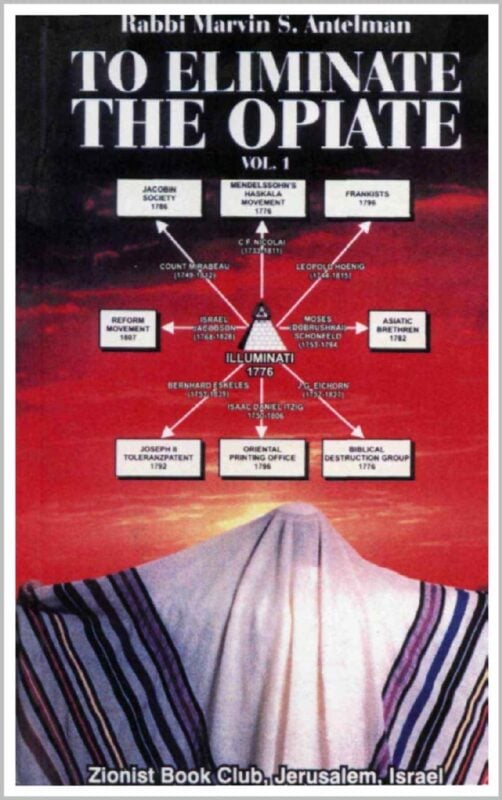
To Eliminate the Opiate Vol. 1 by Marvin Antelman investigates the organized historical forces that, through centuries of ideological movements, secret societies, and revolutionary upheavals, sought to undermine the foundations of Judaism and its ethical systems. The author presents a detailed, source-driven narrative, analyzing the convergence of wealth, ideology, and political maneuvering that produced the major ruptures within Jewish tradition and the broader social fabric of Western civilization.
Origins of the Conspiracy: Secret Societies and Revolutionary Ideologies
Antelman grounds his narrative in the late eighteenth and nineteenth centuries, tracing the genesis of revolutionary thought and covert manipulation to societies such as the Illuminati, founded in Bavaria by Adam Weishaupt, and the Bund der Gerechten, later known as the League of the Just. These organizations, driven by Plato’s vision in The Republic, created a hierarchical class system with distinct functions—rulers, workers, and the military. The Illuminati, established on May 1, 1776, mapped its structure directly onto Plato’s ideal, generating the intellectual architecture that inspired later revolutionary and communist movements.
The League of the Just, serving as the shadow engine for the Communist Party’s emergence, recruited Karl Marx to craft the foundational Communist Manifesto. The underlying motive lay in the drive to replace traditional authority—rooted in faith, family, and national identity—with a rational, secular, and collectivist world order. The architects of these movements built strategies for economic, political, and religious revolution. At their core, these strategies demanded the breakdown of inherited faith systems, above all Judaism, which the masterminds saw as both a foundational and persistent barrier to the total remaking of society.
The Role of Elite Financiers and Political Power
The transformation of abstract ideology into coordinated action depended on access to capital and political leverage. Antelman documents the role of major financial dynasties, including the Schiffs, Warburgs, and Rothschilds, who provided direct funding for revolutionary activities. Jacob Schiff, for example, contributed substantial sums to the Bolshevik Revolution and to the founding of organizations that would later steer the Reform and Conservative movements in Judaism. The Rothschilds and Warburgs, working alongside other elite non-Jewish families such as the Morgans and Rockefellers, functioned as the financial backbone of political change across Europe and America.
Within this matrix of power, secretive alliances orchestrated not just the destabilization of regimes but also the engineered fragmentation of religions. The conspirators—motivated by ambition, ideological commitment, or a combination—conceived a method of undermining authority from within, deploying divide-and-conquer strategies to splinter unified traditions into warring branches.
Schism and Secularization: The Rise of Reform and Conservative Movements
The history of Jewish schisms, as Antelman presents it, reveals calculated intervention by these elite circles. Abraham Geiger, selected by the Bund’s inner circle and aided by strategic marriages into families such as the Oppenheims and Schiffs, becomes the central figure in the launch of Reform Judaism. Geiger’s work in the early nineteenth century institutionalized a new approach to Jewish theology, one that separated the practice of Judaism from its belief in the divine origin of the Torah. The Reform movement rejected the Talmud’s authority and promoted liturgical innovation, philosophical rationalism, and ethical universalism.
Shortly after, as a buffer for traditionalists disaffected by the extremes of Reform, Zecharia Frankel and others launched the Conservative movement. This school, labeled the “historical school,” preserved ritual and ceremonial law for cultural continuity but refused to affirm divine revelation as the foundation of the Torah. The deliberate creation of these branches, Antelman contends, followed a coherent design: fragment the Jewish community and neutralize the religious and ethical power of Torah-based Judaism.
Religious Revolution and Social Engineering
The book identifies three primary axes of revolution: economic, political, and religious. While the political and economic aspects of revolutionary upheaval in the modern era are widely recognized—Bolshevik Russia, Maoist China, Castro’s Cuba—the religious revolution remains more carefully concealed. According to Antelman, the radical transformation of religion, especially Judaism, occurred through both intellectual seduction and institutional infiltration. Elite-controlled rabbinical seminaries and intellectual societies produced a new cadre of leaders who, equipped with resources and legitimacy, systematically promoted secularism, relativism, and atheism.
This revolution did not merely alter theological doctrines. It fostered new social mores, advocated changes in marriage, family, and sexuality, and worked to erode legal and cultural norms rooted in biblical law. Reform and Conservative movements, by institutionalizing these changes, advanced the broader aims of the revolutionary masterminds and hastened the decline of traditional Judaism’s influence on society at large.
Case Study: The Destruction of Boston’s Jewish Community
Antelman draws on personal experience and contemporary events to illustrate the local consequences of these global strategies. He describes the firebombing of a Jewish house in Dorchester, Massachusetts in 1971 and the subsequent legal and social battles involving radical Black militants, Communist front organizations, and Jewish collaborators. Antelman’s investigation revealed deep connections between Reform clergy, left-wing political organizations, and efforts to undermine the cohesion and security of Boston’s Jewish population.
He recounts the systematic expulsion, violence, and destruction visited upon Jewish neighborhoods, leading to the death of hundreds and the forced migration of tens of thousands. The book attributes these actions to the interplay of militant Marxist groups, financial backers, and sympathetic elements within the Jewish community itself, who prioritized ideological goals over communal protection.
Divide and Conquer: The Weaponization of Identity
The fragmentation of Jewish identity emerges as a central tactic in the wider campaign against religious authority. By promoting the label “Orthodox” as a term of derision—akin to a racial epithet—the architects of Reform and their allies succeeded in marginalizing authentic practitioners of Judaism. This strategy, rooted in Marxist and Illuminati traditions, aimed to sever generational continuity and communal solidarity. Through academic societies, intellectual salons, and rabbinical conferences, the propagandists of Reform and Conservative Judaism disseminated the idea that Judaism naturally branches into many legitimate forms. The historical reality, Antelman insists, is that Judaism had always recognized the unity of the Torah and its divine origin as the basis of communal life.
Efforts to replicate these divisive tactics beyond Western Europe found fierce resistance, notably in Russia. The Lubavitcher Rebbe, the Tzemach Tzedek, led the Chasidic defense against the imposition of secular schools and state-sponsored assimilation. The failure of Bund agents like Max Lillienthal in Russia exposed the limits of external manipulation, but it also provoked intensified efforts to subvert Jewish communities through both internal dissension and state violence.
The Protocols of the Elders of Zion: Propaganda and Historical Distortion
Antelman interrogates the origins and impact of the infamous Protocols of the Elders of Zion, exposing its status as a Russian imperial forgery and a tool for deflecting blame and confusing the identification of real conspiratorial networks. Czar Nicholas II, pursuing a vendetta against Jewish financiers, sponsored the publication of the Protocols and used it to foster anti-Semitic sentiment and distract from the genuine cross-ethnic alliances shaping revolutionary events.
The book asserts that conspiracy, as a mode of historical action, transcends ethnic and religious lines. Jews, Catholics, Protestants, and secularists participated in these movements for reasons that ranged from ambition and ideology to conviction and necessity. The true danger, Antelman claims, lies in the failure to distinguish between authentic religious tradition and those who seek its destruction from within.
Ethical Foundations: The Seven Laws of Noah and the Defense of Civilization
In opposition to the secularizing agenda of revolutionary elites, Antelman elevates the ethical core of Judaism—the Seven Laws of Noah—as the foundation of a civilized society. These laws, which prohibit idolatry, blasphemy, murder, illicit sexual relations, theft, cruelty to animals, and demand the establishment of courts of justice, define the minimal requirements for a functioning moral order. The Communist state, by subordinating law, family, and individual life to the needs of the state, promotes a barbaric ethic that contrasts with the sanctity of life at the heart of Judaism.
The defense of these laws and the traditions built upon them becomes, for Antelman, both a spiritual and existential imperative. He contends that the survival of Judaism and its ethical vision depends on the capacity to recognize, confront, and defeat the ideological and institutional enemies arrayed against it.
Structural Patterns and the Legacy of Subversion
The book synthesizes a broad range of sources and historical episodes to establish a recurring structural pattern: elite-directed conspiracies, empowered by wealth and protected by secrecy, target the spiritual and organizational heart of religious traditions. The creation of schismatic movements, the weaponization of identity, and the manipulation of social unrest operate as tools to fracture, assimilate, and ultimately neutralize resilient communities.
Antelman’s analysis underscores the ongoing relevance of these strategies in contemporary society, suggesting that the machinery of subversion adapts and persists across generations. The convergence of power, ideology, and strategy gives rise to new forms of crisis, requiring renewed vigilance and commitment to authentic tradition.
Call to Action: Restoration and Vigilance
The conclusion affirms the necessity of unity, education, and uncompromising fidelity to the Torah and its ethical imperatives. The author issues an appeal to Jews and non-Jews alike, urging them to discern the line between authentic tradition and the designs of those who would eliminate it. By reclaiming the spiritual heritage and moral clarity embedded in Jewish law and history, communities can resist the forces of fragmentation and subversion that continue to threaten their survival and integrity.
To Eliminate the Opiate Vol. 1 by Marvin Antelman stands as a provocative and detailed exploration of the interwoven forces that have shaped the modern Jewish experience, challenging readers to engage critically with both the visible and hidden dynamics of religious and social change. The book’s synthesis of historical research, personal experience, and polemical insight generates a narrative of high tension and persistent relevance for those seeking to understand the vulnerabilities and strengths of faith communities in the modern world.