Getting Us Into War
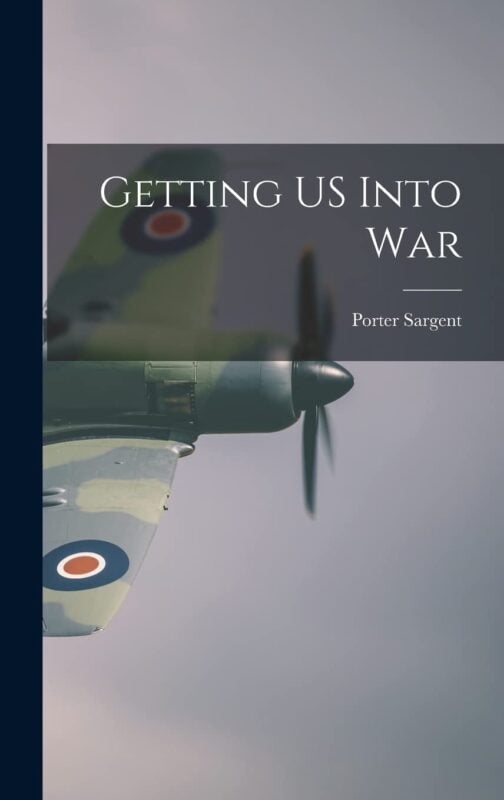
Getting US Into War by Porter Sargent investigates how American public opinion and governmental policy shifted to support U.S. involvement in World War II, exposing a matrix of political strategy, media manipulation, and international influence. Published in 1941, the book collects Sargent’s weekly bulletins alongside deeply researched commentary, reflecting a lifetime of observing power structures and propaganda.
The Road to Involvement
Porter Sargent traces the erosion of American neutrality through deliberate steps by public officials and private interests who, as he argues, coordinated with British policymakers to align the U.S. toward war. He details a chronology of speeches, laws, covert actions, and media narratives that framed the war as inevitable and morally necessary. At the core of this transformation lies a system of consent engineering that functioned through emotional appeals, patriotic slogans, and persistent misrepresentation of foreign developments.
Strategic Propaganda and Policy Convergence
Sargent asserts that British propaganda operations inside the U.S. cultivated a perception of moral duty and strategic kinship. These campaigns appealed to Anglo-Saxon heritage and exaggerated the threat of totalitarianism. Simultaneously, American political elites used these narratives to justify the abandonment of neutrality laws. Sargent identifies private foundations, academic institutions, media syndicates, and political figures who disseminated pro-British arguments while discouraging dissent. According to Sargent, this coordination was systematic, funded, and policy-driven.
The Role of Fear and Economic Leverage
Fear functioned as the prime motivator. Sargent shows how threats of Nazi expansion, espionage, and ideological subversion saturated the public discourse. He examines the repeated amplification of perceived military vulnerabilities and ideological infiltration to justify rearmament and conscription. These fears translated into massive appropriations, selective subsidies, and an economic realignment toward wartime industries. Business interests embraced the shift, anticipating profits from defense contracts and global access via military alliances.
The Collapse of Neutrality
Congressional debate and executive action steadily dismantled neutrality. From the repeal of the arms embargo to the Lend-Lease Act, legislative thresholds fell in response to orchestrated public pressure. Sargent dissects how legal milestones served as political cover for strategic commitments already made. He documents prewar joint military planning between Britain and the U.S., hidden beneath rhetorical commitments to peace. Government spokesmen assured the public of neutrality while coordinating deployment logistics and naval patrol strategies with Britain.
Intellectual Cover and Academic Mobilization
Universities became staging grounds for ideological endorsement. Sargent names Harvard, Columbia, and the University of Chicago as hubs for scholars who lent moral and historical weight to interventionist arguments. These academics framed the war as a civilizational struggle, blending Enlightenment rhetoric with strategic necessity. Through conferences, journals, and fellowships, they cultivated a narrative of democratic preservation that disguised political maneuvering as intellectual consensus.
Press Synchronization and Manufactured Consent
Press agencies and newspaper syndicates filtered and recoded foreign developments to support intervention. Sargent chronicles how editors, often briefed by government or British officials, crafted headlines and features that framed conflict in stark moral terms. He provides examples of omitted facts, buried counterarguments, and the recycling of talking points across publications. Emotional resonance took precedence over balanced reporting, transforming newsrooms into auxiliary propaganda centers.
The Moralization of Strategy
Just war language dominated public speeches, advertisements, and civic mobilizations. Sargent demonstrates how religious imagery, humanitarian appeals, and historical analogies framed the conflict as both redemptive and inevitable. This moralization stripped strategic questions of their ambiguity, casting opposition as appeasement or treason. Clergy, teachers, and civic leaders echoed this moral posture, reinforcing the state’s narrative through social institutions.
The Business of War Preparation
Sargent highlights the economic interests embedded in the push for war. Aircraft manufacturers, oil companies, and financial institutions expanded operations under government contracts. Their lobbying influenced procurement priorities and legislative language. Sargent details how war preparation became a commercial imperative, creating demand cycles that tethered peace to economic decline. These industries, once aligned with isolationism, embraced intervention as a route to growth and global market access.
Coordination Between Intelligence and Public Messaging
Information control extended into surveillance and censorship. Sargent outlines how intelligence agencies monitored dissenting voices, restricted critical publications, and coordinated with media outlets to suppress or reframe critical narratives. The effort was preemptive and persistent, identifying ideological nonconformity as a national security threat. This framework linked domestic surveillance with international commitments, integrating the home front into the larger strategic apparatus.
Civil Liberties Under Pressure
As war approached, Sargent describes a tightening of civil discourse. Critical voices faced character assassination, government scrutiny, and social ostracism. Congressional investigations targeted isolationist groups. Teachers lost jobs, publishers faced economic retaliation, and citizens hesitated to express skepticism. Civil liberties receded under the weight of patriotic conformity, and dissent was rebranded as sabotage.
Religious Institutions and Cultural Legitimacy
Religious leaders sanctified the war effort, framing it as a divine mandate to resist evil. Sargent identifies coordinated campaigns among Protestant and Catholic groups to align their teachings with state objectives. Religious publications and sermons echoed official rhetoric, creating spiritual legitimacy for military action. This alliance deepened the moral stakes, embedding war in the language of righteousness and salvation.
Historical Framing and National Identity
By invoking the Revolution, the Civil War, and World War I, proponents of intervention crafted a lineage of national purpose. Sargent details how speeches, textbooks, and radio broadcasts constructed continuity between past conflicts and present choices. This historiography conferred inevitability upon war, aligning it with national character. The public absorbed this framing, interpreting military action as the fulfillment of historical destiny.
Mechanisms of Cultural Synchronization
Cultural production—films, music, literature—amplified wartime messaging. Hollywood studios, guided by advisory boards with government ties, produced films that romanticized the Allied cause and vilified opponents. Popular music embraced patriotic themes, and mass-market novels centered on espionage and valor. Sargent analyzes how these outputs reinforced official narratives, transforming entertainment into indoctrination.
Strategic Timing and Political Opportunism
Election cycles, budget debates, and legislative recesses provided tactical windows. Sargent describes how policymakers used political timing to minimize opposition. Critical decisions were announced during holiday lulls or overshadowed by unrelated crises. Legislative packages bundled defense appropriations with popular social measures. Political momentum, once initiated, gained institutional inertia that outpaced public deliberation.
The Blueprint for Future Engagements
Sargent warns that the mechanisms used to bring the U.S. into World War II would endure as permanent fixtures of governance. He identifies a template: create emotional urgency, restrict dissent, align business incentives, and invoke moral necessity. These steps, once normalized, would lower the threshold for future interventions. Sargent presents this structure as a strategic system, reproducible and scalable.
Implications for Democratic Governance
The convergence of media, academia, industry, and government reshaped democratic participation. Sargent argues that informed consent became performative. The public, deprived of dissonant perspectives, ratified policies they never debated. Electoral legitimacy masked strategic consensus already achieved in back channels. Political discourse narrowed, and institutional checks softened under pressure from coordinated interests.
Legacy of the Interventionist Turn
Sargent frames the transformation as irreversible. The infrastructure of influence—legal, institutional, ideological—remains embedded. Future generations would inherit a geopolitical role determined less by public will than by strategic precedent. The war, once justified as defense, became a foundation for global assertion. Its prelude revealed the operational mechanics of modern power.
Conclusion
Getting US Into War constructs a forensic narrative of how democratic institutions can align to produce war through the convergence of fear, finance, and narrative control. Porter Sargent does not dwell in abstraction. He names the actors, reveals the mechanisms, and maps the sequence. His work serves as a structural diagnosis of policy formation in a mediated republic. The book remains a primary document for understanding how wars begin within democracies that promise peace.