How to Speak How to Listen
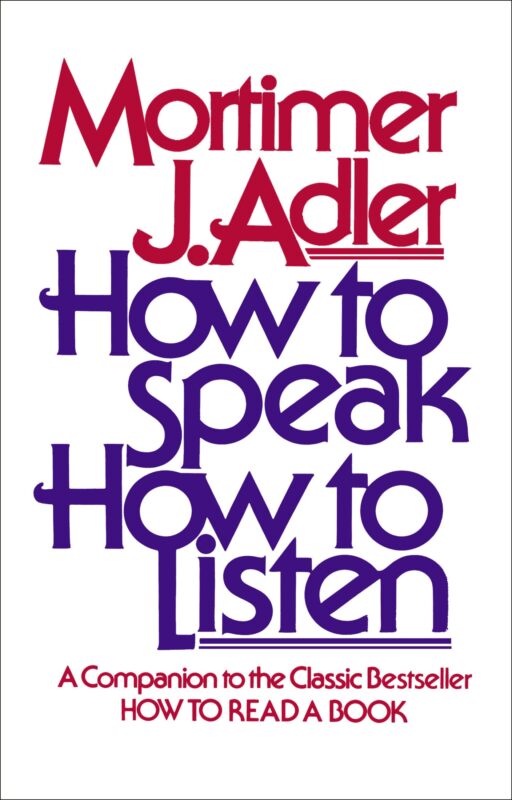
How to Speak How to Listen by Mortimer J. Adler presents a decisive reordering of communication priorities. Adler situates the act of speaking and listening at the center of human contact, insisting that the passage between minds occurs, above all, through oral language—spoken and heard, not merely written and read. His book insists that training in these skills yields measurable advantages in personal fulfillment, professional advancement, and the strengthening of civil society.
The Neglected Foundation of Communication
Mortimer J. Adler opens the field of language arts, distinguishing four essential performances: writing, reading, speaking, and listening. He grounds his argument in the observation that educational systems consistently favor writing and reading, giving formal instruction, curriculum hours, and continued assessment to these activities. In contrast, he demonstrates that schools rarely devote substantial resources to the systematic development of speaking and listening. This educational asymmetry, Adler contends, impedes the creation of fully competent communicators. Mastery of written forms cannot substitute for skill in oral exchanges. Where instruction lags, capability lags further.
The Historical Descent of Rhetoric and the Liberal Arts
Adler anchors his analysis in the history of the liberal arts, examining the transformation of grammar, rhetoric, and logic. Ancient and medieval educational institutions established these arts to furnish students with precise tools for language. Instruction in rhetoric supplied techniques for effective persuasion, while logic delivered structure to argument and grammar secured clarity and correctness. During the medieval period, proficiency in these arts validated one's capacity to participate in higher learning and civic life. The degree of Bachelor of Arts functioned as an endorsement of readiness to engage in advanced study and public discourse.
Gradually, the modern curriculum replaced this tradition. Adler traces the shift from the formal teaching of rhetoric and logic to a generic conception of “English” studies, where composition and reading command attention. The consequence is clear: students rarely gain exposure to persuasive speaking, advanced listening, or the strategies of sustained oral argument. This absence leads to diminished effectiveness in public life, business, politics, and even in private relationships. Adler positions the decline of rhetorical instruction as a root cause of contemporary deficiencies in public communication.
The Structure and Challenges of Oral Communication
Adler establishes that the mechanics of oral communication differ fundamentally from those of written exchange. Oral speech occurs in real time, unrepeatable and fleeting. The speaker cannot revise a phrase or reconstruct a point as one can on the written page. The listener cannot review the spoken word as a reader can revisit a paragraph. Success in oral communication, Adler argues, depends on instantaneous clarity, the immediate apprehension of meaning, and the mutual adjustment of speaker and listener within the moment of exchange. This ephemeral quality of speech sets higher demands on preparation, presence of mind, and adaptability.
Adler observes that in written communication, the physical separation of writer and reader supports solitary labor. Reading and writing occur independently, without social confrontation. Speaking and listening, by their nature, require physical or virtual proximity, social interaction, and responsiveness. These elements combine to create a more complex, unpredictable, and demanding communicative environment. Adler demonstrates that the ability to speak well in public, converse with precision, or listen with analytical acuity derives not from instinct, but from learned skill and disciplined practice.
The Architecture of Persuasion
Adler turns to Aristotle’s Rhetoric to formalize the architecture of persuasive speech. He delineates three primary instruments of persuasion: ethos, pathos, and logos. The speaker first establishes ethos—character and credibility—by presenting a trustworthy, knowledgeable, and appealing persona. Pathos engages the emotions and arouses motivations within the audience, providing the energy that drives assent and action. Logos organizes the logic of the argument, supplying reasons, examples, and connections that appeal to intellect and judgment. Adler insists that effective persuasion orchestrates all three elements, adjusting the balance according to the context and purpose of the exchange.
In practice, Adler illustrates these tactics with reference to classical speeches and everyday transactions. He discusses the process by which a speaker identifies and activates desires—such as justice, liberty, or personal advantage—already present within the audience. He analyzes how a speaker may awaken dormant needs, cultivate novel interests, or create alignment between individual motivations and collective aims. Adler frames persuasion as an ethical endeavor, distinguishing sharply between honest argument and sophistry. He refuses to conflate rhetorical skill with trickery, instead framing rhetoric as the artful use of language for responsible influence and legitimate advocacy.
Types of Speech: Persuasive and Instructive
Adler identifies two principal forms of uninterrupted speech: persuasive speech (sales talk) and instructive speech (lectures). In persuasive speech, the speaker seeks a practical outcome—action, agreement, support—by motivating listeners to accept a proposal, purchase a product, or endorse a candidate. Persuasion relies on activating beliefs, feelings, and commitments that translate into decision and behavior. Adler emphasizes the prevalence of persuasive communication in business, politics, legal argument, and even domestic conversation.
Instructive speech, on the other hand, aims to produce cognitive change—understanding, insight, reconsideration. The lecture model involves the organized presentation of knowledge, structured to facilitate learning, retention, and intellectual growth. Adler details the mechanics of effective lecturing, focusing on the ordering of material, pacing, clarity, and the rhetorical devices that foster comprehension and engagement. He asserts that instructive speech, though less reliant on emotional appeal, still benefits from the full resources of ethos, pathos, and logos. Even in the classroom, the speaker must inspire trust, sustain attention, and provide cogent reasons for belief.
Listening: The Undervalued Skill
Adler devotes considerable attention to listening, which he frames as the most underdeveloped and undervalued communicative skill. He describes listening as an active, disciplined performance that demands intellectual engagement, memory, and judgment. The listener decodes meaning, interprets intent, weighs evidence, and anticipates implications. Adler urges readers to adopt listening as a deliberate practice, rather than an incidental activity. He identifies barriers to effective listening: distraction, prejudice, emotional reactivity, and superficial attention. He offers strategies for improvement, including note-taking, summarization, and critical questioning. In Adler’s schema, the listener bears equal responsibility with the speaker for the success of communication.
The Social Function of Conversation
Adler positions conversation as the consummate act of speaking and listening—a dynamic, reciprocal exchange that constitutes the core of human community. Conversation unites speaker and listener in a shared pursuit of understanding, discovery, and connection. Adler distinguishes conversation from monologue, public address, or silent absorption, emphasizing its inherently collaborative character. Within conversation, participants alternate roles, responding, questioning, challenging, and clarifying. The dialogic flow sustains attention, fosters intellectual growth, and forges bonds of mutual respect and recognition.
Within this framework, Adler elevates conversation as a principal instrument of leisure, friendship, and collective progress. He asserts that conversation synthesizes knowledge acquired through solitary study and solitary thought, transforming it through the friction and stimulus of exchange. The enrichment of life through conversation arises when participants possess the requisite skills and the willingness to devote time and energy to its practice.
The Revival of Rhetorical Training
Adler concludes by calling for the restoration of rhetorical education as an urgent priority. He articulates a vision in which students receive systematic training in the arts of speaking and listening, integrated with instruction in logic and grammar. He anticipates a society in which adults continue to refine these skills throughout life, recognizing their value in both private and public spheres. The fruits of this revival manifest in improved business negotiations, clearer political discourse, richer personal relationships, and more effective leadership. Adler believes that mastery of the spoken word and attentive listening provides a pathway to greater achievement, social cohesion, and intellectual satisfaction.
Search Engine Optimization and Book Description
How to Speak How to Listen by Mortimer J. Adler stands as an authoritative resource for readers seeking practical techniques to improve communication. The book offers a unique blend of historical insight, practical guidance, and philosophical depth. Adler’s approach resonates with educators, business professionals, students, and anyone invested in the art of public speaking, persuasive presentations, and meaningful dialogue. Readers encounter a roadmap for mastering the essentials of rhetoric, building confidence in oral exchanges, and advancing the practice of attentive, critical listening.
The book’s content spans techniques for preparing and delivering speeches, structuring persuasive arguments, and navigating the social complexity of conversations. Adler grounds his strategies in the enduring wisdom of Aristotle and the experience of centuries of public discourse. He delivers case studies, actionable steps, and principles designed to build credibility, shape effective arguments, and sustain engagement.
Within the realm of professional development, the book serves as a reference for executives, managers, lawyers, teachers, and public figures. The methods outlined equip readers to present ideas with authority, influence audiences, negotiate successfully, and foster productive teams. Students and educators benefit from Adler’s detailed prescriptions for classroom speaking, debate, and group discussion.
Search engine queries seeking advice on communication skills, public speaking, effective listening, conversation techniques, rhetorical devices, persuasive strategies, or the history of rhetoric will discover comprehensive, actionable content within this work. Adler’s legacy endures in his insistence on clarity, precision, ethical persuasion, and mutual understanding.
Practical Benefits and Enduring Influence
Adler’s model for effective communication enables measurable advances in career, education, and civic participation. The book’s detailed analysis, narrative examples, and methodical framework provide a complete reference for mastering the arts of speech and listening. Readers who adopt Adler’s principles gain tools to express themselves with power, interpret others with discernment, and contribute meaningfully to public life. As organizations, schools, and communities seek ways to improve dialogue and collaboration, Adler’s guidance remains indispensable for those who value the spoken word and strive for deeper understanding.