On Materialism and Idealism (Collected Works of Adam Weishaupt Volume One)
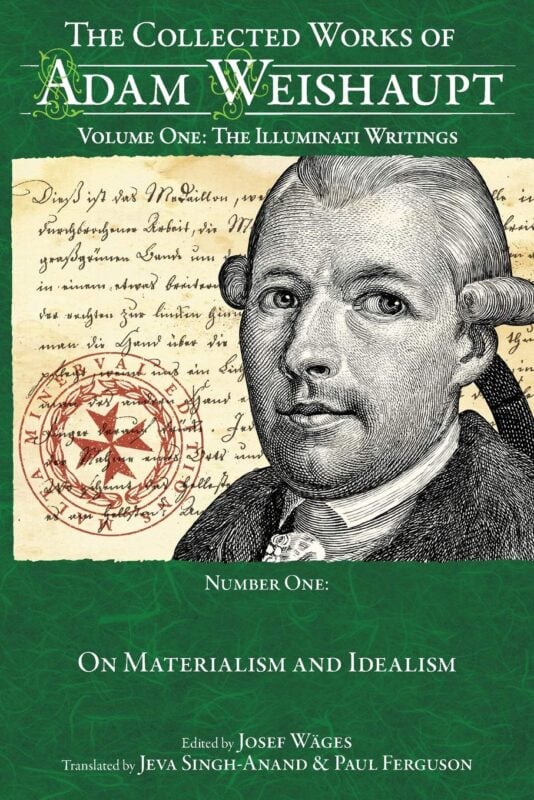
On Materialism and Idealism by Adam Weishaupt initiates a rigorous inquiry into the nature of reality, knowledge, and the soul by mapping the intersection of sensory experience and abstract reason. Weishaupt grounds his system in the Enlightenment context, yet presses far beyond its boundaries, arguing for a new synthesis that exposes the dynamic structure of thought and matter.
Foundations of Sensualist Idealism
Adam Weishaupt orchestrates an ambitious philosophical structure, placing sensory data at the root of human understanding. Perception does not merely collect sense impressions—it organizes and shapes the world for each observer. The faculties transform raw experience into coherent objects, binding together discrete sensations into meaningful wholes. The mind, when it receives an apple, integrates countless visual and tactile signals into a unified idea, not by passive reception but by active construction. Every individual, in living through their own senses, generates a world with its own boundaries, shapes, and colors.
Truth as a Product of Perceptual Diversity
Weishaupt defines truth through the lens of perception. He insists that the world seen by someone with altered senses—such as a person who sees with a yellow tint—reflects a legitimate reality. The authenticity of perception follows from the structure of the perceiver’s faculties, compelling the philosopher to treat all perceptions as valid within their context. As sensory modalities differ, so too do the realities and truths that emerge from them. Absolute truth recedes from reach, its contours determined by the limitations of each being’s perceptual system. Sciences, arts, and politics arise within these confines, growing from the specific ways in which sensory data shapes mental life.
Matter as Appearance, Substance as Cause
The composition of matter, in Weishaupt’s account, unfolds as a function of perception. Matter manifests when the senses unite an aggregate of causes into a form apprehensible to the mind. He illustrates this process through the example of pointillist painting, where the observer’s eye transforms separate dots into continuous images. The apple, as it exists for the observer, consists of clusters of atoms and molecules made available to consciousness through a perceptual filter. These clusters possess underlying causes, unseen but real, that give rise to the forms experienced by sentient beings. Weishaupt calls these forces “receptivities,” the active principles that organize sensory phenomena into the appearances of objects. The structure of human perception, when seen as both filter and creative agent, defines the boundaries of the known world.
The Collapse of Materialist Explanations
Weishaupt scrutinizes the materialist hypothesis with unyielding logic. He examines the proposition that thought emerges from composite physical matter, interrogating whether the union of insensate particles can ever yield consciousness. If no part in itself thinks, then their combination provides no pathway to awareness. The claim that refined or subtle forms of matter possess this power collapses under examination, since refinement of substance never produces a leap from insentience to sentience. The mind, Weishaupt insists, cannot be found in the dance of particles. The search for the seat of thought must move beyond material substance toward a realm where consciousness is primary and indivisible.
The Dynamics of Transformation and Palingenesis
In dialogue with Lessing and Bonnet, Weishaupt explores the transformation of the soul—palingenesis—as a progressive ascent through states of existence. The soul, released from its bodily senses at death, enters into a new mode of being defined by novel forms of receptivity. The philosopher imagines this process as a metamorphosis rather than a return or recycling of the same identity. Through this metamorphosis, consciousness acquires the possibility of perceiving dimensions of reality beyond those circumscribed by earthly faculties. Each passage through life and death amplifies the capacity for higher knowledge, forging a continuity across states of existence.
Natural Law, Ethics, and the Causal Web
Weishaupt constructs an ethics rooted in the causal structure of the universe. Actions generate effects that persist, shaping the destiny of the soul not through arbitrary judgment but by the unfolding of natural consequences. The constitution of the soul, when harmonized with the laws of reality, produces virtue; discordance yields suffering. The rewards and punishments of existence follow the same chain of causation that governs physical processes. The soul, by acting in accordance with the order of the world, advances toward higher states. Moral insight arises through the disciplined exercise of reason, coupled with a commitment to truth born of experience.
Science, Logic, and the Horizons of Knowledge
The sciences, as Weishaupt sees them, grow within the boundaries of human perception, each system of knowledge a response to the faculties and limitations of its creators. Mathematics and logic serve as tools for ordering phenomena within this field, yet their certainty depends on the sensory and conceptual structures available to the observer. Alternative forms of perception imply alternative systems of knowledge, each internally consistent but bounded by its own presuppositions. Progress in science and philosophy proceeds by acknowledging these boundaries and seeking ways to expand the range of possible experience. Inquiry, sustained by openness to diversity and anomaly, advances the frontiers of what can be known.
Historical Continuity and Philosophical Innovation
Weishaupt’s arguments resonate within the tradition of Enlightenment thought while forging new pathways beyond its conventions. His engagement with the works of Leibniz, Locke, and Lessing situates his system within a broader movement to reconcile reason and spirit. The Illuminati’s founder envisions philosophy as a force for intellectual and ethical renewal, capable of guiding individuals and societies toward greater insight and freedom. By emphasizing the creative power of reason, he advocates for a system that grants dignity to inquiry and purpose to human striving.
Anomalous Perception and the Expansion of Understanding
Weishaupt asserts that the investigation of irregular forms of perception—whether produced by injury, disability, or unique constitution—opens new avenues for knowledge. These cases, far from being aberrations, provide vital correctives and enhancements to conventional ways of seeing. Each anomaly uncovers a previously hidden aspect of reality, adding to the stock of collective understanding. By synthesizing the insights gained from diverse forms of experience, thinkers approach a more comprehensive view of truth. The convergence of difference produces not chaos but an expanded logic, one capable of integrating multiplicity into unity.
Rational Inquiry as the Path to Spiritual Meaning
The structure of Weishaupt’s spirituality rests on the foundation of rational investigation. He directs seekers to search for the primal cause of the world, following the chain of explanation to its origin. The design, order, and harmony evident in nature point toward an intelligent creative source, which reason names as God. The pursuit of this source does not demand recourse to mystical dogma or the abandonment of reason; instead, it calls for an intensified engagement with the evidence of experience and the power of thought. Spiritual realization grows through the disciplined exercise of intellect, guided by the awareness of interconnectedness and purpose within the universe.
Global Dimensions of Philosophical Reflection
Weishaupt recognizes that his system finds resonances in traditions beyond Europe, especially in the metaphysics of Buddhism and Hinduism. These systems, with their emphasis on transformation, receptivity, and the transcendence of form, enrich the conversation and demonstrate the global scope of philosophical inquiry. The journey of the soul, as described in the Heart Sutra and similar texts, affirms the possibility of modes of consciousness that surpass current understanding. By integrating these insights, Weishaupt’s work signals a future in which philosophy draws from the entire range of human experience.
The Enduring Value of Weishaupt’s Synthesis
The intellectual architecture of On Materialism and Idealism persists as a resource for those who seek to understand the interrelation of matter, mind, and meaning. Weishaupt’s synthesis unites empirical investigation with speculative depth, constructing a framework where science, philosophy, and ethics converge. The work challenges readers to follow the path of reason into the farthest reaches of possibility, discovering new forms of order and purpose at the heart of existence. Through disciplined inquiry and the embrace of diversity, Weishaupt offers a vision in which knowledge, virtue, and spiritual insight form a seamless whole. Those who engage with his thought encounter a living system, one that continues to inform debates on consciousness, reality, and the fate of the soul across disciplines and generations.