Ordo ab Chao: Volume Four: Mind Control
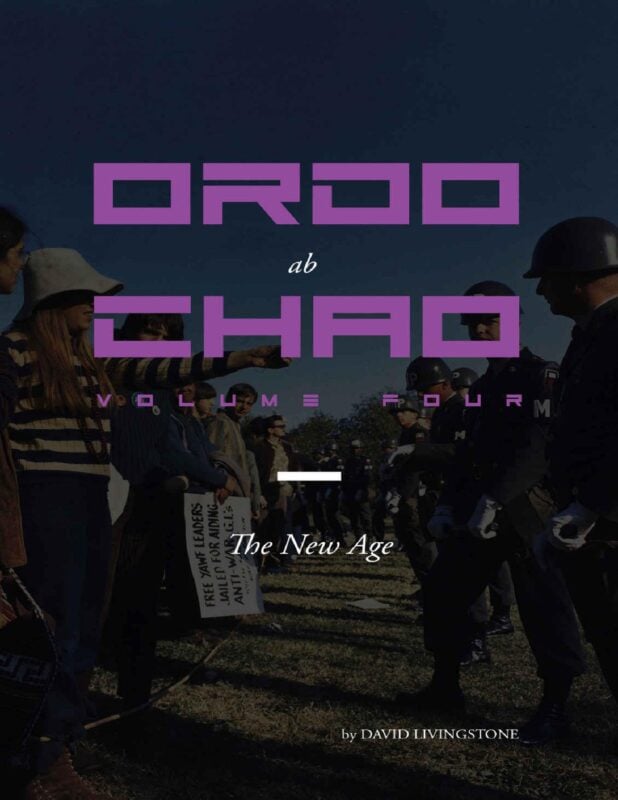
Mind Control, Psychedelics, and the Rise of the Modern Technocracy
David Livingstone’s Ordo ab Chao: Volume Four: Mind Control uncovers the deep historical and psychological networks behind twentieth-century experiments in mind control, linking them to elite institutions, esoteric traditions, and global power structures. The narrative moves through documented ties between intelligence agencies, occult ideologies, and scientific institutions to reveal how control over perception and identity shaped the modern world.
Tavistock, MK-Ultra, and the Infrastructure of Psychological War
The book begins by tracing the lineage of mind control through the Tavistock Institute, a British psychological research institution central to behavioral experimentation. John Rawlings Rees and Dr. John Rees are identified as architects of psychological operations during and after World War II. Their techniques, refined through military and intelligence programs, informed the design of MK-Ultra, a CIA project that integrated hypnosis, sensory deprivation, and psychedelic drugs to manipulate cognition and memory.
The structure of MK-Ultra did not emerge from void. It absorbed scientific talent and ideological paradigms from Nazi Germany, imported under Operation Paperclip. Institutions such as the Kaiser Wilhelm Institute, funded by the Rockefeller Foundation, incubated psychiatrists like Ernst Rüdin, whose racial hygiene theories fueled both eugenics and psychiatric genocide. These figures brought to America a model of mental illness management that equated schizophrenia with dangerous nonconformity.
Occult Foundations of Psychedelic Science
Mind control, in Livingstone’s account, rests not just on scientific coercion but on occult experimentation. Aldous Huxley, author of Brave New World, occupies a central place in this genealogy. His explorations into mescaline and LSD were not isolated artistic inquiries but formed part of a wider synarchist mission to cultivate “spiritual elites” who would shape society through altered states of consciousness. Huxley’s connection to Aleister Crowley and William James reveals the extent to which mystical and occult traditions informed the intellectual foundation of psychedelic research.
Through the CIA’s sponsorship of scientists like Dr. Humphry Osmond and Alfred Hubbard, LSD became a portal into both transcendence and manipulation. These men envisioned hallucinogens not merely as therapeutic tools but as levers of cultural engineering. The Rockefeller-backed Macy Conferences and the World Federation for Mental Health served as convergence points for psychiatry, cybernetics, and social engineering. These conferences constructed a model of the human mind as programmable, with societal applications in mass behavior modulation.
The Eugenic Logic of the Psychiatric Establishment
Livingstone connects the psychiatric underpinnings of mind control to a transatlantic eugenics network. Figures like Franz Kallmann and Otmar von Verschuer exported Nazi medical ideologies into American institutions, where they reemerged in sanitized forms through psychiatric genetics and population control programs. These scientists collaborated with institutions like Columbia University and the Scottish Rite Masons, maintaining continuity with wartime biopolitical agendas.
The continuity extended through experiments at Edgewood Arsenal and Fort Detrick, where psychotropic drugs and nerve agents tested on prisoners, soldiers, and the mentally ill aimed to determine thresholds of psychological collapse and compliance. LSD was not developed in isolation at Sandoz; it was known to IG Farben’s chemical warfare division, which coordinated with Nazi concentration camp experiments at Dachau. The CIA’s use of this chemical, therefore, forms part of a broader military-chemical alliance grounded in coercive psychiatry.
Psychedelics, the Counterculture, and Controlled Dissent
The emergence of the counterculture did not oppose the system—it exemplified an experimental phase in behavioral control. The Harvard Psilocybin Project, directed by Timothy Leary with support from CIA-linked figures such as Frank Barron and Aldous Huxley, served as a laboratory for testing how psychedelics could induce new social norms. Leary, instructed by Huxley to “cheerlead for evolution,” helped initiate artists and elites into a new spiritual framework that would restructure cultural values.
Psychedelic experiments were coordinated with religious rituals, including the Marsh Chapel experiment, designed to demonstrate the capacity of drugs to simulate mystical experience. These studies provided empirical frameworks for interpreting chemical-induced revelations as spiritual truth, feeding into the secular theology of personal liberation that defined the 1960s. Leary’s contacts at the CIA, and his repeated admission of their sponsorship, underscore the synthetic roots of what appeared to be spontaneous rebellion.
Alfred Kinsey and the Biopolitical Redefinition of Morality
Livingstone situates Alfred Kinsey’s sexual behavior studies within the same ideological ecosystem. Kinsey, whose research was funded by the Rockefeller Foundation and whose methods included data from pedophiles, presented a statistical reengineering of morality. His reports redefined normative behavior through pseudo-empirical surveys that distorted the prevalence of deviant acts by oversampling prisoners and sexual predators.
The Kinsey Institute, according to Livingstone, did not merely document sexual behavior—it fabricated a model of universal licentiousness to undermine traditional values and legitimize early sexualization. These findings became foundational to modern sex education and influenced institutions like UNESCO and the World Health Organization. The result was a policy architecture that reframed consent and age appropriateness through the lens of statistical relativity, rather than moral or psychological integrity.
Cybernetics and the Mapping of Human Response
Behind these initiatives lies a model of the human subject as system, developed through the science of cybernetics. Norbert Wiener, Gregory Bateson, and Margaret Mead, working with the Macy Foundation, engineered theories of feedback, inhibition, and information processing that applied equally to machines and minds. The Cybernetics Group worked under Rockefeller and Macy sponsorship to define the parameters of behavioral control across biology, anthropology, and psychiatry.
Cybernetics reimagined society as a programmable interface, with the family, education, media, and therapy as input-output systems. Bateson’s concept of “schismogenesis,” the study of social fragmentation, became a guiding principle for manipulating mass sentiment. The application of these principles in warfare, advertising, and education reveals a technocratic ambition to coordinate perception and action without requiring overt violence.
Operation Midnight Climax and Covert Behavioral Trials
The CIA’s Operation Midnight Climax tested these theories on unwitting civilians. Prostitutes lured men to safehouses rigged with one-way mirrors, where agents observed the effects of LSD on behavior, compliance, and memory. These trials exposed a core principle of the program: the capacity to alter behavior without consent through pharmacological and environmental manipulation.
Project Artichoke, Operation Bluebird, and MK-Ultra used mental hospitals, universities, and federal prisons to extend these experiments across the social spectrum. Volunteers often consisted of those least able to resist—addicts, minorities, and the mentally ill. Their suffering provided the data necessary to build a taxonomy of psychological thresholds that would later inform both therapeutic and carceral regimes.
Mass Media and the Engineering of Consent
Mind control required not only pharmacology but narrative control. Media alliances through Operation Mockingbird allowed intelligence agencies to shape news, entertainment, and literature. Time-Life, under Henry Luce, disseminated ideas developed by Wasson and Huxley to a mass audience. Reports of “magic mushrooms,” rebranded by CIA-friendly journalists, invited readers to embrace altered states as pathways to truth and freedom.
These narratives replaced religious transcendence with psychochemical enlightenment. The psychedelic experience, once taboo, became a rite of passage for the liberal elite. Underneath the rhetoric of personal freedom, Livingstone argues, lay a coordinated campaign to redefine consciousness, reprogram sexuality, and dismantle identity structures rooted in tradition.
Institutional Legacy and Ongoing Influence
The apparatus described in Ordo ab Chao: Volume Four: Mind Control did not dissolve after public exposure in the 1970s. It mutated. Programs were renamed, personnel reabsorbed into new agencies, and research outsourced to private institutions. The goals remained: to predict, control, and recondition human behavior at scale.
Contemporary institutions—biotechnology firms, social media platforms, behavioral economics departments—inherit both the methods and ambitions of earlier programs. The lineage of eugenics, cybernetics, and psychedelics converges in the present drive to quantify and optimize the human mind. Livingstone’s investigation presents this convergence not as accidental, but as the fulfillment of a century-long project to turn chaos into engineered order.