Shakespeare’s Unorthodox Biography: New Evidence of an Authorship Problem
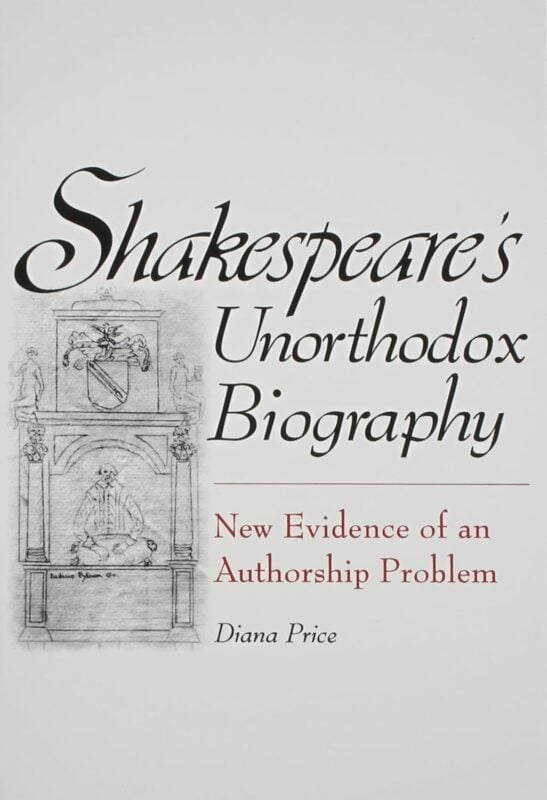
Shakespeare’s Unorthodox Biography: New Evidence of an Authorship Problem by Diana Price redefines the study of the Shakespearean authorship question through the precision of documentary research and the discipline of comparative biography. Price constructs a detailed evidentiary framework that examines the historical record of William Shakspere of Stratford-upon-Avon alongside the professional profiles of other Elizabethan writers. She positions her analysis within the history of literary documentation rather than within the tradition of literary interpretation, creating a forensic narrative that exposes an enduring problem in how authorship has been inferred, transmitted, and institutionalized.
A Documentary Structure of Inquiry
Price begins with the verifiable documents: baptismal records, marriage bonds, property deeds, tax defaults, and lawsuits. She establishes a corpus of approximately seventy authenticated records linked to the man from Stratford. None contain references to writing, reading, or literary work. She treats this omission as the foundation of her method. From this absence she constructs a matrix of evidentiary criteria that any literary biography must meet—education, correspondence, manuscripts, testimony from peers, or posthumous inventories of books and papers. Each test applied to Shakspere yields the same outcome. The surviving documents trace the actions of a businessman engaged in grain dealing, moneylending, and real estate acquisition. The record forms a mercantile biography rather than an intellectual one.
The Comparative Method
To define the magnitude of this anomaly, Price builds comparative case studies. She examines the biographical documentation for dramatists such as Ben Jonson, Thomas Dekker, George Chapman, Samuel Daniel, and Michael Drayton. Their archives contain manuscript evidence, letters, payments for writing, or references by patrons. From this comparison she derives a pattern of literary visibility: professional writers leave traces of authorship because their work generates administrative and financial records. The absence of such traces in the Stratford archive signals a different professional identity. Price transforms comparison into calibration, using it to measure the evidentiary deficit within the Shakespeare record.
The Concept of “Literary Paper Trails”
The book introduces the phrase “literary paper trail” as a diagnostic category. Price compiles a chart that lists each Elizabethan author and the forms of evidence surviving for them—letters, diaries, commissions, or manuscript drafts—and places Shakespeare’s column in stark contrast. The table ends in a blank space. This visual argument defines the authorship question not as speculation but as a problem of empirical asymmetry. The book’s methodological force comes from this architecture of comparison, which replaces opinion with audit.
Reconstruction of a Life Without Writing
Price’s reconstruction of William Shakspere’s life forms the narrative core of the study. She tracks his transactions through legal records: loans to John Clayton, a grain-hoarding citation during a famine, the purchase of New Place in Stratford, investments in tithes, and litigation over debts. Each record illuminates a man operating within local commerce and property law. His signatures appear only on documents of financial obligation. His social ascent culminates in the acquisition of a coat of arms for his father, which converts the family into gentry. The documentary sequence creates a coherent life story grounded in ambition, but the coherence belongs to the world of provincial enterprise, not to the London literary milieu. Price interprets this trajectory as the life of a man who capitalized on opportunity rather than cultivated art.
The Question of Education and Competence
The analysis of education forms a decisive pivot in the book. Price considers the grammar school curriculum of Stratford-upon-Avon, its lack of surviving registers, and the probable termination of Shakspere’s schooling at thirteen. She examines the linguistic range of the plays—over 20,000 distinct words, technical vocabularies in law, medicine, music, and aristocratic sports. She argues that such linguistic authority implies sustained scholarly training and cosmopolitan experience. The Stratford biography offers no mechanism for this acquisition. Her argument proceeds through structural logic: when linguistic data imply a level of education unsupported by documentary evidence, the identity of the writer becomes unstable.
The Hypothesis of the Pen Name
Price situates the pseudonym theory within the social conditions of Elizabethan England. She documents the cultural prohibition against nobles publishing under their own names. Gentlemen risked social degradation by writing for the stage, a profession considered mercenary. The book proposes that “William Shakespeare” functioned as a nom de plume adopted by a courtier with literary ambitions. The Stratford man’s identical name allowed him to appropriate the identity, intentionally or through social accident, benefiting from the economic circulation of the plays. Price connects this hypothesis to precedents in pseudonymous authorship—George Eliot, George Orwell, and the anonymous pamphleteers of earlier centuries—showing that concealment served specific social functions rather than romantic mystery.
Re-evaluating the Early References
Price analyzes the 1592 pamphlet Groatsworth of Wit, attributed to Robert Greene, which derides an “upstart crow beautified with our feathers” and mocks a “Shake-scene.” Biographers have long identified this with Shakespeare. Price dissects the chain of inference: the pamphlet names an actor, not an author, and offers no link to Stratford. Subsequent responses by Henry Chettle are equally ambiguous. By tracing the textual history of these references, Price demonstrates how a cluster of metaphors evolved into biographical evidence. The argument gains authority through close reading of original print editions and contemporaneous publishing conventions.
The First Folio and the Manufacture of Reputation
The 1623 First Folio becomes a central site of analysis. Price treats it as a posthumous artifact produced by actors and stationers who codified the association between Shakspere and the plays. She examines the dedicatory epistles, Ben Jonson’s prefatory poem, and Martin Droeshout’s engraving. Each component, she argues, constructs authorship through memorial language rather than documentary verification. The Folio serves as the first unambiguous moment when “William Shakespeare” becomes a singular literary identity. Price interprets this as the birth of the orthodoxy later institutionalized by scholars.
The Monument and the Memory of the Man
Price devotes detailed attention to the Stratford funerary monument. She traces its iconographic transformations through drawings and engravings from Sir William Dugdale, Wenceslaus Hollar, and George Vertue. Early depictions show a figure holding a sack, possibly of grain or wool, rather than a pen. Later restorations reframe the object as a writing surface. Price reads this visual evolution as evidence of retrospective authorship—the gradual redefinition of a local gentleman into a national poet through the reinterpretation of material culture.
Shakspere’s Network and the Question of Association
The book evaluates claims that Shakspere socialized with writers such as Ben Jonson and Michael Drayton. Price subjects these anecdotes to chronological scrutiny. The documents that link them appear decades after the events they describe. No correspondence between them survives. She reviews every instance in which Shakspere’s name appears beside other dramatists in company or court records, distinguishing between actors and authors. The conclusion remains consistent: the Stratford man operated as a shareholder and investor in theatrical enterprises rather than as a writer of scripts.
The Evidence of Commerce
Price reads financial records as cultural documents. She reconstructs Shakspere’s legal disputes—his pursuit of small debts in Stratford courts, his purchase of tithes worth £440, and his sale of malt to neighbors. She interprets these as patterns of economic behavior. The figure who emerges is methodical, litigious, and profit-driven. This behavioral continuity contradicts the image of a poet absorbed in creative abstraction. Her approach replaces psychological speculation with economic analysis, showing how documentary habits express professional identity.
The Linguistic Texture of Aristocratic Knowledge
The book explores the specialized lexicons of falconry, equestrianism, and courtly etiquette within the plays. Price identifies technical terms such as “tassel-gentle” and “to lure,” used accurately in Romeo and Juliet and elsewhere. She maps these terms to the recreational vocabulary of the Elizabethan aristocracy. This linguistic mapping supports her argument that the dramatist operated within a social milieu of courtiers and diplomats rather than merchants or tradesmen. The precision of vocabulary becomes evidence of class position and experiential knowledge.
Chronology and Displacement
Price reconsiders the dating of the plays in light of the biographical record. She notes that the peak of Shakespeare’s supposed creative output coincides with years when Shakspere was engaged in lawsuits and property transactions in Stratford. She uses this temporal conflict to question the practical feasibility of authorship. The overlapping timelines suggest distinct identities performing different roles within the same cultural network.
Method and Intellectual Legacy
The structure of the book demonstrates how documentary research can operate as literary criticism. Price’s method fuses historiography with textual study, producing a model for evidence-based literary biography. Her approach has influenced subsequent authorship inquiries and remains a reference point for both supporters and critics. The precision of her argument, grounded in verifiable records, gives the book enduring relevance in academic and archival discussions.
The Ethics of Attribution
Price ends with a philosophical reflection on authorship itself. She frames the issue as a question of historical accountability: who deserves credit for a body of work that shaped English literature? The attribution of authorship, she argues, must rest on the same evidentiary standards applied to any historical claim. The reverence surrounding Shakespeare cannot replace documentation. She calls for intellectual integrity in acknowledging uncertainty when evidence fails to meet that standard.
Reception and Scholarly Significance
Since its publication by Greenwood Press in 2001, the book has become a cornerstone of modern anti-Stratfordian scholarship. Academic reviewers have cited its rigor and restraint as a model of responsible revisionism. Price’s work redefined the conversation by removing the debate from the realm of conjectural authorship theories and returning it to the archives. Her insistence on the methodological neutrality of evidence transformed the Shakespeare authorship question into a legitimate field of historical investigation rather than a fringe curiosity.
The Continuing Inquiry
The argument that “William Shakespeare” functioned as an aristocratic pseudonym remains open-ended. Price invites future scholars to test her evidentiary model against new archival discoveries. She proposes that the problem of authorship exemplifies a larger challenge in Renaissance studies: the tension between literary myth and administrative record. The persistence of this tension sustains the vitality of her work, ensuring that the debate evolves through research rather than rhetoric.
Legacy of a Scholarly Vision
Diana Price brings to the field the discipline of an historian trained in the evaluation of evidence and the courage of a scholar willing to confront tradition. Her method of parallel documentation, her precise reconstruction of legal and financial transactions, and her meticulous comparative tables mark a decisive step in the history of Shakespeare studies. Shakespeare’s Unorthodox Biography endures as a work of archival intelligence—a book that redefines authorship as an evidentiary proposition and restores the Shakespeare question to the domain of serious scholarship.