The Fasces: A History of Ancient Rome’s Most Dangerous Political Symbol
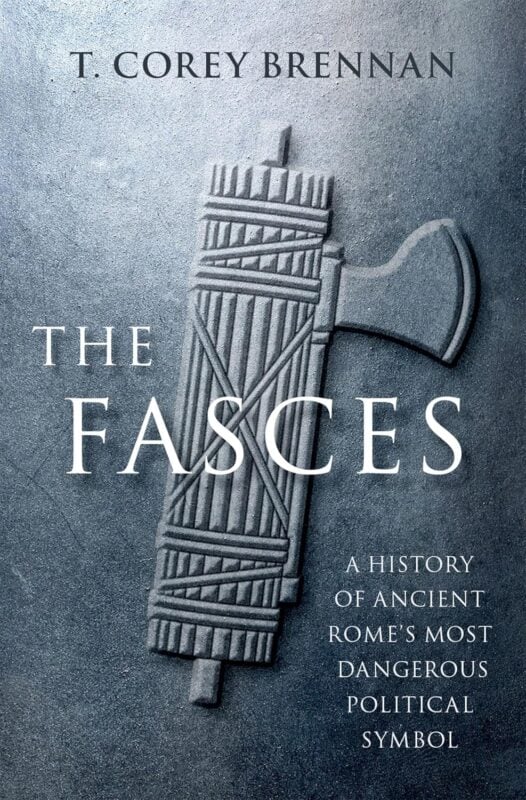
The Fasces: A History of Ancient Rome’s Most Dangerous Political Symbol by T. Corey Brennan investigates the lifecycle of one of Rome’s most enduring emblems of authority. Spanning its origins in Etruscan ritual to its violent resurrection in twentieth-century fascism, the fasces serves as a barometer of political power, state legitimacy, and ideological manipulation across millennia.
Ancient Power Encoded in Symbol
The fasces, a bundle of rods bound together with a projecting axe, did more than accompany Rome’s magistrates. It visualized imperium, the absolute authority to command military and judicial action. Roman kings, beginning with Tarquinius Priscus, brandished this icon as an emblem of divine sanction and civic order. The Romans did not invent this device. They inherited it from the Etruscans, whose elite tombs contained early iron models, signifying a synthesis of status and punitive potential. The physical object—rods and axe bound by leather—encapsulated Rome’s ideological DNA: unity through force, law upheld by violence, power inscribed in ritual.
Republican Redefinition and Civil Performance
As Rome transitioned from monarchy to Republic, the fasces survived as a contested inheritance. Early consuls preserved its form but negotiated its use to reflect shifting political balances. Lucius Junius Brutus, founder of the Republic, used the fasces to execute his own sons for conspiring with royalists. This spectacle marked the fasces as more than an insignia. It became an instrument of civic purification. Publius Valerius Publicola reformed its display—removing axes inside the city walls, rotating lictor access between consuls, lowering fasces in public assemblies—to anchor legitimacy in popular sovereignty rather than royal dominion.
Lictors and the Drama of State
The bearers of the fasces, the lictors, embodied state presence in both literal and figurative terms. Ancient texts portray them as low-born enforcers with reputations for brutality. Their proximity to magistrates symbolized the immediate availability of violence in service of public order. Lictors did not simply enforce commands; they dramatized the boundaries of Roman power. The fasces, as wielded by their hands, fused authority with spectacle. Livy, Cicero, and Plutarch describe scenarios where their appearance alone subdued opposition. In literature, the rods speak arrogance, the axe threatens finality, and the lictors march as agents of order’s last resort.
Myth, Fable, and Renaissance Revival
A fable intervened. Aesop’s tale of a father teaching his sons unity through a bundle of sticks migrated into interpretations of the fasces during the Renaissance. This misalignment between narrative and artifact softened the fasces’ original connotation of state-enforced violence into a didactic allegory of harmony. Artists, humanists, and political theorists conflated these meanings, embedding the fasces in iconography of collective strength, not coercive power. The parable spread across Europe, detaching the fasces from its juridical roots and inviting new layers of symbolic function, from monarchic consolidation to civic virtue.
Early Modern Mutations and Political Embrace
The fasces entered state symbolism in France and the United States during the 18th century. In revolutionary France, it represented unity and the people’s will, often paired with the Phrygian cap. In America, it appeared in architecture, coinage, and legislative ornamentation, signaling authority under law. The United States Capitol, Supreme Court building, and military insignia featured fasces prominently. What did these societies see in the rods and axe? A message of republican strength embedded in classical authority. That reappropriation depended on suppressing the Roman fasces’ punitive essence in favor of its associative grandeur.
Mussolini’s Fascist Refoundation
Benito Mussolini reversed centuries of symbolic drift. In 1919, he adopted the fasces to anchor the Italian Fascist movement in the imagined continuity of Roman authority. By 1926, it became the official emblem of the Italian state. His regime orchestrated a comprehensive visual campaign: coins, architecture, uniforms, and public monuments all carried the image. Mussolini’s architects scoured archaeological evidence to reconstruct an “authentic” fasces. The axe returned not as metaphor but as assertion. The symbol no longer implied unity through consent. It imposed submission through spectacle. Mussolini did not reinterpret the fasces—he reinstated its archaic violence as modern creed.
Erasure and Survival after Fascism
With the fall of Mussolini in 1943, the fasces entered a period of active suppression. Italian authorities removed them from public buildings and currency. Yet erasure remained incomplete. In the United States, the fasces continued to appear across federal iconography. Its presence persisted not from neglect but from divergent symbolic lineage. In Washington D.C., fasces stand behind Lincoln’s chair at the Memorial, carved years before Mussolini’s rise. The American version clings to a classical interpretation divorced from fascist brutality. Yet the ambiguity remains unresolved. Symbols transcend their historical moments only when context permits disassociation.
The Fasces in Contemporary Extremism
Recent decades have witnessed the fasces’ return in extremist iconography. White supremacist groups, particularly in the United States, integrate the symbol into logos, merchandise, and rally regalia. These groups exploit the symbol’s layered history to obscure intent. The fasces’ aesthetic form offers coded language: unity, order, ancient strength. Its origins in Roman authoritarianism provide ideological grounding without requiring textual justification. This new appropriation leverages the symbol’s obscurity to inject historical resonance into present-day radicalism. The fasces has become a vessel for ambiguity, weaponized for plausible deniability.
Symbol as System, History as Sediment
The fasces operates as a semiotic system composed of physical form, historical use, and cultural memory. Its rods signify collective strength, the axe judicial power, the leather bindings cohesion through constraint. Across eras, these elements acquire new meanings without shedding the old. A Roman lictor’s bundle, a Renaissance emblem of harmony, a fascist badge of control—each iteration layers new intentions over durable geometry. The symbol does not evolve. It accumulates. To read the fasces is to interpret strata of power, filtered through myth, reenacted in stone, minted in currency, and revived in ideology.
The Book’s Argument in Sharp Relief
T. Corey Brennan’s work insists on clarity amid confusion. He reconstructs the fasces not as a static icon but as a dynamic agent of political drama. The symbol’s longevity derives from its adaptability. Its danger lies in its return. The book maps this recurrence across material culture, coinage, civic ritual, and political theory. Brennan’s scholarship exposes the mechanics of symbolic transfer and ideological masking. The fasces is not a relic. It remains a live wire in the circuitry of political meaning. Understanding its trajectory helps explain how societies weaponize antiquity to consecrate authority and animate power.
Why This Symbol Matters Now
What happens when a civilization forgets the violence embedded in its visual codes? How do democratic societies reconcile classical references with authoritarian appropriation? The fasces poses these questions with unrelenting precision. Its current use by fringe groups does not merely echo Fascism. It reactivates Rome’s original script for state power—visible threat, ceremonial authority, performative violence. The past supplies more than aesthetic inheritance. It delivers a political script. The fasces binds ancient prerogative to modern ambition. This book teaches readers to read that binding.

About the Book
Author Videos: