Origins of the World War Volumes I & II
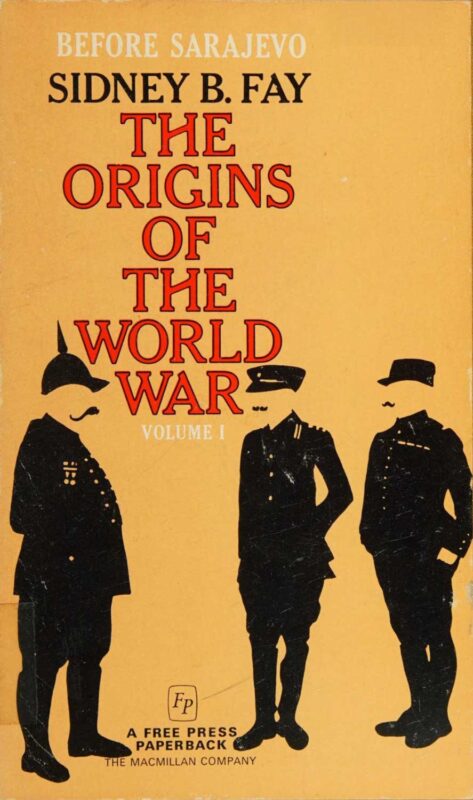
Sidney Bradshaw Fay’s The Origins of the World War reshapes the historical understanding of the causes behind the First World War through a meticulous and wide-ranging examination of diplomatic archives, memoirs, and treaties spanning from the late 19th century to 1914.
Rethinking Culpability: Who Set the World on Fire?
Fay dismantles the monolithic interpretation of German war guilt codified in the Treaty of Versailles. He tracks how the public and official narratives formed during wartime relied on incomplete or manipulated collections of diplomatic documents—the British Blue Book, the German White Book, the Russian Orange Book. By exposing omissions, alterations, and selective translations, he challenges the moral clarity presumed by these early wartime narratives.
Instead of isolating responsibility in Berlin or Vienna, Fay situates the outbreak of war within a network of intersecting decisions. He evaluates Austria-Hungary’s aggressive posture toward Serbia, Germany’s calculations about alliance solidarity, France’s diplomatic entanglements, and Russia’s mobilization strategies. In tracing the converging patterns of mobilization, deterrence failures, and alliance signaling, Fay reconstructs the conditions under which war became, for decision-makers, a necessary extension of policy.
The Machinery of Diplomacy: Alliances as Triggers
Diplomatic entrenchment defines the geopolitical landscape of the prewar decades. Fay emphasizes the formation and evolution of secret alliances—the Dual Alliance, the Triple Alliance, the Franco-Russian Alliance, and the Entente Cordiale. Each alignment responds to perceived threats and reinforces strategic dependencies. These agreements embed automatic responses into diplomatic frameworks.
Austria’s commitment to the Triple Alliance linked its Balkans ambitions to German support. Russia’s loyalty to Serbia positioned it as the protector of Slavic nationalism, a role it formalized through its military conventions with France. The British-French military conversations from 1905 onward embedded assumptions of future cooperation. These commitments hardened decision-making. When Franz Ferdinand fell to an assassin’s bullet in Sarajevo, diplomatic responses did not merely escalate—they activated a complex system preloaded with conditional obligations.
From Assassination to Mobilization: The Clockwork of Crisis
The assassination on June 28, 1914, initiates a diplomatic countdown. Fay reconstructs the thirty-seven days between the killing and the outbreak of general war through daily dispatches and internal memos. He details Austria’s ultimatum to Serbia, which carried deliberately unacceptable demands. Germany’s support, pledged during the Potsdam meetings, emboldened Vienna’s resolve. Fay underlines that Berlin believed in a localized war. That belief determined Germany’s risk calculus. Its commitment to Austria was not based on military timing but diplomatic misreading.
Russia’s partial mobilization transformed into full mobilization in response to Austria’s declaration of war. That shift carried immense consequences. German military plans required immediate and total mobilization against both France and Russia. France, bound to Russia by military convention, could not signal neutrality. Britain’s decision-makers debated intervention until the German violation of Belgian neutrality forced their hand.
Narratives of Delay and Denial: How Peace Was Lost
Fay follows the arguments made by European statesmen during the July crisis to forestall war. He analyzes Grey’s mediation efforts, Bethmann’s “pledge plan,” the backchannel communications between Wilhelm II and Nicholas II. None of these initiatives moved fast enough to arrest the chain reaction.
Fay does not attribute failure to a single actor or refusal. He argues that each government acted under real constraints—military timetables, alliance expectations, public pressures, internal politics. Delays in communications, poor translations, and misinterpreted intentions compounded the risks. Mobilization, once begun, stripped leaders of alternative tools. No nation could reverse course without inviting strategic catastrophe.
The Archduke’s Role: Symbol, Catalyst, or Threat?
Franz Ferdinand represented a paradox within the Habsburg monarchy. He opposed war with Serbia and supported federal reforms to accommodate Slavic populations within the empire. Fay examines his role not as architect of aggression, but as a threat to entrenched Austro-Hungarian nationalist and military agendas.
His assassination offered Austria’s leadership a unifying symbol for action. Fay scrutinizes the activities of Serbian nationalist groups such as the Black Hand and the Narodna Odbrana, showing how loosely coordinated networks created plausible deniability for official complicity. Austria’s investigation and decision to reject Serbia’s conciliatory reply to its ultimatum reveal a will to confrontation already in motion.
The Myth of Premeditation: What the Archives Reveal
Fay’s access to postwar document collections—the Kautsky documents, the Austrian Red Book, Soviet publications from the Tsarist archives—reshapes the evidentiary base. These sources reveal a more fluid, uncertain crisis than wartime propaganda suggested. He identifies Germany’s hopes for localization, Russia’s internal debates over partial versus full mobilization, and France’s concern about German intentions rather than eagerness for war.
Rather than seeking to exonerate, Fay emphasizes that decision-making under uncertainty produced compounded escalation. His argument rests not on moral defense, but on structural clarity: the war emerged from a volatile system of interlocked decisions, poor communication, and rigid planning frameworks.
Military Logic and Strategic Deadlines: Plans That Preempted Peace
The Schlieffen Plan and its French counterpart determined sequences of action before diplomacy could complete its course. Fay reveals how military planners operated on timelines independent of political decisions. These schedules dominated July’s endgame.
In Germany, the window for full mobilization closed fast once Russia moved. The French General Staff pressed for readiness without awaiting diplomatic outcomes. Russia’s railway limitations meant its mobilization had to occur in stages, turning partial deployments into de facto general war preparation. Each nation interpreted the other's movements as aggressive certainty, even when internal records show indecision and debate.
The Press, the Public, and Political Theater
Fay exposes how press rhetoric inflamed perceptions and cornered statesmen. Newspapers, influenced by nationalist fervor and influenced by limited official releases, fueled public demands for strength. Political leaders in Paris, Berlin, and Vienna responded to these pressures while concealing the full scope of their internal doubts.
Memoirs and postwar confessions, often self-serving or vindictive, misrepresent deliberations made under extreme stress. Fay dissects these narratives to uncover inconsistencies, contradictions, and strategic silences. He considers not only what documents reveal, but what their absences imply.
Serbia and the Balkans: Regional Tensions as European Trigger
The Balkan context shapes the crisis’s ignition. Fay devotes substantial attention to the regional frictions that accumulated between 1908 and 1914. Serbia’s expansionist aspirations after the Balkan Wars of 1912–13 threatened Austria’s regional dominance. Vienna perceived Serbia’s nationalism as existential. Fay evaluates Serbia’s internal political divisions, highlighting the role of intelligence networks and the blurred lines between official policy and secret operations.
Austria’s 1908 annexation of Bosnia deepened this rift. Fay details how failed diplomatic resolutions during previous Balkan crises taught Austria to act decisively. Germany’s support encouraged that posture. Fay’s documentation of the Balkan League, Russia’s pan-Slavic ambitions, and the Austro-Hungarian strategic position demonstrates how regional conflict acquired European significance.
The Historian’s Task: Telling How It Really Came About
Fay closes with a methodological reflection. He urges historians to look beyond wartime simplifications and nationalist mythologies. The goal is not apportioning guilt, but reconstructing the decisions that led to the war’s outbreak. Fay claims this requires neutrality, access to all relevant documentation, and a commitment to understanding motives from within their historical context.
His insistence on structural analysis, combined with his critique of manipulated records and memoirs, offers a model for historiographical precision. Fay’s work refuses both exoneration and condemnation without evidence. He positions the historian as arbiter of complex truths embedded in thousands of pages of diplomatic correspondence.
A Legacy of Clarity and Complexity
The Origins of the World War established a new benchmark for scholarship on the First World War’s outbreak. By interweaving multiple national perspectives, tracking evolving strategic calculations, and dissecting the machinery of alliance diplomacy, Fay built a comprehensive account that continues to inform historical inquiry.
He replaces moral judgment with structural insight. He shifts the focus from personalities to systems, from declarations to decisions, from propaganda to policy. The book stands as a detailed guide to the fragile architecture of peace and the cascading choices that led to its collapse.

About the Book