The Modern Anglo-Dutch Empire: Its Origins, Evolution, and Anti-Human Outlook
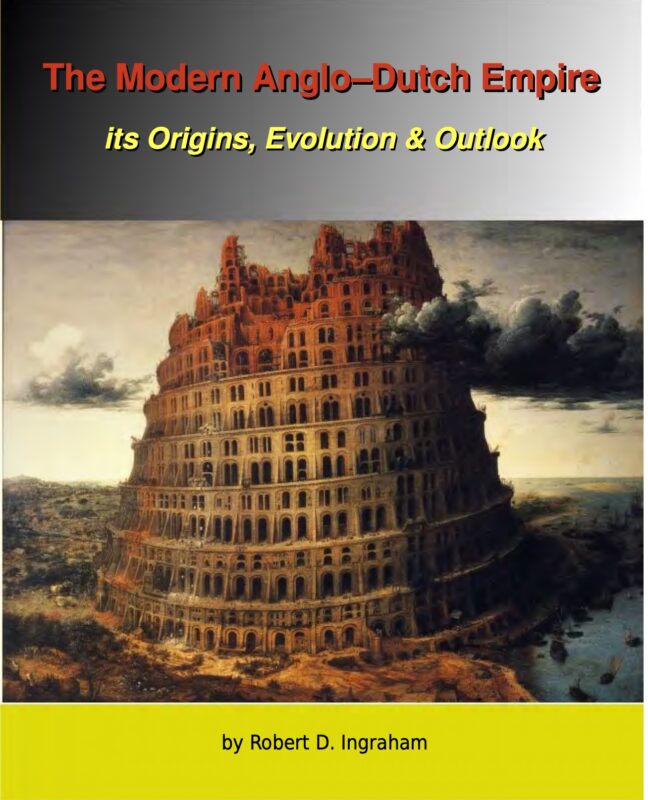
The Modern Anglo-Dutch Empire: Origins, Evolution, and Outlook by Robert D. Ingraham reveals a global financial oligarchy rooted in the transference of imperial power from Venice to Amsterdam and London. It frames this development not as the rise and fall of discrete empires, but as a continuous oligarchical structure that has persisted, adapted, and expanded through financial mechanisms rather than direct colonial rule.
The Venetian Genesis of Empire
Empire begins in Venice—not with territory, but with a worldview. The Venetian model fused banking, trade control, and legal manipulation into a consolidated oligarchical system. This structure subordinated republican governance to private wealth. Venice's dominance of Mediterranean commerce allowed it to prototype imperial economics based on finance, speculation, and slavery. After 1100, Venice’s reach extended into Byzantium, influencing ecclesiastical politics and banking across Europe. The Fourth Crusade and the sack of Constantinople cemented Venice as Europe’s commercial overlord.
From Venice to Amsterdam: Strategic Relocation of Power
By the late 16th century, as Venice’s Mediterranean dominance waned, a strategic shift of capital and oligarchical management moved north. This wasn’t spontaneous migration; it was a calculated reconstitution of the Venetian model in the Low Countries. The exodus from Antwerp after the Spanish reconquest in 1585 marked the transition. Amsterdam quickly emerged as the new financial nucleus, not merely inheriting Venice’s commercial institutions but expanding them. The Dutch East India Company (VOC) founded in 1602, the Amsterdam Exchange in 1608, and the Bank of Amsterdam in 1609 created the architecture of empire through finance.
The VOC: Sovereignty Without a State
The VOC was more than a trading company. It operated as an autonomous empire, with its own laws, armies, and taxation. Its directors governed cities, minted coins, and negotiated treaties. The VOC subjugated the Indonesian archipelago, established Batavia as its Asian capital, and imposed a ruthless regime of slavery and forced monopolies. Its control over nutmeg, cloves, and pepper created capital flows that enabled massive speculative expansion in Europe. No European entity had ever wielded such private economic power before.
1688: The Glorious Revolution as Takeover
The so-called Glorious Revolution of 1688 was not a domestic English affair. It was the geopolitical imposition of Dutch-Venetian financial interests. William of Orange’s ascent to the English throne allowed for the transplantation of Amsterdam’s financial structures into London. Within a few years, England adopted key instruments of the Dutch system: a central bank (the Bank of England, 1694), a funded national debt, and a stock market linked to sovereign debt issuance. These institutions transformed England from a maritime monarchy into a financial empire.
London and Amsterdam: One Oligarchy, Two Capitals
By 1700, the merger of Dutch and English finance created a binational oligarchy. Contracts and credit instruments flowed by ship between Amsterdam and London. Dutch capital bankrolled English wars, and British imperial expansions opened markets for Dutch finance. The coordination was total. The state became an agent of bondholders. National interest gave way to market interest. The empire’s wars—in India, the Caribbean, or Africa—were structured not by territorial logic but by bond premiums and debt service capacity.
Slavery as Core Mechanism
The Anglo-Dutch empire normalized slavery as an operational pillar. In the 17th century, both VOC and the Dutch West India Company (WIC) trafficked enslaved Africans across the Atlantic and Indo-Pacific. Colonies like Batavia, Capetown, and Curaçao had majority slave populations. British participation exploded after 1713, with London financing and insuring mass human trafficking. This was not incidental. The financial empire’s profitability rested on the extraction of labor at minimum cost and maximum speculative return. Slavery was coded into its balance sheets.
Locke, Sarpi, and the Intellectual Architecture of Empire
The empire required more than guns and ships. It needed ideological legitimacy. Paolo Sarpi, a Venetian monk and strategist, denied the existence of lawful human creativity. His empiricism displaced Platonic reason with mechanistic materialism. John Locke repurposed Sarpi’s model into political philosophy: the state existed to protect property, and property defined humanity. This epistemological shift underpinned modern economics, dismantled natural law, and paved the way for liberalism as imperial ideology.
Empire Without Armies: The Rise of Global Finance
The collapse of colonial empires in the 20th century did not end the Anglo-Dutch system. It evolved. From Bretton Woods to the European Union, from the World Trade Organization to offshore tax havens, the same structure reasserted itself. Financial power replaced political sovereignty. Central banks, hedge funds, and sovereign debt markets became the new instruments of governance. Privatization, deregulation, and speculative arbitrage enforced the empire’s logic globally.
Globalization as Imperial Continuity
Globalization functions as the empire’s final form. It centralizes capital without accountability, imposes debt structures on sovereign nations, and transforms economic life into perpetual extraction. Nations are not partners in this system; they are administrative zones. Whether in Africa, Asia, or the Americas, resource flows follow financial command structures emanating from New York, London, and Brussels. These are not cultural phenomena—they are managerial operations of a centuries-old empire.
Humanity’s Mission: Break the Empire
Ingraham does not conclude with nostalgia. He insists that humanity possesses the capacity to defeat empire, not with slogans but with structure. Economic sovereignty, national banking, protection of labor, and moral law—these define the republican alternative. The American System of Hamilton, Carey, and Lincoln offered this model once. Its revival demands recognition that empire remains the mortal enemy of human progress. The question is no longer historical—it is existential.
The Modern Anglo-Dutch Empire presents a thesis both sweeping and granular. Its implications reach from the banks of the Thames to the oil rigs of Nigeria, from the VOC’s charter to today’s IMF conditionalities. If empire is a structure, not a phase, then dismantling it requires more than opposition. It requires understanding. And strategy.