Barren Metal: A History of Capitalism as the Conflict between Labor and Usury
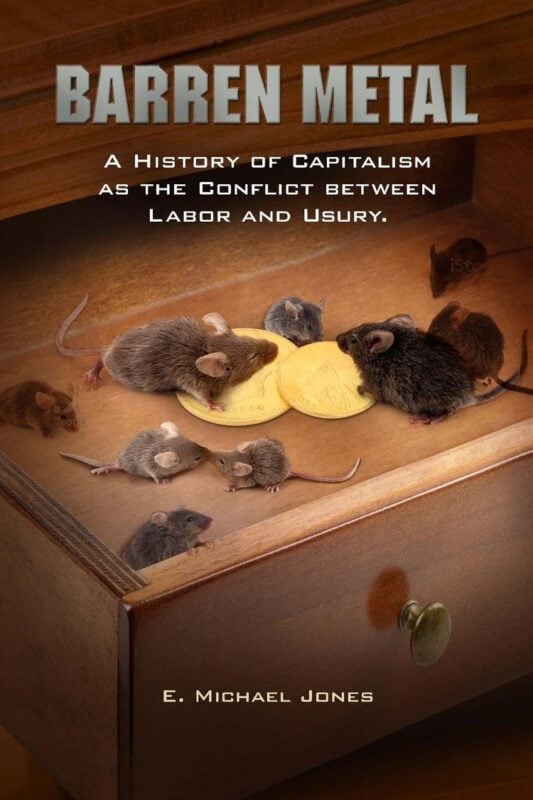
Barren Metal: A History of Capitalism as the Conflict between Labor and Usury by E. Michael Jones traces the economic trajectory of Western civilization through the lens of moral theology, focusing on the foundational clash between the productive force of labor and the parasitic mechanism of usury.
Capitalism as State-Sanctioned Usury
Capitalism originates in usury. Not merely a financial practice, usury becomes a legal and cultural mechanism that reshapes economies by prioritizing money's self-replication over human effort. Jones defines capitalism as the systematic, state-supported appropriation of surplus value through debt. Its legitimacy depends on removing moral constraints that historically banned or regulated interest on loans.
The book locates the inception of capitalism in Renaissance Florence. As the Medici family amassed wealth through banking, they shifted the economy from guild-based production to finance-driven control. Wages stagnated. Coinage debased. Workers lost agency over their earnings. In response, revolts like the Ciompi uprising erupted, but the system absorbed dissent without altering its trajectory.
Jones draws a structural connection between banking innovations and the cultural rejection of moral theology during the Reformation. When Protestant regimes dismantled the Church's ban on usury, capital consolidated into fewer hands. This concentration enabled political manipulation, military conquest, and imperial extraction, all undergirded by compound interest.
Labor Displaced by Mechanism
Adam Smith, David Ricardo, and their intellectual successors framed economic value through utility and marginalism. Yet their systems rest on an underlying displacement: labor becomes a cost, not a source of value. Jones recovers the older scholastic tradition, where labor bears moral weight as the expression of the human soul in material form. In this tradition, just wages bind producer and consumer in an ethical loop.
Usury severs this link. It abstracts value into financial products. It transforms exchange into accumulation. In capitalist regimes, money earns money without producing goods. That logic rewards speculation, leverages debt, and displaces productive enterprise. As a result, economies grow in volume yet deteriorate in coherence. Crashes become predictable. Recovery mechanisms shift losses onto workers while insulating lenders.
Historical Cycles of Extraction
Florentine oligarchs used state power to enforce debt collection, suppress wages, and criminalize guild resistance. These early capitalist dynamics repeat across European history. The Fuggers of Augsburg replaced the Medicis. They funded imperial ambitions through mining monopolies and indulgence financing. By 1557, despite controlling the flow of New World silver, the Habsburgs declared bankruptcy. Interest had outpaced empire.
Jones tracks similar patterns in England. Gresham’s financial reforms under Elizabeth I institutionalized currency manipulation. The Bank of England formalized debt as the state’s operating system. Later, figures like Newton shifted economic metaphors into mechanistic science, removing theological critique from public discourse. The economy no longer served man; man served markets.
The French Revolution, American industrialization, and German unification followed different trajectories but returned to the same cycle: labor exploitation, capital concentration, debt accumulation, and eventual collapse. Jones argues that even social responses like socialism and communism—though rooted in legitimate grievances—misdiagnosed the problem. They replaced moral critique with materialist ideology, leaving the structure of usury intact.
Occupy Wall Street and the Unspoken Crisis
In a vivid narrative of the Occupy Wall Street movement, Jones reveals a contemporary iteration of this centuries-old conflict. Young Americans, burdened with student debt, protested against a system they could not name. Their signs decried economic servitude. Their chants targeted financial institutions. Yet few articulated the core issue: usury as the mechanism by which capital enslaves labor.
Clergy who joined the movement failed to define its moral dimension. Media mocked its incoherence. Politicians deflected demands. The movement lacked leadership not because it was grassroots but because no one dared reintroduce the moral vocabulary necessary to critique capitalism at its roots. Jones argues that this silence reveals the success of capitalism’s final conquest: cultural control over meaning itself.
Economic Science Reclaimed by Moral Law
Jones resurrects the economic thought of Heinrich Pesch, SJ, whose solidarist model opposed both capitalist exploitation and socialist collectivism. Pesch rejected the false dichotomy between laissez-faire and state control. He rooted economic science in natural law, insisting that economics must serve the common good, honor labor, and restrict contractual abuses.
Pesch’s theory affirms that wages do not reduce wealth but redistribute it to sustain national vitality. Labor is not a commodity. It is a human act that requires just compensation. A society that permits wage suppression in favor of profit courts demographic decline and moral decay. By contrast, policies that support families, incentivize birth, and protect employment create resilient economies.
Jones emphasizes the role of the family as an economic unit. Population growth, not austerity, signals national health. Capital accumulation must serve the community, not abstract shareholders. By advocating for just wages and rejecting usury, societies can prevent the cycle of boom and bust that defines capitalist history.
Capitalism as Theological Deviation
Capitalism is not a neutral system. It arises from theological choices. When the West abandoned the Church’s teaching on interest, it replaced moral law with contractual law. Usury became permissible, then profitable, then sacrosanct. This legal shift changed how people understood debt, property, labor, and value. Economic injustice gained the protection of law.
Jones views capitalism as a theological heresy—a belief that money can reproduce itself, that contracts sanctify exploitation, and that profit justifies any means. This heresy institutionalizes theft under the guise of market freedom. It turns human labor into a liability and rewards those who manipulate systems rather than create value.
This critique reaches its climax in the analysis of modern finance. Leveraged buyouts, pension fund raids, and currency speculation do not represent corruption within capitalism. They represent capitalism’s logical expression. The system rewards these behaviors because it defines success by capital growth, not human flourishing.
The Return to Ethical Economy
The path forward requires clarity. Jones calls for the elimination of contractual usury, restoration of just wages, and subordination of finance to the common good. This does not demand central planning. It demands moral boundaries. States must prohibit interest-based exploitation, support family formation, and reward productive enterprise over speculative gain.
Jones points to historical models. The monastic economy of medieval Europe accumulated capital through discipline and distributed it through charity and infrastructure. Guilds regulated quality and protected labor. Land remained tied to families and communities, protected from debt foreclosure. These systems balanced freedom with responsibility, innovation with order.
He insists that modern economies can adapt these principles without regressing. Legal frameworks can ban usurious contracts. Tax codes can reward families. Trade policy can protect national labor. Currency policy can stabilize value. Education can reconnect economics to ethics.
The Moral Core of Economic Life
Economies emerge from human choices. Systems reflect values. Where capital rules, labor suffers. Where contracts dominate, justice weakens. The economy must serve man, not enslave him. A living wage, grounded in moral law, secures the dignity of the worker. Usury, by contrast, erodes that dignity by treating labor as disposable and debt as destiny.
Jones demands a metanoia, a turning of the national heart toward justice. He proposes no utopia. He proposes law, restraint, equity, and solidarity. Economics belongs to the realm of practical reason. It must function under moral scrutiny, shaped by the belief that human beings deserve more than survival. They deserve justice.
By tracing the arc from medieval guilds to Wall Street bailouts, from monastic charity to leveraged buyouts, Barren Metal offers a unified critique and a concrete alternative. It holds capitalism accountable to the values it erased and recovers the vision of an economy that honors labor, restricts usury, and seeks the common good.