The Travels of Marco Polo
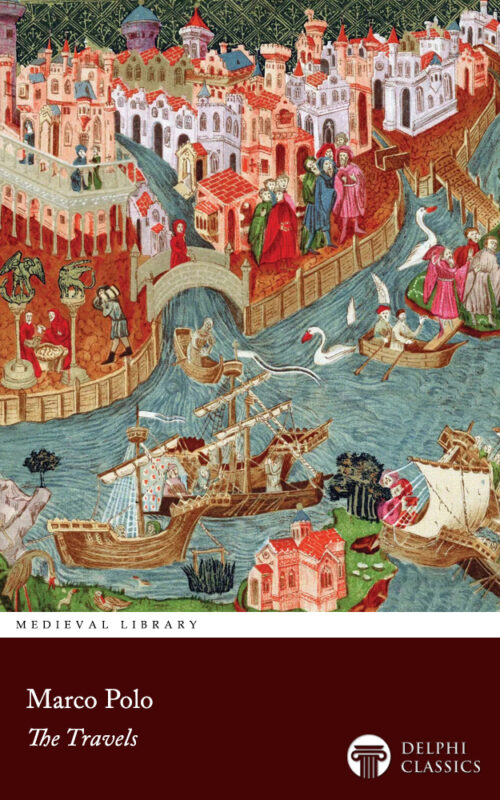
The Travels of Marco Polo by Marco Polo presents the fullest surviving account of Eurasian economy, empire, and exchange from the thirteenth century. Written in collaboration with Rustichello da Pisa during Polo’s captivity in Genoa, the work blends eyewitness description with the technical awareness of a Venetian merchant trained in measurement, taxation, and money. Across four books, the narrative establishes a geography of value—how empires minted, stored, and circulated wealth. Polo’s treatment of monetary systems forms the intellectual backbone of his record. His precise observation of coinage, bullion, credit, and paper reveals an analytic mind attentive to instruments of exchange as markers of civilization.
Venice and the Arithmetic of Trade
Marco Polo was born in 1254 into a family whose wealth depended on the liquidity of goods, jewels, and foreign currency. Venice, governed by its merchant republic, operated through a sophisticated ledger economy where florins, ducats, and Byzantine bezants moved through accounts as easily as goods through ports. This world trained Polo to view exchange as structure. When his father Niccolò and uncle Maffeo anticipated the fall of Constantinople in 1260, they converted their assets into portable wealth—rubies, sapphires, and emeralds. That act of monetization shaped Marco’s understanding of money as abstraction: a transferable store of value that survived across borders and languages. Their eastward journey transformed their capital into a medium of diplomacy when Berke Khan accepted their jewels as tribute and proof of credibility.
Currency and Trade Along the Silk Road
The Polos’ long passage through the Middle East exposed Marco to hybrid monetary environments. In Armenia and Persia he noted the coexistence of gold dinars, silver dirhams, and copper fals coins, each carrying inscriptions that marked allegiance and religious authority. Merchants measured equivalence by weight rather than mint, using balances standardized along caravan routes. In Tabriz he recorded that merchants transacted with cloth and precious stones when coinage grew short, creating a flexible credit economy rooted in trust and reputation. His accounts of Khorasan and Badakhshan describe barter economies in transition, where salt, livestock, and silk supplemented coin. Every description links geography to value: the worth of a city reflected the stability of its money and its ability to fund caravans, roads, and guards.
The Fiscal Machine of Kublai Khan
At the court of Kublai Khan, Polo witnessed a monetary revolution that had no precedent in Europe. He described the Chinese invention of government-issued paper money, a system that replaced metal currency with notes backed by imperial decree. The Khan’s mint, located in the city of Cambaluc (modern Beijing), used the inner bark of the mulberry tree, pressed and cut into rectangular sheets. Official seals in vermilion and the signature of the chief treasurer authenticated the notes. The Khan ordered his subjects to accept them on penalty of death, ensuring universal circulation. Marco recorded denominations ranging from small copper equivalents to large units equal to several taels of silver.
In his detailed narrative, he explained the cycle of issuance and redemption: old notes collected by officials were replaced with new series bearing fresh seals. The treasury exchanged them for gold, silver, and pearls that remained locked in the imperial vaults. Through this system, the empire controlled liquidity without depleting reserves. Polo observed that merchants across Asia accepted this money with confidence because the Khan’s law guaranteed its convertibility. The mechanism anticipated later fiduciary currency. He recognized its power to mobilize resources over immense distances—an administrative technology as decisive as the empire’s postal relay.
Gold, Silver, and the Hierarchy of Metals
Polo identified a clear metallurgical hierarchy in Chinese finance. Gold functioned as a ceremonial metal reserved for imperial gifts and religious offerings. Silver circulated in ingots called sycee, cast in standard molds and weighed rather than counted. Copper, abundant and durable, supplied small coinage. Yet paper money superseded all. In Hangzhou, Marco noted that copper cash continued to circulate in markets for minor purchases, but large commercial transactions and taxes occurred in paper. The state required that even distant provinces use the Khan’s notes when remitting tribute, integrating local economies into the imperial monetary web.
He described the minting of coins in Yunnan, where copper was extracted from mountain mines and cast into strings of cash. These strings, tied by thousands, became accounting units for soldiers’ wages and agricultural taxes. The fiscal system depended on accurate conversion tables: a given weight of silver equaled a fixed number of strings, and each string corresponded to a standard value of paper currency. Such precision impressed the Venetian observer accustomed to Europe’s fragmented coinage. His record identifies the Yuan dynasty’s early experiment in central banking—paper backed by bullion and tax receipts, unified across thousands of miles.
Taxation, Wages, and Exchange in the Provinces
Polo observed that Kublai Khan’s administration collected taxes primarily in kind—grain, silk, and salt—but converted those resources into monetary value for recordkeeping. He detailed the system of salt monopolies in Jiangsu and Zhejiang, where revenue from salt licenses financed public works. Taxpayers paid in salt certificates redeemable in paper money, allowing the treasury to regulate both commerce and currency. He described customs duties assessed as percentages of declared goods, with clerks issuing receipts in paper notes. In Yangzhou, where he claimed to have served as governor, Polo saw local officials balance accounts between metal and paper units. He described exact ratios: one gold saggio equaled six marks of silver or roughly eighty paper strings, depending on the province.
Soldiers and laborers received wages in paper or cloth, both convertible at official rates. Merchants preferred paper for its portability, and Polo marveled at the sight of caravans transporting no coin yet conducting enormous trade. The Khan’s accountants, he wrote, verified payments by weight and seal rather than by count. The image of economic order dominates the narrative: markets full of goods, clerks stamping notes, officials maintaining ledgers. The Mongol Empire, through its monetary discipline, appeared to him as the most efficiently organized power in existence.
Economic Geography and Trade Routes
Throughout his travels, Polo measured distance in terms of monetary conversion—how far a merchant could travel before his currency changed value. He described regions by their fiscal character: Persia rich in silver veins, Cathay abundant in copper, India wealthy in gold, and Java thriving on spices exchanged for coins. In Yunnan, he observed local currencies made from cowries and salt cakes, noting their exchange rates against imperial paper. In Tibet and Kashmir he encountered barter economies using wool and yak tails as currency equivalents. Such observations reveal a systemic approach: each territory expressed its economic health through the form of its money.
He recorded the Khan’s tribute system as a network of value transfer. Governors remitted revenue to the capital in paper notes transported by courier through relay stations. Tribute caravans carried silk, gold dust, and gems, but the state accounted for them in written figures. This bureaucratic abstraction of wealth fascinated Polo. His tone shifts from wonder to technical admiration when describing treasuries and offices, using the language of ratios and records rather than marvel.
Maritime Commerce and the Price of Goods
During the return voyage from Quanzhou in 1292, Polo documented the maritime markets of Southeast Asia and the Indian Ocean. In Champa, merchants traded gold for silk and porcelain, using scales standardized across ports. On Sumatra, he described barter systems where camphor and pepper replaced coin. At Ceylon and the Malabar Coast, he analyzed the purity of gold coins, naming the fanam and the dinar, and recording their relative worth against silver dirhams. In Hormuz he measured trade by cargo value rather than weight, showing a conceptual leap from object to abstraction. Prices moved by reputation as much as by supply. He noted that merchants advanced goods on credit, secured by written obligations—a form of maritime bill later perfected in Mediterranean banking.
Polo’s economic awareness extended to risk management. He observed the Khan’s use of government granaries to stabilize grain prices, preventing famine and speculation. He described insurance-like arrangements among traders who pooled capital to share losses. His chronicle of markets in Baghdad, Samarkand, and Cambaluc thus forms an early global treatise on fiscal order.
Money as Instrument of Power
Throughout the narrative, Polo defines money as the mechanism that sustains empire. The Khan’s paper currency unifies vast territories more effectively than armies. His tax system converts tribute into administrative stability. His regulation of gold and silver preserves reserves for foreign trade. Polo interprets each act of minting, weighing, or stamping as an assertion of authority. When he recounts that refusal to accept paper money brought execution, he expresses neither moral outrage nor admiration, only the observation that sovereignty depends on control of value.
The Venetian’s account reveals that he understood the symbolic force of currency design. The Khan’s red seals and official inscriptions acted as visible extensions of imperial will. In Hangzhou, the most prosperous city he described, markets functioned on faith in that signature. Polo saw the same structure that governed Venice’s ducat: trust institutionalized through metal or paper. Yet in the Khan’s empire, trust became law, transforming value into obedience.
The Return to Venice and Memory of Wealth
When the Polos reached home in 1295, their fortunes existed mostly as jewels and memories. Their stories of paper money, bureaucratic taxation, and statistical recordkeeping astonished Venetian contemporaries accustomed to coin. During his later years, Marco Polo invested in property and maritime ventures, applying lessons from the East to local trade. Legal documents record payments in ducats, the gold standard of Venice, and occasional references to “Eastern stones,” remnants of their converted capital. His will freed a Tatar servant and distributed assets to his daughters. At his death around 1324, he reaffirmed the truth of his book’s descriptions, insisting he had withheld more than he had told.
The Legacy of a Monetary Vision
The Travels functioned as a financial as well as geographic revelation. European readers encountered through it the first description of fiat currency, controlled inflation, and state-backed exchange. The book entered merchant libraries as a manual of commerce as much as an adventure. Its later annotators—Sir Henry Yule and Henri Cordier—recognized the economic intelligence within the narrative and traced Polo’s monetary references through Chinese archives. Their commentary confirmed his accuracy: Yuan records show mulberry-bark notes issued in the exact denominations he described. Archaeological discoveries of copper cash, silver ingots, and sealed paper fragments corroborate his account of circulation.
Through these details, The Travels of Marco Polo defines the monetary consciousness of early globalization. Money in the book acts as measure, medium, and metaphor—the system that binds diverse territories into one calculable world. The Venetian merchant recorded exchange as the essence of civilization, where power depends on the management of value and writing transforms metal into authority. His journey across empires produced the first sustained economic geography, a map drawn not by rivers and mountains but by the movement of wealth.