Solomon’s Treasure: The Magic and Mystery of America’s Money
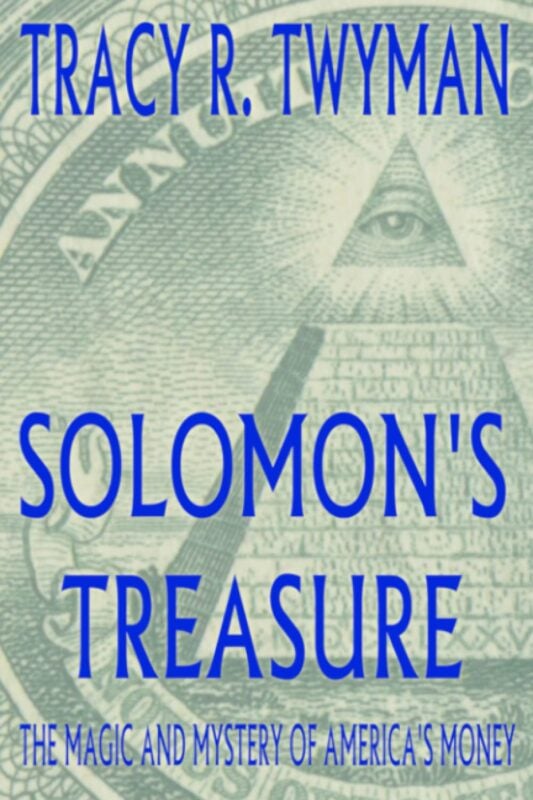
Solomon’s Treasure: The Magic and Mystery of America’s Money by Tracy R. Twyman examines the occult foundations of the U.S. economy and its currency through the lens of Masonic, Templar, and Rosicrucian philosophies, revealing how these influences shaped American institutions and imbued money with esoteric meaning.
The Currency as a Magical Instrument
American money functions beyond economic utility. Twyman identifies the U.S. dollar as a ritual object, constructed with precise symbolism to convey spiritual authority and energetic charge. The design elements of the one-dollar bill—pyramids, eagles, Latin phrases, and numerical patterns—perform more than aesthetic duties. They constitute a metaphysical grammar intended to shape public consciousness and channel belief into material stability. Symbols like the All-Seeing Eye and the number 13 become vectors for invisible forces, grounding national identity in an esoteric schema that predates the Constitution.
Origins in Secret Orders
The book traces the roots of American nationhood to secret orders such as the Freemasons, whose ideological legacy flows through early colonial planning, Revolutionary leadership, and foundational architecture. These societies inherited their doctrines from the Knights Templar, whose dissolution in the 14th century dispersed initiates across Europe, where they reconstituted their mission through merchant networks, coded knowledge, and visionary architecture. The Rosicrucians, with their aspirations for a universal reformation, shaped Enlightenment thought and embedded their spiritual science into the scaffolding of modern democracies. Freemasonry, synthesizing these traditions, became the carrier of a sacred project aimed at establishing a new kind of empire.
The Great Seal and Its Double Structure
Twyman scrutinizes the dual-sided Great Seal of the United States, adopted in 1782 and placed on the dollar bill in 1935. The obverse side, with the bald eagle, articulates state power through martial and peaceful elements: arrows and olive branches. The reverse, more enigmatic, reveals a pyramid crowned by the Eye of Providence and flanked by the mottos “Annuit Coeptis” and “Novus Ordo Seclorum.” This reverse remained unused on government documents for over a century, interpreted by Masonic scholars as a hidden glyph for spiritual destiny. Roosevelt’s decision to print it on currency activated its latent symbolism, fusing the magical and fiscal into a single interface.
The Alchemical Foundation of Modern Banking
Solomon’s Treasure aligns the logic of the Federal Reserve with alchemical transmutation. Central banking, in Twyman’s analysis, mirrors the philosopher’s goal of turning lead into gold. Fiat money, created by decree, circulates based on collective faith rather than intrinsic value. The economic rituals of the Federal Reserve—issuing currency, manipulating interest rates, and controlling reserves—operate as modern spellwork, shaping reality through belief and systemic projection. The transformation of tangible commodities into abstract instruments of credit replays the core alchemical ambition in a financial theater.
The Role of Faith in Monetary Reality
The book argues that American economic power depends on public belief in the dollar’s sanctity. After severing ties with the gold standard under Roosevelt and finally under Nixon, the U.S. currency became a manifestation of faith. Money, once a store of material value, now functions entirely as a psychological contract. Twyman shows how the terminology of finance—“trust,” “credit,” “fiduciary”—carries religious resonance, structuring money as a spiritual phenomenon as much as a legal tender. Every transaction reaffirms this belief, reinforcing the dollar’s dominance through repeated acts of communal assent.
Columbia and the Symbolic Geography of America
Twyman connects American mythmaking to ancient metaphors of divine guidance. The feminine figure of Columbia, often depicted as a goddess bearing a dove, acts as a spiritual patron of the republic. Her name, rooted in the Latin “columba,” evokes the archetype of the divine messenger. The U.S. capital, the District of Columbia, enshrines this symbolic logic. The alignment of civic identity with esoteric iconography transforms the American landscape into a temple—each institution, a shrine to a hidden cosmology.
From Atlantis to Bensalem: The Philosophic Empire
The vision of America as a philosophic empire emerges from the writings of Sir Francis Bacon, particularly in his utopian work The New Atlantis. Bacon described an advanced society governed by a college of scientists and sages, Solomon’s House, tasked with uncovering nature’s secrets and applying them for the public good. This model, transposed onto the New World, became a blueprint for the Enlightenment’s sacred experiment in governance. Twyman tracks how Bacon’s vision passed into Masonic thought, shaping the ideology of the Founding Fathers and informing the moral grammar of American exceptionalism.
The Etymology of America and the Merican Star
Twyman explores contested theories about the origin of the word “America.” Beyond the conventional attribution to explorer Amerigo Vespucci, alternative narratives link the term to ancient cosmology. Some traditions claim the name derives from “Amaruca,” a term used by native peoples to describe the land of the Plumed Serpent—a deity symbolizing wisdom, transformation, and celestial guidance. Other accounts, drawn from Gnostic sects like the Mandeans, speak of a star named “Merica” marking the location of paradise across the western sea. These esoteric etymologies frame the continent as preordained, known to initiates long before its official discovery.
The Phoenix and the Transformation of State
In analyzing the heraldic bird on the Great Seal, Twyman recalls Manly P. Hall’s assertion that the eagle was originally intended to represent the phoenix. The phoenix, emblem of death and rebirth, signifies cycles of destruction and renewal. This symbolic substitution reveals the ideological foundation of the American project: a republic capable of perpetual self-reinvention, charged with a sacred mandate to regenerate political and spiritual life. The economic system, too, mimics the phoenix cycle, burning through inflationary crises and policy resets to sustain its mythic continuity.
Templar Money and the Rise of the Dollar
Tracing the lineage of the dollar, Twyman reconstructs its genealogy from medieval talers minted in Bohemia to Spanish pillar dollars inscribed with “Plus Ultra.” The symbolism of these coins, bearing the Pillars of Hercules wrapped in scrolls, migrates into the modern dollar sign ($), representing commerce beyond the known world. This emblem encapsulates America’s ideological charter: expansion beyond historical boundaries, economic evangelism, and the conquest of the material through spiritual conviction.
The Invisible Constitution of the Economy
Twyman argues that the U.S. economy follows an unwritten constitution—an esoteric architecture composed of belief systems, ritual language, and concealed history. Central to this structure is the idea of the dollar as a living agent, charged with symbolic and magical function. Its operation requires initiation into a collective mythology that transcends standard economic theory. Banknotes become more than instruments of exchange; they are ceremonial documents, functioning as contracts with a hidden priesthood.
Money as Moral Energy
The book positions money as a spiritual vector that channels intention, values, and belief into material outcomes. The act of spending, saving, or investing becomes a form of ritualized willpower. Financial decisions echo moral choices, encoding personal and collective priorities into the economy’s structure. Twyman elevates this process to a sacred act, where the economy itself becomes a mirror of national karma—each dollar a spell, each transaction a reaffirmation of shared faith.
Toward the Temple of the Future
Twyman closes by asserting that the modern dollar prefigures a new spiritual order. As the temple of Solomon served as a sacred center for ancient Israel, the American financial system aspires to act as a global sanctuary—a magnetic field of belief, aspiration, and symbolic authority. The call to rebuild this temple becomes a metaphor for the renewal of civilization through esoteric science, collective purpose, and disciplined imagination. The book proposes that understanding the magical structure of money reveals not only how nations are governed but how reality itself is conjured.