The Global Coup d’État
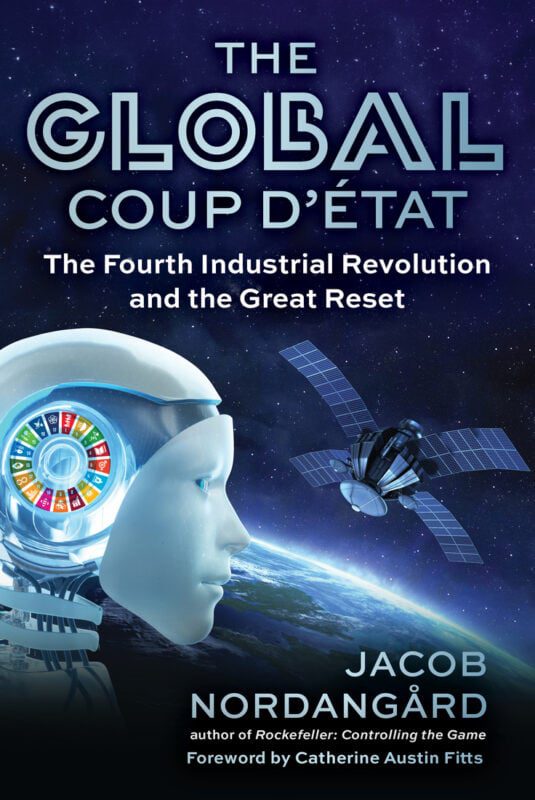
The Global Coup d'État by Jacob Nordangård examines the deliberate architecture of global governance as constructed by specific networks of financial dynasties, philanthropic foundations, and technocratic organizations. Nordangård, a Swedish scholar with a PhD in Technology and Social Change from Linköping University, identifies names, dates, and institutions to map what he calls the “long coup”—a century-long process in which crises have been engineered or leveraged to consolidate planetary control. The book does not merely speculate on hidden power; it documents a lineage that begins with Andrew Carnegie and John D. Rockefeller, continues through David Rockefeller and Maurice Strong, and culminates in Klaus Schwab’s World Economic Forum and the United Nations’ Agenda 2030.
The Foundational Network of Power
Nordangård opens his historical arc in 1908, when the trustees of the Carnegie Foundation met to discuss how to alter the behavior of entire populations. He cites congressional testimony by Norman Dodd from the 1952–1954 Reece Committee, which reported that the Carnegie Endowment found war to be “the most effective means of social transformation.” The early Rockefeller foundations—the General Education Board and the Rockefeller Foundation—adopted similar ambitions. These organizations, according to Nordangård, worked closely with the Carnegie network to shape education, diplomacy, and science into instruments of social engineering.
Figures such as Elihu Root, Woodrow Wilson’s Secretary of State, and Jan Smuts, the South African statesman and philosopher, served as intermediaries between British imperial networks and the emerging American establishment. Smuts helped draft both the League of Nations and the United Nations charters, embodying a continuity of global federalist ambition. The Round Table movement, organized by Cecil Rhodes’s disciples like Lord Alfred Milner, created front institutions such as the Royal Institute of International Affairs (RIIA) in London and its American counterpart, the Council on Foreign Relations (CFR) in 1921. These think tanks coordinated transatlantic elites—bankers, industrialists, and policymakers—in designing a managed international order.
The Rockefeller Imperative
John D. Rockefeller Jr. donated the land for the United Nations headquarters in New York, symbolizing the family’s institutional influence. Nelson Rockefeller, later U.S. vice president, directed wartime intelligence in Latin America and championed the creation of the United Nations’ specialized agencies. The Rockefeller Foundation financed the League of Nations Health Organization, which later evolved into the World Health Organization (WHO) in 1948. Nordangård presents this as an early template for global administrative control—public health as a lever for international governance.
David Rockefeller advanced this strategy further by founding the Trilateral Commission in 1973 with Zbigniew Brzezinski, bringing together North America, Europe, and Japan to coordinate policy across governments and corporations. Nordangård interprets this as a critical structural merger: political sovereignty subordinated to corporate and financial consensus. He quotes Richard N. Gardner’s 1974 Foreign Affairs article, “The Hard Road to World Order,” which proposed building a “house of world order from the bottom up,” eroding national sovereignty piece by piece.
The Ideological Blueprint
The intellectual framework of technocracy traces back to the 1930s Technocracy Movement, which sought to govern society through scientific data and energy accounting rather than politics. Nordangård shows how this ideology found cultural expression in H. G. Wells’s The Open Conspiracy and The New World Order (1940), which envisioned a global scientific elite managing resources and population. Pierre Teilhard de Chardin’s concept of the “noosphere”—a collective human consciousness evolving toward unity—inspired UNESCO’s first director-general, Julian Huxley, who promoted eugenics and “scientific humanism.” Huxley’s writings explicitly called for the “necessary” unification of humanity under scientific management.
Oliver L. Reiser, in World Sensorium (1946) and Cosmic Humanism and World Unity (1975), proposed building a “world brain” supported by communications technology, controlled by global planners. Nordangård draws a line from these intellectuals to Ervin László, founder of the Club of Budapest and senior member of the Club of Rome, whose 1977 report Goals for Mankind to the Club proposed a planetary society managed through cybernetics and population control.
The Club of Rome and the Birth of Eco-Governance
Founded in 1968 by Italian industrialist Aurelio Peccei and Scottish scientist Alexander King, and funded by the Volkswagen Foundation and the Rockefeller network, the Club of Rome institutionalized the use of computer modeling for planetary management. Its 1972 report The Limits to Growth, created at MIT under Jay Forrester and Dennis Meadows, forecast ecological collapse unless growth was curtailed. Nordangård emphasizes that these models were not neutral science but policy tools that rationalized global intervention in energy, industry, and population.
The Rockefeller Brothers Fund’s Special Studies Project in the late 1950s had already identified three global threats—nuclear war, population growth, and climate change—as vehicles for transnational coordination. These priorities guided later UN conferences such as the 1972 Stockholm Conference on the Human Environment, organized by Canadian oil executive Maurice Strong, a close ally of David Rockefeller and member of the Trilateral Commission. Strong went on to lead the 1992 Earth Summit in Rio de Janeiro, where Agenda 21 was adopted—a blueprint for comprehensive social and economic reorganization under the principle of sustainable development.
The Continuum from Earth Charter to Agenda 2030
Nordangård traces the evolution of Agenda 21 into Agenda 2030, endorsed by the UN in September 2015 under Secretary-General Ban Ki-moon. He lists the seventeen Sustainable Development Goals (SDGs) as the structural framework for a global regulatory system governing energy, industry, and human behavior. The drafting involved collaboration between the UN, the World Economic Forum, the World Bank, and multinational corporations. The Earth Charter, drafted by Strong and former Soviet leader Mikhail Gorbachev and overseen by Steven Rockefeller, provided the ethical foundation for this program—a fusion of environmental spirituality and managerial governance.
Nordangård argues that these goals are implemented through mechanisms such as ESG (Environmental, Social, Governance) scoring, the digitalization of identity, and financial inclusion programs tied to biometric data. The partnership between the UN and the World Economic Forum, formalized in 2019, institutionalized corporate influence within global policymaking. He identifies Klaus Schwab, founder of the WEF, as the architect of the “Fourth Industrial Revolution,” an initiative to integrate artificial intelligence, biotechnology, and digital surveillance into the structure of governance.
The Trigger Event: COVID-19 and the Great Reset
The COVID-19 pandemic serves as the inflection point in Nordangård’s narrative. He cites the 2020 World Economic Forum’s Great Reset initiative, launched by Schwab and Prince Charles, as the operational name for implementing the digital technocracy envisioned for decades. The WHO, under Director-General Tedros Adhanom Ghebreyesus, coordinated lockdowns and digital health passes that functioned as behavioral control systems. Nordangård connects these measures to prior simulation exercises such as Event 201, co-sponsored by the World Economic Forum and the Bill & Melinda Gates Foundation in October 2019.
He details the relationships among key actors: Bill Gates’s influence on WHO funding and vaccine policy; Anthony Fauci’s coordination of pandemic research through NIAID; and the GAVI Alliance’s role in distributing vaccines linked to biometric identification in developing countries. These organizations, Nordangård contends, converge around a single operational logic—technological management of human mobility and biological data.
The Financial Consolidation
Nordangård situates the 2020–2021 economic shutdowns within a broader monetary transformation. He references the Federal Reserve’s Going Direct plan, designed by BlackRock executives including Philipp Hildebrand, as the blueprint for merging central bank liquidity with private investment control. The introduction of Central Bank Digital Currencies (CBDCs) by institutions like the Bank for International Settlements under Agustín Carstens represents, in his view, the final phase of monetary centralization. The IMF’s Managing Director Kristalina Georgieva echoed this transformation in her 2020 speech on “a new Bretton Woods moment.”
The author highlights the role of major financial families—Rothschild, Rockefeller, and the successors of J. P. Morgan—in steering this transition through partnerships with the World Bank, the IMF, and WEF-affiliated financial forums. Asset management giants such as BlackRock, Vanguard, and State Street now command more than $20 trillion in combined holdings, effectively merging corporate and state capital under sustainability mandates.
The Infrastructure of Control
Digital identity systems form the operational backbone of what Nordangård calls the “technocratic coup.” He documents the World Bank’s ID4D (Identification for Development) initiative, the European Union’s planned digital wallet, and the G20’s push for cross-border data standardization. Biometric verification, he writes, will merge with digital currencies and carbon tracking to produce a totalized management grid. The World Economic Forum’s partnership with Microsoft and the Rockefeller Foundation to establish the Digital Public Infrastructure Alliance represents a prototype of this integration.
He connects this architecture to surveillance technologies pioneered during the pandemic—contact tracing, QR-based access systems, and AI-driven censorship networks coordinated with platforms like Google, Meta, and X (formerly Twitter). Under this configuration, access to travel, employment, and commerce becomes conditional on algorithmic validation.
The Actors and the Apparatus
Nordangård’s roster of institutions reads like an atlas of influence: the United Nations, World Bank, IMF, WHO, OECD, G20, European Commission, WEF, and their interlocking think tanks such as the Chatham House (RIIA), the CFR, and the Trilateral Commission. Individuals such as António Guterres, Christine Lagarde, George Soros, Henry Kissinger, and Al Gore recur in his analysis as strategic intermediaries. The coordination between governments and corporations—Google, Microsoft, Pfizer, BlackRock, and Mastercard—forms the logistical layer of the global coup.
He describes how the WEF’s Young Global Leaders program has installed graduates like Emmanuel Macron, Justin Trudeau, Jacinda Ardern, and Sanna Marin into key governmental roles, aligning national policy with transnational agendas. These leaders function, in his words, as “executors of the managerial state.”
The Cultural Mechanism
The consolidation of power depends on narrative. Nordangård details how media conglomerates and philanthropic foundations collaborate to shape perception. The Gates Foundation’s funding of The Guardian, NPR, and Reuters; the Rockefeller Foundation’s partnership with the Johns Hopkins Center for Health Security; and the World Economic Forum’s “Global Shapers” network collectively define public discourse. Climate movements such as Fridays for Future and Extinction Rebellion, he writes, operate as mobilization fronts for policy acceptance, channeling moral urgency toward predetermined goals like carbon rationing and digital surveillance justified by environmental necessity.
The Future: Integration or Autonomy
Nordangård concludes that the convergence of digital finance, health governance, and ecological regulation represents the culmination of a century of technocratic planning. The global coup is not a sudden seizure of power but an administrative evolution. He predicts that Central Bank Digital Currencies linked to biometric IDs and carbon allowances will redefine citizenship and ownership. Individual autonomy will depend on resistance through decentralization—local economies, independent media, and direct knowledge exchange.
He foresees growing fractures within the system as overreach exposes the mechanisms of control. The coup depends on compliance; awareness disrupts it. Nordangård’s closing assertion is unequivocal: “The success of the plan hinges on everyone believing the propaganda and playing along. But truth always finds a way.”
Through meticulous documentation—naming Carnegie, Rockefeller, Strong, Huxley, Peccei, Brzezinski, Gates, and Schwab—The Global Coup d'État maps the genealogy of a world order designed to govern through data, health, and climate. It positions the present moment as the decisive chapter in a century-long project to fuse humanity into a programmable system, where survival is conditional on obedience and awareness becomes the final frontier of freedom.