The Mystery of Francis Bacon
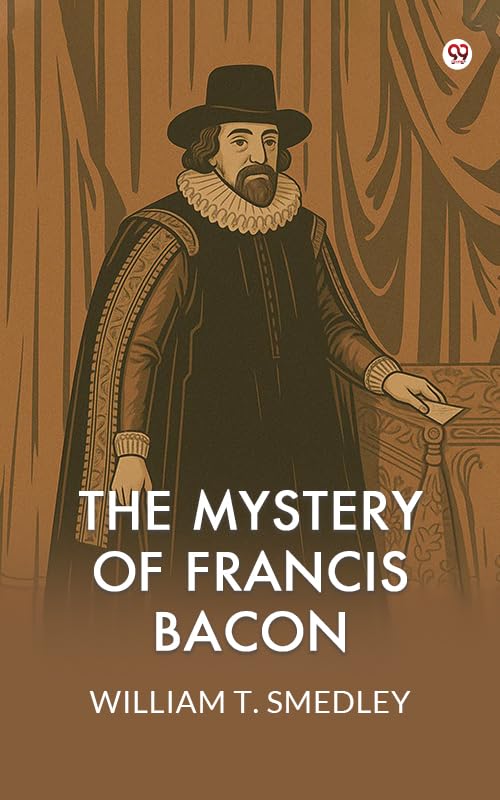
The Mystery of Francis Bacon by William T. Smedley examines the concealed life, writings, and intellectual design of Francis Bacon with the rigor of a historian and the precision of a documentarian. Smedley presents Bacon as a deliberate architect of secrecy, a figure who structured his legacy through encoded works and strategic anonymity. The book reconstructs the lost narrative of Bacon’s youth, his education at Cambridge, his continental travels, and his literary affiliations in Elizabethan and early Jacobean England. Through archival sources, annotated books, and cross-referenced correspondences, Smedley assembles a portrait of Bacon as both philosopher and literary craftsman whose influence, he contends, extends into the Shakespearean canon and the cultural foundations of English thought.
Origins and Formation of an Intellectual Lineage
Smedley begins with the Bacon family’s history, tracing a lineage of intellect and governance that framed Francis Bacon’s development. Sir Nicholas Bacon, Lord Keeper of the Great Seal, embodied legal and political acumen, while Lady Anne Cooke Bacon, a classical scholar and translator of Bishop Jewel’s Apologie of the Church of England, infused her son’s education with theological and linguistic discipline. Through detailed accounts of the Cooke sisters and their father, Sir Anthony Cooke—tutor to Edward VI and a scholar of philosophy—Smedley situates Bacon within a household where erudition served as moral architecture. The convergence of public service and private learning produced a young prodigy whose formative environment fused statecraft, scholarship, and Puritan devotion.
Early Years and the Discipline of Study
Bacon’s childhood at York House, near the Strand, marked the beginning of a methodical intellectual regimen. Smedley recounts that by the age of twelve Bacon mastered Latin, Greek, Hebrew, and French, a breadth of study reinforced by his grandfather’s didactic model. His time at Trinity College, Cambridge, from 1573 to 1575 under Dr. John Whitgift, sharpened his critical instinct. There, Bacon encountered Aristotelian philosophy and rejected its dialectical sterility, asserting that scholastic logic yielded debate rather than discovery. Smedley interprets this rejection as the seed of the Novum Organum, the methodological revolution Bacon would later formalize. His dissatisfaction with academic formalism catalyzed an enduring pursuit of empirical inquiry—a movement from argument toward observation, from abstraction toward experiment.
The Hidden Years and Continental Apprenticeship
In 1576 Bacon joined Sir Amias Paulet, the English ambassador to France, beginning what Smedley calls his “continental apprenticeship.” His tenure in Paris, Blois, and Poitiers introduced him to political correspondence, linguistic experimentation, and diplomatic protocol. Smedley highlights Bacon’s exposure to the humanist academies of France and Italy, linking these experiences to his later conception of “The Great Instauration,” a universal reconstruction of knowledge. The author documents that Bacon’s private writings during this period, such as Temporis Partus Maximus, anticipated the systematic skepticism that would characterize his philosophy. His return to England in 1579, precipitated by his father’s death, brought him financial insecurity but intellectual independence. Smedley reads this interlude as the crucible in which Bacon’s literary ambitions took covert form.
The Case for Concealment
Central to Smedley’s argument is the proposition that Bacon intentionally veiled his authorship across the literature of the Elizabethan age. He advances this thesis through documentary analysis rather than conjecture. Manuscripts, marginalia, and coded annotations in over two thousand recovered volumes demonstrate Bacon’s consistent practice of marking texts connected to his intellectual projects. Smedley asserts that Bacon adopted the motto Mente videbor—“By the mind I shall be seen”—as both personal creed and operational cipher. The concealment served a double purpose: to protect political ambitions under Elizabeth’s volatile court, and to allow philosophical ideas to circulate under diverse literary masks.
Bacon and the Elizabethan Corpus
Smedley investigates how Bacon’s stylistic fingerprints appear in emblem books, sonnet cycles, and anonymous pamphlets. He examines parallels between Bacon’s phrasing in The Advancement of Learning and linguistic structures in the Shakespearean plays. Rather than treating these similarities as accidents of culture, he argues for a unifying authorship guided by Bacon’s intellectual mission to educate through allegory. The chapter on “How the Elizabethan Literature Was Produced” outlines a coordinated literary enterprise, where writers such as Ben Jonson, Thomas Nash, and Edmund Spenser functioned within Bacon’s conceptual orbit. Smedley identifies a shared rhetoric of moral philosophy and experimental inquiry, tracing it to Bacon’s influence as a silent director of England’s literary awakening.
The 1623 Shakespeare Folio and the Architecture of Authorship
The analysis of the 1623 Folio occupies a pivotal section. Smedley documents the organizational logic of the publication—its typographical codes, emblematic devices, and dedications—as evidence of Bacon’s editorial supervision. He draws connections between the Folio’s structure and Bacon’s earlier classification of knowledge into history, poetry, and philosophy. The tripartite design mirrors the architecture of The Great Instauration, reinforcing Smedley’s contention that the Folio stands as an extension of Bacon’s philosophical system rendered in dramatic form. This reading transforms the plays from theatrical entertainments into instruments of intellectual reform, designed to instruct through imitation and reflection.
The Authorised Version and the Rhetoric of Sacred Language
Smedley extends Bacon’s influence beyond drama into theology and translation. He contends that Bacon participated in the conceptual supervision of the 1611 Authorised Version of the Bible, contributing to its linguistic cadence and structural coherence. This involvement aligns with Bacon’s belief that sacred texts required a clarity of expression consistent with divine order. The rhythmic balance and syntactic symmetry that characterize the English Bible correspond to stylistic principles evident in Bacon’s essays. Through this claim, Smedley integrates Bacon into the broader cultural project of standardizing English prose and defining the intellectual language of the seventeenth century.
Marking the Books and Mapping the Mind
The chapters on Bacon’s library and emblematic systems provide empirical support for Smedley’s thesis. Detailed catalogues of volumes annotated in Bacon’s hand reveal a mind in constant dialogue with classical and contemporary sources. Marginal notes, cross-references, and symbols suggest an evolving network of conceptual associations. Smedley interprets these markings as a cartography of thought—a visible record of Bacon’s synthetic method. The recovered commonplace books and Promus notebooks, containing aphorisms and linguistic experiments, serve as repositories from which Bacon drew material for his published and concealed works. The evidence, Smedley asserts, transforms speculation into verifiable continuity between Bacon’s documented writings and the wider corpus attributed to his era.
Contemporary Witnesses and Continental Reception
The testimony of Bacon’s contemporaries occupies a substantial portion of the narrative. Letters from Thomas Bushell, Peter Boener, and William Rawley reveal private recollections of Bacon’s working habits and philosophical intent. Smedley contextualizes these accounts within European perspectives, citing early translations of Bacon’s works in France, Holland, and Germany. The Discours sur la vie de M. François Bacon, prefixed to the 1631 Paris edition of Sylva Sylvarum, records travels in Italy and Spain unknown to English biographers. German critics of the seventeenth century, Smedley notes, perceived a stylistic unity between Bacon’s essays and the Shakespearean dramas. These external testimonies, often overlooked, strengthen his reconstruction of a transnational Baconian authorship.
The Missing Fourth Part of The Great Instauration
Smedley addresses the unfinished architecture of Bacon’s philosophical project. The Great Instauration was conceived in six parts; only fragments survive. Smedley proposes that the “missing fourth part,” the practical demonstration of Bacon’s method, exists dispersed across allegorical and dramatic literature. He treats the plays as case studies in the philosophy of human behavior, experiments in moral cause and effect rendered through character and plot. This interpretation positions the Elizabethan stage as the laboratory of Bacon’s human science, where empirical observation of passion and reason replaced scholastic abstraction.
The Philosophy of Bacon and Its Legacy
The final chapters synthesize Bacon’s metaphysical and ethical vision. Smedley defines Bacon’s philosophy as an operative system grounded in the renewal of the senses, the disciplined observation of nature, and the moral duty of inquiry. He presents Bacon’s method as the structural foundation of modern science and the ethical model of intellectual labor. By tracing the transformation of observation into discovery, and discovery into civic progress, Smedley articulates a genealogy of thought that links Renaissance humanism to the empirical revolutions of later centuries. Bacon’s fall from political grace, including his impeachment for corruption, appears as the external irony of an inner constancy—the statesman’s failure shadowing the philosopher’s triumph.
The Craft of Historical Reconstruction
Throughout the book, Smedley’s research operates with forensic precision. He reconstructs Bacon’s movements through archival documents, legal records, and library catalogues. His attention to the 1577 translation of The French Academy by Pierre de la Primaudaye, the emblematic literature of Alciati, and the ciphers within the Resuscitatio volume of 1657, creates a lattice of textual evidence. Each reference functions as a node within a network of proof, leading toward the central claim that Bacon orchestrated a literary and philosophical program spanning multiple genres and pseudonyms. The investigation unfolds as both biography and intellectual archaeology, revealing the deliberate architecture behind Bacon’s apparent anonymity.
Enduring Significance
Smedley concludes that Francis Bacon’s life cannot be confined to the recorded facts of office and downfall. The legacy resides in the interwoven texts, the encoded philosophies, and the linguistic innovations that shaped English expression. The Novum Organum, the Advancement of Learning, and the essays serve as the visible framework of a larger enterprise whose hidden components extend through the culture of the age. Smedley’s The Mystery of Francis Bacon transforms biography into revelation, restoring to Bacon the authorship of ideas that altered the structure of knowledge itself. By unearthing the traces of a mind that sought to be seen only through its works, the book establishes a narrative of intention, discipline, and creative magnitude that continues to define the intellectual imagination of modernity.