The Predators Versus The People
The Hidden Architecture of Five Centuries of Power
Meeuwis T. Baaijen traces a continuous chain of influence stretching from the merchant oligarchies of Renaissance Italy to the financial technocracies shaping the twenty-first century. The book argues that a network of dynastic banking families, collectively termed the “Glafia,” designed a system of control through capital and deceit beginning around 1522. Genoa and Venice form the point of origin. Their merchant-bankers pioneered offshore credit systems, maritime monopolies, and the earliest experiments in state capture through debt. As the Mediterranean lost commercial primacy, these methods migrated westward to Amsterdam and London. Baaijen maps this transfer as a deliberate movement of financial command, orchestrated by investors who used corporate charters and central banks as instruments of dominion.
From Empire to Enterprise
The seventeenth century saw the creation of the Dutch and English East India Companies, private ventures endowed with sovereign powers. According to Baaijen, these corporations functioned as prototypes for the modern state-corporate complex. They fused trade, war, and administration under the same accounting logic. The author follows their evolution into the “Brutish Empire,” a term he uses to emphasize predation rather than civilization. The Bank of England, founded in 1694, institutionalized national debt as a permanent mechanism of control. Wars financed through bonds enriched the financiers while binding governments to their creditors. The system expanded through colonial extraction in Asia, Africa, and the Americas, forming a planetary lattice of exploitation that Baaijen interprets as the operational field of the Glafia.
Revolution as Method
Baaijen treats the American and French Revolutions as controlled transfers of power. He attributes their ideological foundations to financiers who sought to replace monarchical oversight with commercial sovereignty. The Declaration of Independence and the Rights of Man become, in his analysis, corporate charters for a new managerial class. The Enlightenment appears as a coordinated campaign to displace spiritual authority with secular materialism, redirecting moral allegiance from divine order to financial rationality. This transformation inaugurated the modern “Empire of Capital,” where human liberty was reframed as market participation.
The Industrial Crucible
The nineteenth century provided Glafia with the tools for global consolidation. The Rothschild banking dynasty and its American successors—the Morgans, Rockefellers, and Warburgs—extended credit networks across continents. Baaijen outlines how industrialization created immense capital surpluses that demanded geopolitical outlets. Railways, mining, and oil concessions became instruments of leverage. Political revolutions in Spain’s American colonies, financed through London and Amsterdam, prepared new markets under the guise of independence. The author presents the American Civil War, European unifications, and imperial conflicts in Africa and Asia as sequential investments directed by financial cartels seeking monopolies on natural resources and currency issuance.
The Great Twentieth-Century Slaughter
The twentieth century forms the core of Baaijen’s indictment. He calls the combined devastation of the two World Wars “The Great Slaughter of Eurasia.” He asserts that the same financial interests armed all sides, using ideological movements as operating systems for war economies. Communist Russia, Nazi Germany, Fascist Italy, and Imperial Japan emerge as manufactured proxies shaped through selective funding and technological transfer. The wars, he contends, accomplished two objectives: destruction of independent national economies and centralization of power within transnational institutions. The League of Nations, the United Nations, the International Monetary Fund, and the World Bank appear as successive shells housing the same operators.
The Postwar Order of Managed Reality
Baaijen interprets the Cold War as a stabilization phase. The apparent ideological division between capitalism and communism sustained military spending and psychological control. Behind the spectacle, global governance matured through Bretton Woods institutions and covert networks such as NATO, the CIA, and MI6. He traces how propaganda techniques evolved into mass mind-management systems. Media conglomerates, educational reform, and cultural production functioned to normalize the rule of finance. He calls this phenomenon “Plato’s Cave 2.0,” a matrix of illusions in which citizens internalize the logic of their controllers.
The Digital End Game
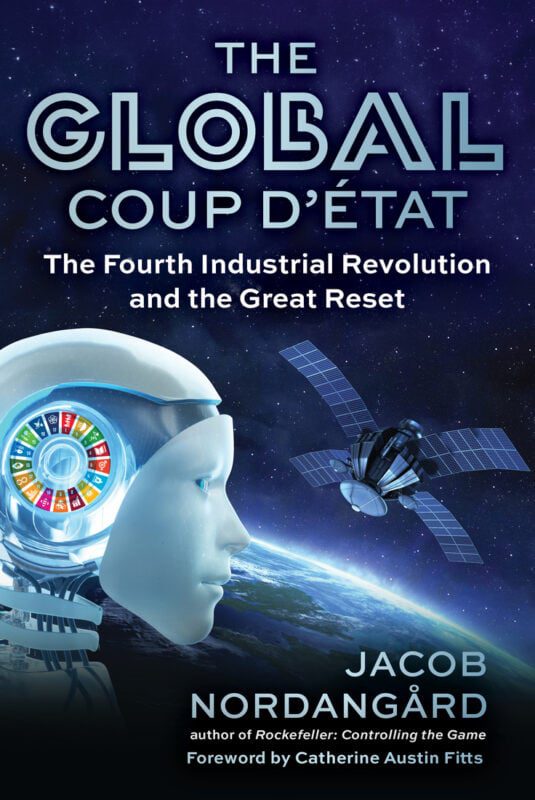
The twenty-first century, in Baaijen’s framework, marks the transition from territorial empire to biometric dominion. The attacks of September 11, 2001, the 2008 financial crisis, and the COVID-19 pandemic appear as orchestrated accelerants toward total digital governance. He names the objective the “Global Digital Prison.” Central Bank Digital Currencies, Universal Basic Income, and carbon credit systems serve as infrastructure for population management. The Fourth Industrial Revolution, promoted by the World Economic Forum under Klaus Schwab, represents the technological arm of Glafia’s strategy. Artificial intelligence, genetic engineering, and surveillance integrate economic and biological control. Baaijen links these developments to a deeper philosophical shift—the replacement of human consciousness with algorithmic authority.
The Spiritual Countercurrent
Against this architecture of domination, the author positions a counter-movement he calls the “Great Freeset.” He draws on Taoism, shamanic traditions, and metaphysical philosophy to propose reconnection with the creative intelligence of the universe. He rejects reductionist materialism as a conceptual cage that isolates humanity from the cosmic order. Life, in his view, emerges from intelligent design rather than random processes. He critiques scientism for transforming discovery into control and technology into dependency. The recovery of spiritual awareness becomes the necessary precondition for political liberation.
The Mechanics of Deceit
Baaijen dissects the operating tools of Glafia with forensic intensity. He identifies debt as the central mechanism. Usury transforms time into property; compound interest converts the future into collateral. Through control of money creation, bankers dictate the terms of production and consumption. Propaganda secures compliance by framing servitude as progress. Education reproduces obedience by fragmenting knowledge into specialized disciplines that obscure systemic patterns. Entertainment anesthetizes awareness through saturation of trivial images. The author calls this ensemble “Menticide in Totalitaria,” a culture that kills the free mind by overstimulation and misinformation.
The Political Puppet Theater
He extends the analysis into governance. Politicians appear as preselected actors trained through programs such as the World Economic Forum’s “Young Global Leaders.” Elections legitimize decisions already made in transnational forums. Policies on war, health, and environment follow the same templates across nations because the same corporate consultancies design them. Baaijen cites the synchronization of pandemic restrictions as evidence of a centralized command structure. He interprets global agreements on climate and digital identity as expansions of administrative reach under humanitarian rhetoric.
The Economic Extraction Grid
Resource privatization and financial speculation, in his account, represent modern forms of colonization. The author introduces the concept of “assetization,” the conversion of the global commons—air, water, biodiversity—into tradable financial instruments. He argues that carbon markets, conservation bonds, and intellectual property regimes transform nature into a ledger entry. Agriculture, once a sustenance system, becomes a field for biotech monopolies. Food, medicine, and energy follow the same pattern of concentration. The result is a planetary economy designed for rent extraction rather than production.
The Intellectual Resistance
Throughout the book, Baaijen acknowledges historians and thinkers who challenged official narratives: Carroll Quigley, Antony Sutton, Gerry Docherty, Jim MacGregor, and Andrey Fursov. Their work provides corroboration for his thesis of coordinated financial power. He examines how academic gatekeeping suppresses dissent through publication monopolies and peer-review orthodoxy. The marginalization of alternative research becomes, in his interpretation, evidence of the system’s coherence. He urges independent scholarship and open networks of inquiry to restore historical accuracy.
The Cultural Reprogramming
The author situates the Enlightenment within a longer “Endarkenment.” He argues that by severing humanity from spiritual cosmology, the modern age replaced wisdom with computation. He links this shift to educational secularism, industrial design, and the ideology of progress. Cultural Marxism, social engineering, and transhumanist philosophy appear as late manifestations of the same project: the redesign of the human being into a programmable unit. He views gender politics, mass migration, and identity activism as managed disruptions that dissolve traditional communities, making populations more governable.
The Strategic Continuum
Baaijen’s chronology forms a continuous arc from the Big Bang narrative to artificial intelligence. He challenges the scientific cosmology that describes the universe as random emergence from matter. He calls it a foundational myth serving materialist control. His argument follows a structural logic: false cosmology produces false anthropology; false anthropology legitimizes technocratic management. The recovery of meaning requires re-examining origins. In this sense, his book functions both as historical analysis and metaphysical diagnosis.
The Contemporary Theater of Crisis
He details how modern crises reproduce the same architecture of debt and dependency. The 2008 financial meltdown transferred public wealth to private banks through bailouts. The COVID-19 response expanded pharmaceutical monopolies and digital surveillance. Environmental emergencies justify carbon taxation and resource enclosure. Geopolitical conflicts in Ukraine and the Middle East sustain military expenditure and distract from systemic reforms. Each episode reinforces centralized control under the banner of rescue.
The Language of Liberation
Baaijen adopts precise terminology to describe emancipation. Freedom, in his lexicon, means self-governance grounded in moral consciousness. Democracy, stripped of its theatrical façade, becomes the daily practice of truth recognition. The path forward involves rebuilding local economies, restoring communal ownership, and cultivating intellectual courage. He portrays this transformation as both practical and spiritual: practical in decentralizing systems of supply and exchange; spiritual in realigning humanity with cosmic order.
The Future According to the Predators
The book closes with a vision of the near future shaped by data capitalism. Artificial intelligence governs credit scoring, employment, and movement. Digital currencies define access to goods. Genetic modification extends from crops to humans. The convergence of biotechnology and finance produces a new species of control—the algorithmic overseer. Baaijen warns that the loss of privacy equals the loss of personhood. The only viable resistance arises from the recognition of life as sacred intelligence rather than programmable matter.
Reading as Awakening
The narrative operates as a process of deprogramming. Baaijen invites the reader to move from confusion to comprehension through historical reconstruction. He frames knowledge as liberation: understanding the true operators of power dissolves their psychological hold. The act of study becomes the first gesture of freedom. The author’s personal journey—from atheist veterinarian to spiritual historian—illustrates this metamorphosis. His transformation embodies the transition from skepticism to insight that he envisions for humanity.
Toward the Great Freeset
The closing section calls for an epochal reversal of direction. Instead of advancing deeper into digital dependence, humanity can reclaim its autonomy through deliberate simplicity, community self-reliance, and reverence for the living world. The “Great Freeset” represents a civilization founded on truth rather than profit. It redefines progress as harmony with creation and power as responsibility to life. Baaijen presents this as the logical culmination of historical understanding: once the pattern of predation is revealed, another pattern—cooperation with the universe—can take its place.
The Predators Versus The People functions as both historical exposé and spiritual manifesto. It merges documentary research with metaphysical reasoning to produce a unified theory of human enslavement and liberation. Through five centuries of continuity, from the banking halls of Renaissance Italy to the digital grids of the present, Baaijen asserts a single structural lesson: whoever controls the creation of value commands the shape of reality. The recovery of truth therefore begins with reclaiming the power to define what is real.