Tolstoy on Shakespeare
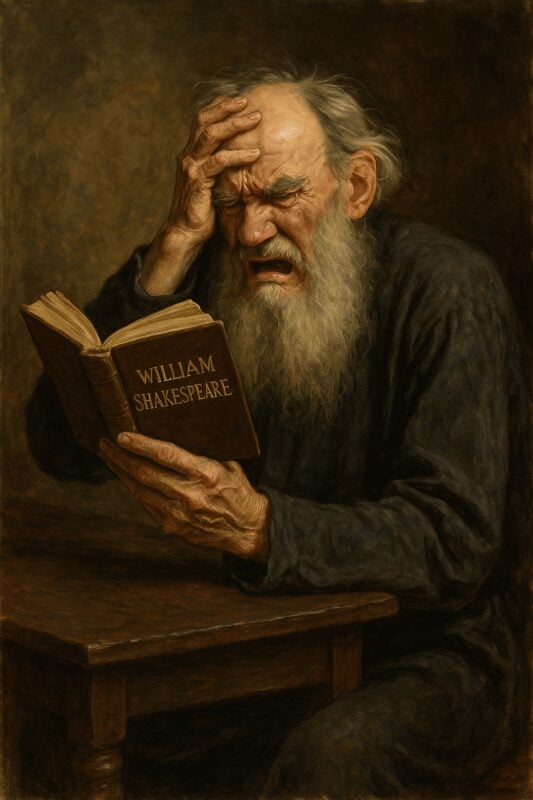
Tolstoy on Shakespeare: A Critical Essay on Shakespeare by Leo Tolstoy presents one of the most rigorous, controversial, and introspective literary analyses in modern criticism. Published in 1906 through the Free Age Press and translated by V. Tchertkoff and I. F. Mayo, this work captures Tolstoy’s profound disillusionment with William Shakespeare’s art, voice, and ethical vision. The essay, later joined by Ernest Crosby’s “Shakespeare’s Attitude Toward the Working Classes” and a letter from George Bernard Shaw, stands as a confrontation between moral philosophy and literary canonization. Tolstoy, approaching the height of his intellectual maturity, dismantles the myth of Shakespearean genius with the same moral seriousness that shaped War and Peace and The Kingdom of God Is Within You.
The Moral Impulse Behind the Critique
Tolstoy’s analysis begins with confession. He recalls decades of effort spent forcing admiration for Shakespeare’s plays, from King Lear to Hamlet and Macbeth. Each reading, he explains, produced not delight but weariness and aversion. His inquiry arises from this dissonance between personal experience and universal acclaim. He seeks moral clarity, not aesthetic alignment. For Tolstoy, literature demands service to truth, beauty, and the moral improvement of humankind. When that demand fails, art corrupts perception.
In Tolstoy on Shakespeare, this principle becomes absolute. He considers Shakespeare’s prestige a cultural illusion—a “hypnotic suggestion” maintained by education, imitation, and social convention. The essay’s force emerges from Tolstoy’s conviction that moral sincerity, not technical flourish, defines greatness. He asks whether a society that prizes deception and spectacle can still recognize the ethical purpose of art. This question drives his reading of King Lear and anchors his critique in spiritual urgency rather than aesthetic rivalry.
Dissection of King Lear
Tolstoy selects King Lear as the centerpiece of his examination. He summarizes its entire structure scene by scene, exposing what he perceives as incoherence and artificiality. He calls Lear’s abdication irrational, Cordelia’s virtue mechanized, and the subplot of Gloucester and Edmund a mechanical doubling of the main plot. He insists that genuine tragedy arises from moral necessity, not arbitrary misfortune. In his rendering, the characters act without believable motivation, their speeches filled with pomp and verbal excess detached from real emotion.
His account strips the drama to its scaffolding. Each act becomes a case study in literary inflation. Tolstoy observes that Lear’s rage, Gloucester’s credulity, and Edgar’s disguises create confusion rather than pity. He rejects Shakespeare’s reliance on theatrical effects—the storm, the Fool’s riddles, the blindness of Gloucester—as decorative substitutes for genuine moral conflict. The tragedy, in Tolstoy’s eyes, lacks the spiritual logic that links suffering to redemption. He concludes that Shakespeare’s Lear portrays madness without meaning.
The Ethical Measure of Art
Tolstoy’s standard for judgment originates in his mature philosophy of art, later expressed in What Is Art?. He argues that authentic art transmits sincere feelings that unite people in moral awareness. Shakespeare’s plays, he claims, transmit confusion. He finds no spiritual core, only linguistic ingenuity and moral ambiguity masquerading as depth. For Tolstoy, the greatness of art depends on its capacity to communicate a clear ethical consciousness accessible to all people, regardless of class or education.
The essay defines beauty as moral harmony—the unity of truth, goodness, and aesthetic power. Shakespeare’s beauty, Tolstoy insists, dissolves this unity. He accuses him of serving aesthetic vanity rather than spiritual necessity. Such art, he warns, cultivates false admiration and distorts the heart’s sense of right and wrong. By this logic, the worship of Shakespeare becomes a symptom of cultural decay—a preference for intellectual play over ethical insight.
Historical Context and Critical Voices
The 1906 edition situates Tolstoy’s essay amid a dialogue with two figures who expand its reach: Ernest Crosby and George Bernard Shaw. Crosby’s appended essay, “Shakespeare’s Attitude Toward the Working Classes,” interprets Shakespeare’s social outlook as aristocratic and indifferent to common humanity. Shaw’s letter responds with both sympathy and dissent, calling Tolstoy’s attack “a tremendous piece of moral criticism” while defending the theatrical vitality of Shakespeare’s art. Together, these contributions transform the book into a triadic conversation about genius, ethics, and social truth.
The publication history of Tolstoy on Shakespeare reflects Tolstoy’s network of reformist thought. Released by the Free Age Press in Christchurch, England, it reached Western readers through the translation work of Vladimir Tchertkoff, Tolstoy’s close collaborator and literary representative. The edition’s preface acknowledges the book as a deliberate challenge to European aesthetic orthodoxy. The inclusion of Shaw—then one of the most prominent dramatists of modern Europe—amplifies its intellectual tension, placing moral absolutism against artistic autonomy.
Character, Speech, and the Failure of Verisimilitude
Tolstoy dissects Shakespeare’s use of language as the core of his failure. He maintains that Shakespeare’s characters speak not as living beings but as instruments of rhetoric. Every king, fool, and villain speaks the same ornate, self-conscious idiom. In Tolstoy’s formulation, the speeches depend on verbal play, not inner necessity. Lear’s curses, Kent’s loyalty, and the Fool’s jokes blend into a uniform style of theatrical declamation.
Tolstoy defines true dramatic speech as an extension of action—a moral revelation that grows from character and circumstance. Shakespeare’s language, he argues, proceeds from word association and metaphorical extravagance rather than motive. The result, in his view, is a flattening of human diversity. Distinctions between good and evil, wisdom and folly, dissolve into linguistic noise. The absence of sincerity in voice becomes, for Tolstoy, evidence of Shakespeare’s detachment from life’s moral structure.
The Problem of Universality
The essay challenges the very concept of Shakespeare’s universality. Tolstoy traces the cult of Shakespeare to educational repetition and critical reverence rather than genuine feeling. He observes that the belief in Shakespeare’s greatness forms part of European intellectual conformity. The more people repeat his genius, the less they test it against personal experience. He describes this as “a hypnotic suggestion,” a phrase that recurs throughout the essay.
For Tolstoy, the power of imitation sustains this illusion. He recalls his own youthful attempts to admire Hamlet and Macbeth, persuaded by the authority of critics like Dr. Johnson, Coleridge, and Victor Hugo. Yet repeated readings yielded only fatigue. From this dissonance he derives his central thesis: that Shakespeare’s reputation survives through social conditioning, not artistic necessity. The question he raises—how a civilization can adore what numbs its moral sense—remains one of the essay’s most enduring provocations.
Comparative Reconstruction: King Leir and King Lear
Tolstoy’s scholarship extends beyond critique to textual reconstruction. He compares Shakespeare’s King Lear to its earlier source, the anonymous Elizabethan play King Leir. The comparison grounds his argument in specific dramatic evidence. In King Leir, Tolstoy finds coherence, tenderness, and moral proportion. The earlier play, he asserts, presents a believable father, a loving daughter, and a sequence of actions consistent with human behavior.
Tolstoy cites entire scenes from King Leir—the daughter’s refusal to flatter her father, the King of Gaul’s disguised courtship, the reunion of father and daughter in poverty—to demonstrate emotional clarity absent from Shakespeare’s version. In his reading, Shakespeare replaced moral truth with theatrical shock: storms, madness, and multiple deaths. Where the original author built reconciliation, Shakespeare inserted despair. Tolstoy interprets this transformation as evidence of artistic degradation—a descent from ethical realism to spectacle.
The Philosophy of Reception
Tolstoy’s reflection extends to the psychology of readers and audiences. He asks what happens when a culture mistakes obscurity for profundity. His answer is sociological as much as aesthetic. When the educated elite praise incomprehensible art, they reinforce their social distinction. The pleasure of “understanding” what others do not becomes an emblem of superiority. In this dynamic, Shakespeare functions as a symbol of intellectual hierarchy.
Tolstoy exposes this mechanism with precision. He argues that critics and educators maintain Shakespeare’s prestige to affirm their own refinement. The admiration becomes self-referential, detached from the work’s real emotional power. In this sense, the cult of Shakespeare exemplifies what Tolstoy calls “the great untruth”—a cultural idol built from imitation rather than conviction. His essay calls for liberation from this illusion through honest feeling and moral introspection.
The Human and the Divine in Art
Underlying Tolstoy’s polemic is a theology of creativity. He defines artistic inspiration as the communication of divine love through human form. Art, for him, must serve the growth of compassion. The highest artist becomes a conduit for spiritual energy that reconciles people through shared emotion. Shakespeare, in Tolstoy’s estimation, breaks this covenant. His dramas celebrate passion without redemption, intelligence without conscience.
Tolstoy measures greatness by service to moral awakening. In Tolstoy on Shakespeare, the writer of War and Peace applies his own moral system to the theater, seeing drama as a moral act, not entertainment. When art abandons the responsibility to reveal goodness, he writes, it loses its authority. The audience that worships such art participates in moral blindness. The essay thus becomes both literary critique and ethical sermon—a declaration of spiritual accountability within aesthetic creation.
The Enduring Significance of Tolstoy’s Rebellion
The long afterlife of Tolstoy on Shakespeare arises from its intellectual courage. Few writers of Tolstoy’s stature confronted the foundations of Western culture so directly. His rejection of Shakespeare forced readers to reconsider the relationship between genius and goodness, art and conscience. The essay’s endurance lies not in its accuracy as criticism but in its moral audacity. It demonstrates how conviction, pursued to its limit, can redefine the horizon of critical thought.
The work also captures the transition from nineteenth-century moral realism to twentieth-century modernism. By exposing the contradictions in canonical worship, Tolstoy anticipates the skepticism of later critics who questioned inherited hierarchies. His insistence on sincerity as the measure of artistic worth remains a central question for writers and readers alike: what kind of feeling does art awaken, and toward what end?
A Work of Defiance and Vision
Tolstoy on Shakespeare: A Critical Essay on Shakespeare operates as a manifesto of artistic integrity. Its power lies in the unity of its method—historical evidence, moral reasoning, and linguistic analysis converge toward one conclusion: art devoid of moral truth forfeits its claim to greatness. Tolstoy’s indictment of Shakespeare becomes a larger statement about culture’s responsibility to truth.
The essay closes not with reconciliation but with conviction. Tolstoy declares that Shakespeare’s influence represents “a great evil, as is every untruth.” The phrase crystallizes his worldview: that the highest duty of the artist is to serve truth through simplicity and sincerity. By this standard, he measures Shakespeare and finds him wanting. Yet the deeper achievement of Tolstoy’s book lies in its challenge to the reader—to examine admiration, to test inherited beliefs, and to reclaim moral perception as the ground of beauty.
Through this demanding and deliberate work, Tolstoy transforms literary criticism into an act of conscience. He invites readers into a space where judgment becomes a moral experiment and art a measure of human integrity. The essay remains one of the most fearless confrontations in literary history, a testament to the power of conviction to reshape the language of culture.