Toward a Eusocial Empire: A Guide to the Insect Management of Sex & Race in Tomorrow’s Dystopia
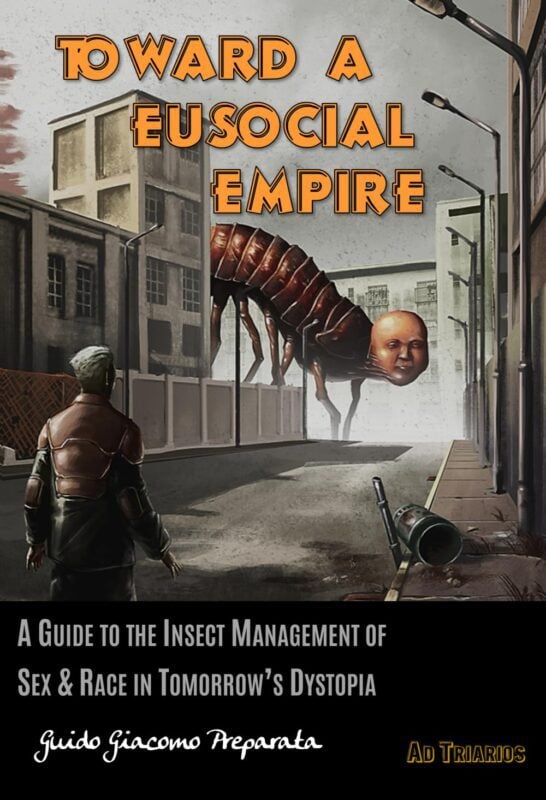
Toward a Eusocial Empire: A Guide to the Insect Management of Sex & Race in Tomorrow's Dystopia, published in 2026 by Ad Triarios Press, extends and deepens a thesis Guido Giacomo Preparata first advanced in The Ideology of Tyranny (2007, reissued as Reign of Discursive Terror). Across 245 pages organized into a Preface, two principal chapters on race and sex, and a substantial Afterword, Preparata argues that Anglo-American ruling elites draw structural inspiration from the social organization of ants, bees, and termites as they push toward what he calls the "insectification" of human society — a program of caste regimentation, demographic control, and systematic sterilization of the working and middle classes.
The book's analytical spine runs through entomology, imperial history, sociobiology, and postmodern critical theory. Preparata opens with Jules Michelet's 1858 account of Pierre Huber's observations of slave-making ("dulotic") ants, whose raiding queens seize larvae from rival colonies and rear them into a servant brood of foragers, builders, and nursemaids. The parallel to human imperial practice — in which a narrow dynastic class conscripts labor, talent, and resources from subordinate populations — carries through the entire work and structures its argument at the civilizational scale.
Preparata coins the framework by drawing on E.O. Wilson's 1971 term "eusociality" (from the Greek prefix eu, signifying a positive or developed condition), which Wilson applied to insect species characterized by cooperative brood care, reproductive division of labor, overlapping generations, and a common nest. Preparata treats Wilson's sociobiological project as a prescriptive blueprint for human social management rather than a neutral scientific taxonomy.
Race as Imperial Management
The first major chapter examines how American and Anglo-American power structures manage racial dynamics. Preparata identifies two criteria that he claims generate racism as a structural phenomenon: reverence for technical and military mastery, and a competitive ethos rooted in pecuniary rivalry and dominance. He credits Thorstein Veblen's critique of patriotism as "a sense of partisan solidarity in point of prestige" and argues that these two criteria, instilled through education, media, and institutional life from an early age, produce a hierarchical evaluation of peoples scaled according to their perceived technological capability and business proficiency.
How does this ranking operate in practice? Preparata describes a "two-tier" imperial structure modeled on the dulotic ant colony. At the apex sit endogamic Anglo-American dynastic families, bound by intermarriage and tradition, whose continuity stretches back to the colonial era. Beneath them work the technicians, soldiers, professionals, and wage-laborers who keep the apparatus running — Melville's "motley harpooneers" from Moby-Dick, recruited from across the globe for their utility to the imperial enterprise. Preparata cites the scene from Robert De Niro's The Good Shepherd (2006) in which a CIA officer tells a mafioso that Anglo-Americans own the country and everyone else is "just visiting."
Within this framework, Preparata treats Hollywood's depictions of interracial harmony and black professional achievement as "color-compensated" propaganda — cinematic fictions curated for diplomatic export and domestic containment. He contrasts these fictions with the statistical reality that interracial marriages between black and white Americans account for barely one percent of new unions. The chapter scrutinizes Robin DiAngelo's White Fragility (2018) as a symptomatic artifact of postmodern race-management: a choreographed liturgy of white contrition designed to channel African-American resentment into bureaucratic ritual and thereby neutralize the potential for structural challenge. Preparata finds DiAngelo's claim that whites "need" blackness to define their identity historically untenable, noting that the most intense and consequential hostilities among white populations have been intra-white — above all, the Anglo-American drive to subordinate continental Europe, exemplified by the two World Wars and NATO's enduring architecture.
Immigration as Geopolitical Instrument
A sustained section traces the infrastructure of managed migration from Africa into southern Europe through the U.S. State Department's Bureau of Population, Refugees, and Migration (PRM), the UNHCR, the International Organization for Migration (IOM), and a network of vetted NGOs including HIAS, the International Rescue Committee, Catholic Relief Services, and others. Preparata argues that Washington has channeled an estimated three to six billion dollars over the past decade into an apparatus that sustains a metered trickle of some of Africa's poorest into European metropolitan centers. The intended effect, in his reading, is to replicate America's segregated urban geography across the continent, loading European cities with the potential for racially inflected civic unrest and supplying the United States with an additional lever of political pressure against vassals who step out of line. He notes that Mediterranean EU states — the "PIGS" of British financial commentary — lose tens of thousands of skilled graduates to the Anglo-American core and its proconsular garrisons in Germany and France, even as they absorb arrivals from the world's poorest regions under the banner of humanitarian obligation.
Why have decades of development economics programs failed to address the conditions that drive migration at its source? Preparata poses this question alongside an arresting comparison: American households spend close to one trillion dollars annually on entertainment alone, roughly one-third of Africa's entire nominal GDP. He frames the immigration apparatus as a function of imperial logistics, calibrated through experimental dosing rather than humanitarian concern.
Sex, Sterilization, and the Insect Model
The second major chapter, titled "Sex: Abolishing the Orgasm — To Honor the Cultural Heritage of Social Insects," pivots from racial management to demographic engineering. Preparata argues that the postmodern and posthumanist discourse surrounding gender erasure, transgender politics, and reproductive technology serves a single strategic function: the gradual sterilization of the working and middle classes, modeled on the infertile worker castes of eusocial insect colonies.
He draws on Orwell's 1984, in which the Party's stated objective is to "remove all pleasure from the sexual act" and "abolish the orgasm" — severing loyalties between men and women that the state cannot control. Preparata reads the contemporary pornography industry, the devitalization of conjugal love through mechanized work conditions, the institutional discouragement of pregnancy through high living costs and compressed wages, and the rise of surrogacy as sequential phases in a program aimed at eliminating reproduction from the mid-level toiling castes.
What sociobiological framework rationalizes such a program? Preparata devotes sustained attention to the work of E.O. Wilson (1929–2021), the Harvard myrmecologist who coined the term "sociobiology" and proposed that human social behavior could be understood — and redesigned — through the evolutionary lens of insect colony organization. Wilson's concept of the "Superorganism," in which individual worker survival and reproduction become "increasingly less important" as colony-level organization intensifies, supplies Preparata with the theoretical scaffolding for his argument. Wilson's description of "obligatory eusociality" — in which the capacity for reproduction ceases altogether, and workers become "robotic extensions of the Queen's phenotype" — functions in Preparata's reading as a political prescription dressed in zoological language.
Preparata traces Wilson's "sociobiology of religion" in detail, examining Wilson's argument that religious practice confers biological advantage by preparing the individual for "supreme effort and self-sacrifice" through sacred rituals, special costumes, and music "accurately keyed to his emotive centers." Wilson's treatment of homosexuals as "a eusocial caste, and in the highest possible sense" — childless helpers whose altruism benefits the colony — receives extended analysis, as does his invocation of the Native American berdache system and monastic celibacy as functional precedents for a non-reproductive social role.
Insect Ethology as Political Template
Preparata presents detailed entomological accounts of the sexual and caste organization of honeybees, ants, and termites, drawing on Wilson, Maurice Maeterlinck (Nobel Prize in Literature, 1911), and Denis Saurat (La religion des géants et la civilisation des insectes, 1955). The honeybee mating flight — in which the drone's abdomen explodes during copulation and the queen stores his sperm for lifelong use — serves as a template for what Preparata calls "love's hostile delirium," Maeterlinck's phrase for the fusion of sex and death in the insect world. The ant colony's treatment of males as "privileged prisoners of State" — bred for a single insemination, then dispatched by female workers — and the termite colony's comparatively conjugal royal pair, whose king performs most of the early nursing, provide Preparata with three distinct models of sexual management that he maps onto contemporary political configurations.
The chapter examines Denis Saurat's thesis that ancient human religions functioned as "insectolatries" — cults that drew behavioral templates from the social organization of termites, ants, and bees. Saurat's claim that the ritual killing of kings, the notion of the virginal mother (modeled on haplodiploidy, in which unfertilized eggs produce males), and the concept of sexual shame itself trace back to human imitation of insect practices gives Preparata a deep-historical dimension for his argument. The Graeco-Latin civilization and Christianity, in Saurat's account, labored to obliterate traces of insect suggestion by transposing the myth of the honeybee (in which the male dies) and the myth of the termitary (in which the male embodies chastity) into the realm of the spiritual.
The Posthumanist Program
Preparata reviews the posthumanist and post-genderist literature as a discursive instrument of state policy. He catalogs its key propositions: the claim that men and women are "virtually identical" and interchangeable; the advocacy of artificial wombs to "deconstruct the biological basis of patriarchy"; the promotion of "teledildonics," robot sex, and pharmacological suppression of pair-bonding impulses; and the call for gender-neutral pronouns such as "ze," "per," and "zir." He reads the 2024 Paris Olympics boxing controversy — in which two athletes previously barred from international competition for hormonal profiles closer to the male range competed in women's events — as a consequential precedent in the insectification program, amplified by the Olympic Committee Head Thomas Bach's public assertion that science cannot clearly distinguish between male and female.
Preparata frames these developments as converging on a single administrative objective: the construction of a non-reproductive labor caste sustained by a universal basic income paid in traceable central bank digital currency, compensated for "the distractions of sex" through pornography and virtual simulation, and stripped of formal distinctions between male and female.
The Afterword traces Preparata's intellectual autobiography: his discovery, as a graduate student in economics in California during the 1990s, that Michel Foucault's Power/Knowledge framework — then dominating American humanities — substantially reproduced the sociological schema of Georges Bataille's Accursed Share (1949) without attribution. This genealogical observation, which led to The Ideology of Tyranny, informs Preparata's treatment of postmodernism as a state-sponsored discursive technology rather than an organic intellectual movement.
The book references Thorstein Veblen, Henry George, Herbert Spencer, Ernst Jünger, R.G. Collingwood, Émile Durkheim, Wilhelm Reich, Bronislaw Malinowski, Pierre-Joseph Proudhon, Mircea Eliade, William S. Burroughs, Julian Huxley, Aldous Huxley, and Georges Bernanos.
It carries the ISBN 979-8-9925904-2-5 and features cover art by Leonardo Arci.